Making it Easier to Copy from the Board

Copy 1.jpg

Copying accurately and quickly from a board at the front of a classroom can be a challenge at the best of times. For young children and those with specific learning difficulties it can be near on impossible. It is amazing how many children lose some, if not all, of a break time because they could not complete the copying task quickly enough in the lesson time.

The practise of taking information off the board has its uses and there are times when there is just no other alternative but it can be made more manageable, here are a few ideas which may help.

  • Make sure the child is sitting facing the board.
  • That they can see the board clearly.
  • That light is not reflecting off the board so that the writing disappears.
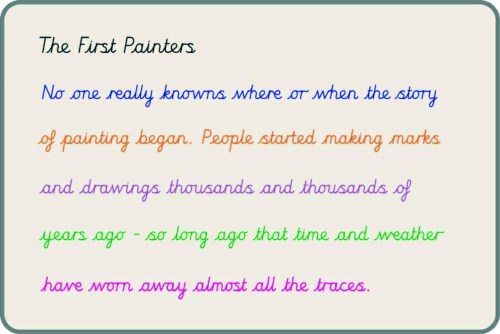
  • Try using a different colour marker pen for each line of writing (this way a child will be able to quickly locate the line they were copying from).
  • Or try numbering the lines so the child can more effectively find their way around the text.
  • Leave more of a gap between each line of writing so that each line is clearly visible from the back of the room.
  • Ask those children, who struggle copying, to start the first line of writing as you transfer the text to a smaller board which can then be placed at a more appropriate distance and level for them to continue copying from.
  • If you know the information that will need to be transferred to the child’s book then pre-prepare a text that can be given to the child to copy from. It may be in a different order or layout to that on the board; but it is the information and the child’s ability to access it, that is important.
  • Is a full sentence explanation always required or could the information be presented in another way such as a mind map or diagram which would be equally, or even more, useful to the child.

It can be surprising how frustrating and upsetting being asked to copy from the board can be for many children. So anything that can help to alleviate these emotions and difficulties has got to be worth a try!
Half-term Fun – Clothes Peg Games

Clothes peg games 2

Some fun indoor activities may be the order of the day if the half term weather proves not to be so hot.

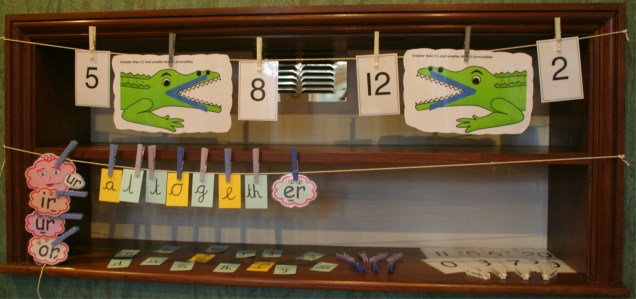
This is a very simple idea which children love because they can take greater ownership of it. The aim of the activity is to help build up hand and finger strength through using the pegs; however it can have a dual purpose, helping to keep track of the week by using it as a timetable or for learning spellings or maths activities, as well as supporting the development of language skills.

You do not need anything fancy, just some string (for the washing line), clothes pegs and pieces of paper or card to peg onto the washing line. The washing line can be a permanent fixture or you can just pop it up when you need to use it.

The clothes line needs to be at a height suitable for your child to peg things on to (placed against a wall is a safe option so that no-one can walk into it by accident and hurt themselves).

There are a whole range of games that can be played using this simple washing line and pegs concept:

  1. Memory games – Get your child to peg up 5 to 10 different pictures or items on the line. Then give them 1 minute to remember the items. Once the time is up ask them to look away, or close their eyes, and then you remove one or more of the items. Get them to look back at the line. Can they work out what is missing?
  • You could try just moving one or two of the items around. Can they figure out which ones are in the wrong place and put them back in their correct place?
  • Try swapping an item for something new, which your child did not hang up on the line. Can they work out which is the new item on the line?
  1. Odd One Out – Hang pictures on the line that belong together. Can they pick out the odd item on the line and explain why it is the odd one out.
  • They could all be pictures of fruit with a picture of some clothing
  • They could be shapes with straight sides and one with curves
  • They could all be animals but all are wild with only one being domestic
  1. Sorting – Ask your child to sort all the pictures or items from a selection and to hang all the identical things on the washing line. They could all be the same;
  • Colour
  • Shape
  • Type
  1. Pattern Work – Using pictures, different colour and shaped paper or items create different patterns. The patterns can be based on colour, size or type of object. You can create a pattern sequence on the washing line and then ask your child to try and copy the sequence. Can they explain the pattern and create their own for you to copy and explain?
  2. Pairing or What is the Same? – Hang a range of pictures or items on the line, making sure that some of the items can be paired together because they are exactly the same. They could match because;
  • They are exactly the same e.g. a pair of socks
  • Match numbers to a picture with the same number of items on
  • Match capital to lower-case letters
  • Or have items that can be put together because they are both from the same set, for example they are types of fruit or are the same colour.

Handwriting Half-term Fun!

Water fun 2

Next week is half-term for many of us and The SUN should be out which makes it time for the water fights and games to begin.

How can water fights and games, where you can get wet, be handwriting homework?

It will soon be June, the weather should be perfect, so why not set up water squirting games in the garden. The kids are waterproof and everything else will dry out, eventually!

You will be encouraging your child to develop their hand strength, co-ordination and eye tracking skills (all handwriting skills), while increasing your cool adult status.

Some fun water games:

  • Try setting up a target wall, using chalk to draw the targets.
    • How many of the targets can you hit with water squirted from a water pistol or squeeze bottle in a set time.
    • How many targets can be washed off.
  • Set up a skittles range.
    • Each skittle hit with water can be worth a certain number of points, or the distance of the skittles may affect their value.
    • A time trial game to hit all the skittles. If you are using plastic bottles as skittles try making some of them a little heavier by putting sand or dirt in them to make it a bit harder to knock them over.
  • Move the object race games.
    • A light toy/ball has to be moved by squirts of water over a distance.
    • A range of objects moved in to target areas to gain points.

The only limitation is you and your child’s imagination and trust me kids never tire of finding new ways to play with water (but then again neither do many adults)!

Homework has never been so much FUN!

Is your child reluctant to handwrite or has a poor writing speed?


Relucant writer 2

Our ‘Tips on encouraging reluctant writers’ is a step by step guide to support you in identifying possible reasons for your child’s reluctance to handwrite or poor handwriting speed: http://bit.ly/2JHgAmE

Some children have a poor handwriting speed or just don’t want to try handwriting because of sensory pressure related difficulties and struggle to maintain and control the pressure required to handwrite. Our ‘Hand dominance, swapping and pressure’ section offers practical advice to help you support your child’s development: http://bit.ly/2VlGfDH

Handwriting Letter & Word Spacing Issues

spacing issues 8729

Some children find it difficult to space their letters in words correctly and to show spacing between words. There can be a number of reasons for this:

  1. They may not understand the concept or conventions of spacing words and letters and this needs to be explained.
  2. Other Physical Skills such as poor spatial awareness skills, eye tracking or general eyesight.
  3. Poor Key Strengths and/or Key Abilities elements, required for handwriting, such as sitting position, paper position, pencil grip, hand position and letter formation knowledge may also be hindering them.

1. ‘Tips to support letter and word spacing’ will help you to identify if your child is having difficulty in understanding the spacing conventions and how to support them: http://bit.ly/2LynVrn

2. Our ‘Other Physical Skills’ assessment will help you to identify if your child’s spatial awareness or eye tracking skills may be affecting their spacing skills: http://bit.ly/2P5jS44

If you are not sure then book an eye test for your child, just to be on the safe side, it could be they need glasses.

3. Our step by step ‘Overcoming Handwriting Difficulties’ guide will support you in identifying other possible reasons for your child’s letter and spacing issues: http://bit.ly/2C7xYwq

Why is it so important to correct a poor body posture for handwriting tasks?

Boy head on desk 2

We expect our children to sit and write at a desk for longer periods of time at school and this can become very challenging for some children. Handwriting is a very physical task requiring good gross and fine motor skills. A weakness in either, or both, of these areas can be why a child struggles with longer handwriting tasks.

Children with a poor body posture often slouched over a desk, laying their head on the table or with their head propped up by their hand and arm or pull their chair in so far that they can rest their tummy on the edge of the table to help them keep a more upright position. This can look as if they are bored and disinterested in what they are doing. However this is not generally the case.

A poor posture position is not always due to boredom or incorrect chair and table height. For many children it is a lack of body strength or core muscle tone (the large muscle groups that control shoulder stability and the trunk of the body that work to enable us to sit and stand upright for sustained periods of time).

This is bad for them, as it puts unnecessary strain on the body, causing neck or backache and discomfort, which in turn makes them fidget as they try to get comfortable. All this can distract them from the task in hand and limit their handwriting ability as it reduces their hand and finger movements.

You can use our simple online Key Strengths assessment to check your child’s core strength (gross motors skills): http://bit.ly/2C7xYwq or use our core strength development games and activities to support your child: http://bit.ly/2FhFkR7

Identifying Poor Motor Memory and Visual Memory Skills in Handwriting

Motor & Visual Memory 2.jpg

Motor memory and visual memory difficulties can have a dramatic effect on a child’s handwriting ability. Possible signs of poor motor memory or visual memory skills can be that their handwriting is slow and deliberate or fast and messy (as they try to hide their letter formation issues), making it difficult to read. They can spend so much time on trying to remember how to form the letters, they have no working memory space left for the important tasks of composing their writing and spelling.

Poor motor memory skills can make handwriting difficult as shapes and letter formation movements are often forgotten, causing letter reversals and incorrectly formed letter shapes, which can make joining a very slow process to learn. A poor and often slow handwriting style can develop as font styles are mixed and capital letters are used inappropriately. Combined, these difficulties can cause poor presentation, spelling and legibility issues.

Poor visual memory skills make handwriting difficult as the ability to recall how letters look and reproduce them with appropriate spacing and positioning is partially or completely lost. This leads to poor letter formation skills, letter reversal along with spelling and presentation difficulties.

Visual memory and motor memory skills are linked and so a game or activity that supports one is likely to support the other.

For more information on how to identify motor memory and visual memory difficulties see our Other Physical Skills Assessment: http://bit.ly/2P5jS44

For games and activities to help support and develop these skills use this links: http://bit.ly/2M350S1

Identifying Poor Eye Tracking and Spatial Awareness Skills in Handwriting

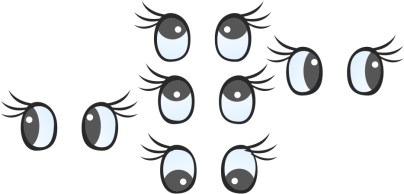
Eyes

Eye tracking and/or spatial awareness difficulties can have a dramatic effect on a child’s handwriting ability.  Weak skills in these key areas make it difficult for children to form letters correctly (curves and lines often not joining to complete the letter shape), as well as being unable to appropriately space letters in words and words in sentences. Other poor presentation skills include being unable to write on lines and often missing lines out when following on with a sentence.

It is also worth pointing out that a child with poor eye tracking and/or spatial awareness skills will also find reading difficult.

For more information on how to identify eye tracking and spatial awareness difficulties as well as activities to help support and develop these skills use these links:

Helping to Overcome Handwriting Difficulties

Step by Step overcoming difficulties 1

It can be difficult to identify why a child is having trouble learning to handwrite fluidly and with speed. This is because handwriting is a complex skill, requiring both physical skills (Key Strengths) and the knowledge (Key Abilities) of how to form and join letters correctly.

Where do you start?

Follow our step by step guide to identify where the problem may lie and then work with the child using our suggested solutions: http://bit.ly/2uFcUJF

Don’t miss the early steps, even though you think they may not be relevant to an older learner, as the child may be struggling because they have either missed an earlier stage of physical development or teaching.

Sometimes children need to be taken back before they can move forward.

Does Your Child Have Weak Hands?

Earlier this week we highlighted a few of the articles that reported on the fact that children struggle to hold pencils correctly for handwriting and drawing. The reason for this is based on our children’s use of technology and the effect this has on their hand strength and finger dexterity (Fine Motor Skills). Here at Teach Children we have been warning of this for some years now.

Poor fine motor skills and hand strength not only affects a child’s ability to learn and develop a good handwriting style it can make other grip patterns difficult to master as well. Power, precision, stability or a combination of all three are needed by children to compete everyday tasks, such as dressing, picking up and carrying objects (especially small items), using a knife & fork, other tools and scissor skills.

To assess your child’s hand, finger strength and dexterity check out our assessment page: http://bit.ly/2C7xYwq

To improve their overall hand and finger strength check out our hand and finger strength and dexterity games:  http://bit.ly/2FhFkR7

Learning to hold a pencil in an appropriate grip is not the only grip style your child needs to develop, especially once they have started school. They will need to develop those which enable them to effectively use scissors as well as a knife and fork. If your child struggles with these activities it may be that they need to be taught how to form the grips correctly (as bad habits develop quickly and are difficult to change) or develop the appropriate hand and finger skills.

How to Hold Scissors

IMG_9147

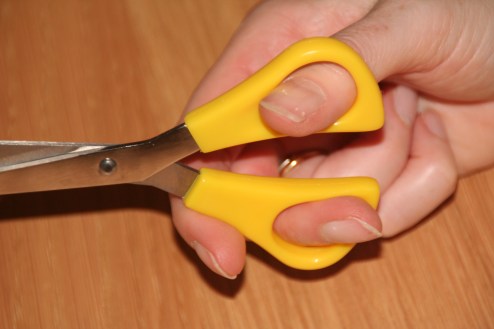
The tip of the thumb is in the top hole of the scissor handle while the tip of the middle finger is in the bottom hole. The index finger is on the bottom edge of the lower handle supporting and stabilising the scissors. The ring and little finger are curled into the palm (except if you are using large scissors as then they will fit in the bottom hole of the handle with the middle finger, to help create the cutting action).

The non-cutting hand should support the paper or item being cut; the thumb is on top of the paper and the fingers underneath, steadying and moving the paper.

How to Hold a Knife & Fork

The handle of the knife or fork lies diagonally across the top section of the palm. The ring and little finger wrap around the handle, the thumb sits on the side of the handle, while the index finger sits flat and straight on the back of the handle. The middle finger curls slightly around the handle so that when the wrist twists round, so that the knife blade edge or prongs of the fork are facing down towards the plate, the handle rests on the top middle finger joint area.