Why do young children love to draw on walls?

Artist with easel

Young children love drawing on walls due to the stage of their physical development. They draw from the shoulder, rather than the elbow and wrist, using large arm movements. At this stage they prefer vertical drawing and painting surfaces as it allows a free range of movements. This is why they will write on walls (often newly decorated), not because they are meaning to be naughty but because it just feels comfortable and so more enjoyable.

Drawing and writing on a vertical surface is important at this stage as it helps young children develop the wrist strength and flexibility they will need later on to hold a pencil correctly for handwriting.

The jump from a vertical to a horizontal writing surface can seem too great for some children; due to their stage of development. If they are still using some large whole arm and/or big elbow movements then they may benefit from the paper being positioned on a sloped board.

If you are not sure whether a child needs a sloped board for handwriting, instead of buying a specialist board, you could make one. Try using a ring binder or lever arch file stuffed with magazines and newspaper to make a sloped board. Tape the edges to stop the papers falling out; you could cover it in sticky back plastic to give a smoother finish to the board. The advantage of this is that you can make them to any angle of slope. Try a few to see which, if any, your child prefers.

A homemade sloped board is just as effective as a bought one. Often a child only requires one for a short amount of time and quickly moves to writing on a horizontal surface. For a few children a sloped surface may be required for a few years, or indefinitely, in which case a purpose bought sloped writing board is a sounder investment.

Handwriting Really Starts with Play

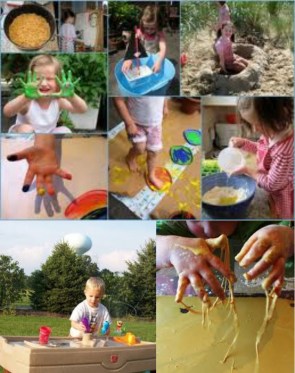
Messy paly 1

Learning to handwrite does not start with pen and paper but through play, as children explore shape and motion (how the body moves) through their senses – touch, sight and body awareness. Play is such an important element of your child’s physical, emotional, social and academic development.

It is through play that you can really engage your child in learning how to correctly form pre-handwriting patterns and letters (the start points, orientation, directional movements and finish points).

Our non-pencil – ‘Big to Small’ activities are an easy fun way to start developing these skills early on through play: http://bit.ly/2AaX8sk

Young children love seeing their name so it is a great way to introduce letter formation; here are some other fun ideas:

  • This activity can be done indoors on large sheets of paper or using chalk on a path or patio (the beach is also a great place to do this). Write your child’s name very big and make a mark on each letter that represents a start point (an arrow showing the direction of travel can also help). Remember to use a capital letter for the first letter of their name and we would suggest lower case letters for the remaining letters. Use the letters as a track for racing cars or toys. If you make the letters big enough your child could walk, hop, jump or skip around the letters. To help them remember the letters, once they have finished a letter, encourage them to say that letter‘s alphabet name (NOT a sound the letter can make).
  • Collect stones, twigs, leaves, etc… Use them to make the letters of your child’s name. They may only make one or two of the letters, before making a hedgehog house, nest or den for their toys becomes more interesting, but this does not matter, it is all part of the adventure.
  • Feely bag games are a fun way to explore shape and form. Try placing the letters of your child’s name into a bag or box they cannot see into. It is useful to talk through the letter shapes beforehand so they can see them as they move them about in their hands; then place them in the bag. Ask them to put their hands in (both hands if possible, but if not, then use the dominant hand) the bag, picks up a letter, feels it, identifies it and pulls it out to check only AFTER identifying it. If correct, they get to “keep” it, if wrong, you get to “keep” it. The winner is the one with the most letters at the end. For some children it can help to have another set of the letters outside the bag to help them identify the shape they are handling in the bag. Again encourage them to use the alphabet name of the letter.
  • Play-dough, clay and Plasticine activities are great for developing hand strength for handwriting and learning how to form letter shapes.

Your child will love these sort of activities as they see it as just playing and they get your undivided attention. You will enjoy it as you are sharing quality time with your child helping them to develop more than just their letter formation ability but also their communication and social skills.

Learning through play is a powerful way of supporting your child’s development. So have fun and play!

The Third Stage to Handwriting Success – Joining

Joins A & W 2

Here at Teach Handwriting we believe that a child is only ready to start learning to join their handwriting when:

  • They have learnt to form all 26 lower case letters correctly
  • Letters are of a consistent and suitable size (not necessarily the perfect size, remember big is beautiful)
  • Letters are positioned appropriately on the writing line as well as in relation to one another.

Children generally begin to join letters between the ages of 6 to 7 years old, depending on the handwriting font style being taught. Those taught a continuous cursive font style from the beginning tend to join much earlier due to the nature of this font (for some by the end of their Reception Year).

Children do not need to be able to remember how to correctly form all their capital letters before they are taught how to join their letters. This is because capital letters never join to the lower case letters in a word. However, for these children correct capital letter formation needs to be taught alongside the introduction of letter joins.

We would recommend teaching joins in join type groups, whether your child has learnt cursive or continuous cursive single letter fonts.

Teaching the join types in their groups helps a child to understand the directional pushes and pulls required to successfully join the different letter combinations.

We would recommend teaching the bottom joins first, then the top exit to ‘e’ join and finally the top exit letter joins.

For our free join animations and worksheets: http://bit.ly/2F9P7cI

For tips to support the teaching of joins check out our Teaching Tips section:  http://bit.ly/2AaX8sk

The Importance of Using Letter Names

Letter 1

On our Teach Handwriting website and Scheme, as well as on our Teach Phonics website, children are taught the letter names to begin with. Some schools, teacher and parents still seem to be concerned that this is not consistent with the teaching of phonics.

A myth which seems to have become popular, since the introduction of phonics into schools, is that children should not be taught the alphabet letter names as they find it too confusing. However, there is no evidence to suggest this is true. The Independent review of the teaching of early reading, final report, Jim Rose March 2006 states:

“The teaching of letter names is often left until after the sounds of the letters have been learned, in the belief that it can be confusing for children to have to learn both together. However, research indicates that children often learn letter names earlier than they learn letter sounds and that five year olds who know more letter names also know more letter sounds. The reasons for this are not fully understood by researchers’.

Given that children will meet many instances outside, as well as within, their settings and schools where letter names are used, it makes sense to teach them within the programme of early phonic work.

It appears that the distinction between a letter name and a letter sound is easily understood by the majority of children.” (Page 26)

Rose, cites Professor Morag Stuart who suggests that:

‘…children expect things to have names and are accustomed to rapidly acquiring the names of things.’ (Independent review of the teaching of early reading’ final report, Jim Rose March 2006, page 27.)

Learning the unique letter names of the alphabet is a pre-phonics skill; as well as an early learning goal. It has to be remembered that a letter is a shape which only represents a sound when it is placed within a word or sentence. Also a letter or combination of letters can represent more than one sound and so the only unique way of identifying alphabet letters when we talk about them is to use their names.

Learning the correct letter names helps to reinforce that when talking about the letter ‘a’ (ay) for example it has a set shape regardless of the sound that it will be representing in the word. This further supports children’s handwriting development as the communication of your requirements is unambiguous.

One of the first things we like a child to be able to write correctly is their name, however most names are impossible to spell using the simple phonics code taught to young children. A name does not have to be long in length to be phonetically difficult to spell such as Christopher or Charlotte. Shorter names such as Lucy or Liam also cause a problem.

The only logical answer I suggest is to use the letter names until a child has been introduced to the more complex phonics coding system.

Is your child’s handwriting good for their age?

Ch Handwriting 2

With more and more expected of our pre-school and 4 to 7 year old children it can be difficult to know what the realistic age appropriate skills for handwriting are.

So, to help, we have created our ‘Handwriting age related guide’ (https://www.teachhandwriting.co.uk/handwritiing-age.html)

You can find this by clicking on the ‘Parents’ section of our website and on the button for:

Is your child’s handwriting good for their age?

Just click on the appropriate age range group button to find useful information on the expected handwriting achievement levels. You will also find the appropriate resources, information and advice to support your child’s handwriting if they need it.

How to improve your child’s handwriting

School Reports – Handwriting Improvements Needed!

So, the school report has been received and you have been told that your child needs to improve their handwriting.

This is all well and good, but what exactly needs improving?

CC Z 1


What are they finding difficult and how on earth do you write a continuous cursive z?


So, you eventually get some handwriting practice sheets home or off the web. But no amount of time spent doing them seems to make much difference. It seemed to take longer to get them started than they spent practising handwriting. In fact they seemed worse because they were unhappy and frustrated with their own progress, so the more you try to push them the more resistant they become. Eventually you think there has to be a better way than this?

Doing more of what you are already struggling with is not always the answer. Handwriting is a complex skill to learn and there are a number of reasons why a child may be struggling.

To check that your child’s handwriting skill base is appropriate for their age, and/or to find where you are best focusing support at home, check out the parent section of our website, I would suggest looking at the following section first:

Supporting your child’s handwriting development can be fun using physical games and activities. To check if your child needs extra physical strength support or has other specific learning needs check out these areas in the parent section of our website:

With the summer holidays coming up it is a great time for you to be able to observe and assess your child’s key physical strengths and skills. Armed with this knowledge you can play games and do activities which then help them to develop the strengths and skills which may be holding them back and making handwriting a difficult task to master.

warning signIt is important to check and know which letter formations are being taught in school and that this is what you teach at home. Otherwise you will only be causing more frustration and stress for your child.
To Trace or Not to Trace, that is the Question?


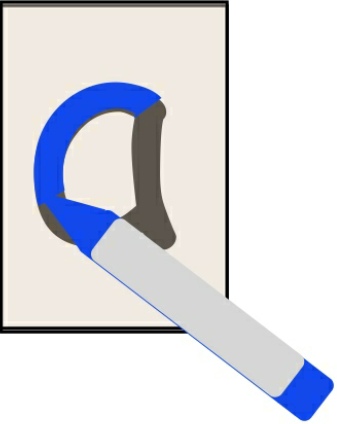
Trace 1Tracing has been an activity frequently presented to encourage young children to learn how to form letter shapes, especially in early years teaching.
However, current research suggests that encouraging young children to free write is a more powerful way of engaging the brain to learn how to form letters when compared to tracing them.

Learning to handwrite requires a child to remember which shape they want to make (visual memory) and how to make it (motor memory).

Here at Teach Handwriting we feel that traditional pencil tracing activities are not a particularly effective way to teach children pre-handwriting patterns and letter formations. This is because children are often so focused on controlling the writing tool around the shape that they do not fully engage their motor memory storage and visual memory skills.

We believe that finger tracing a pre-handwriting pattern or letter shape is more effective than pencil tracing. The greater resistance provided by finger tracing stimulates a child’s nervous system, instantly making them aware of their actions and helping them to focus on the movement by engaging both the motor memory and visual memory. This information is initially stored in their short-term memory but, with continued practise, moves to their long-term memory. Having to think less about how to form the shape, because they can subconsciously recall how to make it, allows a child to then concentrate on controlling the pencil.

Is it a cursive or continuous cursive handwriting font?

CC & Cursive 1

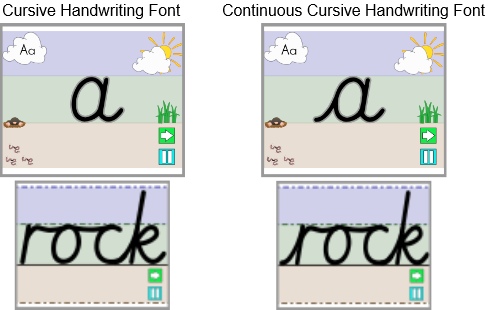
Looking at a few different school websites and queries from parents this week we found that some think that Cursive is just short for Continuous Cursive. In fact, they are two different handwriting font styles:

Cursive:

Cursive a Cloud

https://www.teachhandwriting.co.uk/cursive-beginners-letter-choices.html   


  • The letters start at different points (the same as print letters).
  • The finishing points for all the letters is at the writing line (with a small exit stroke); except for, o, r, v and w, which have a top exit stroke.
  • The single letter formations are taught with just the exit strokes.
  • When cursive is joined the first letter in the word does not have an entry stroke for example:

Curive Rock

https://www.teachhandwriting.co.uk/cursive-joins-letter-choices.html


Continuous Cursive

httpsCC a Cloud://www.teachhandwriting.co.uk/continuous-cursive-beginners-letter-choices.html                                            


  • The starting point for all the letters is the same; on the writing line.
  • The finishing points for all the letters is also at the writing line; except for, o, r, v and w, which have a top exit stroke.
  • The single letter formations are taught with the entry and exit strokes, this makes the transition from single letter formation to joined handwriting very straightforward and allows it to occur sooner.
  • When continuous cursive is joined the first letter in the word has an entry stroke for example:

CC Rock

https://www.teachhandwriting.co.uk/continuous-cursive-joins-letter-choices.html


 Be aware, some schools will say they are teaching a Cursive font when in fact they are teaching a Continuous Cursive font.

Poor Bilateral Coordination Skills Affects more than Handwriting

Bilateral skills 1

Poor bilateral coordination skills not only have an impact on handwriting but also many other day to day tasks such as the ability to get dressed quickly, pick up and carry objects as well as the use of a knife and fork and scissors.

It can also affect a child’s sporting abilities, hindering their ability to run, skip, catch, throw and kick effectively. The consequence being that they are put off playing sport and participating in physical activities, which in turn hinders their bilateral coordination development, a kind of ‘Catch 22’ situation.

The impact of this is becoming more wide spread with the popularity of fun and engaging computer gaming and a greater use of touch screen devices as children may not be getting the opportunities they would have had in the past to fully develop their bilateral coordination skills.

Bilateral coordination refers to the use of the left and right sides of the body, needed for coordination and well-balanced movement, including those that require movements such as the left arm moving across the body to the right-hand side (crossing the mid-line point).

These skills are learnt and developed through everyday play and activities and need to be practised.

Learning to cross the mid-line point is one of the stages to developing handedness (hand dominance): http://bit.ly/2VlGfDH

To check your child’s bilateral skills and development try our quick and simple bilateral coordination assessment activities: http://bit.ly/2C7xYwq

For fun physical activities to help build and encourage your child’s bilateral coordination skills check out this section in our gross and fine motor skills page: http://bit.ly/2FhFkR7

Good Handwriting is …

join sentences

Often good handwriting is associated with how neat and lovely it looks. Beautiful penmanship is not a guarantee of quality. Some children will spend ages forming their letters so that the piece looks great but have not produced a well composed piece of work.

So, what do we consider the important elements to a good handwriting style:

  • a fluid hand movement that is comfortable;
  • letters are of a consistent and appropriate size and positioned correctly;
  • that the writer can produce and maintain a good handwriting speed;
  • that it is completely legible to others.

Here at Teach Handwriting we believe that learning to join letters increases the accuracy, fluidity, speed and legibility of handwriting. However, we also recognise that for some SEND children learning to join their handwriting may not be a logical option. However, this does not mean that using a single letter font style stops them from handwriting with accuracy, fluidity, speed and legibility (though it may never be as fast as a joined font).