Week 4 of Our 5 Week Handwriting Lesson Program

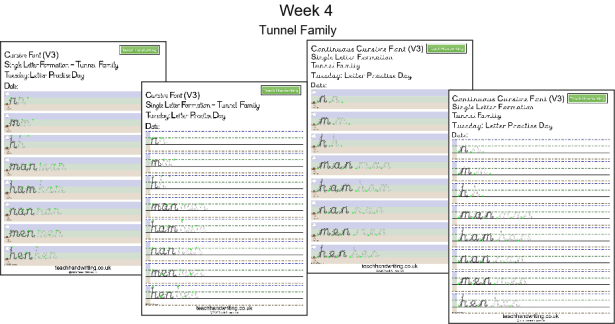
Week 4 handwriting 1

The fourth week of our handwriting program is ready for you to download. Today it introduces the ‘Tunnel Letters’.

The free weekly set of worksheets can be downloaded, printed off and used alongside our letter formation animations.

Click on this link and it will take you to the correct page of our website:

https://www.teachhandwriting.co.uk/covid-19-handwriting-lessons.html

5 Week Handwriting Lesson Program

Each week a new letter family will be introduced:

  1. Straight lines (Finished).
  2. Curves to start (available until Sunday 10th May 2020).
  3. Top exit
  4. Tunnel
  5. Hooks, loops and lines

There is a separate worksheet for each day:

Monday – Have a go worksheet

Today you can check if your child knows how to write the letters and if they are writing them correctly. If you know your child cannot form the letters in the letter family then show them the letter animations and then let them have a go.

Tuesday & Wednesday – Specific letter practise days

Each day focuses on different sets of letters from the letter family.

Thursday & Friday – Letter practise days

On these days letters from the letter family being taught and some letters from letter families already introduced are practised.

There are also “Rainbow” worksheets where your child can share with others what they have learnt and achieved over the week as well as appropriately sized practise paper for them.

We hope you find these useful. If you have any questions about this 5 week handwriting program please feel free to contact us through the contact us page and we will do our best to help.

Take care Lucy & Chris from Teach Children Ltd
Week 3 of Our 5 Week Handwriting Lesson Program

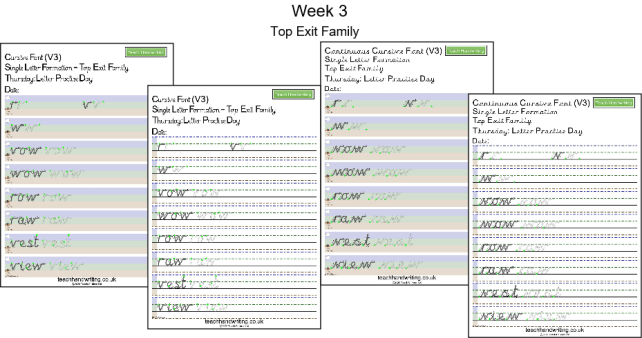
Week 3 1

The third week of our handwriting program is ready for you to download. Today it introduces the ‘Top Exit Letters’ and revisits letters from the letter families already taught in week 1 – ‘Straight lines family’ and Week 2 – ‘Curves to start family’.

The free weekly set of worksheets can be downloaded, printed off and used alongside our letter formation animations.

Click on this link and it will take you to correct page of our website:

https://www.teachhandwriting.co.uk/covid-19-handwriting-lessons.html

5 Week Handwriting Lesson Program

Each week a new letter family will be introduced:

  1. Straight lines (available until Sunday 3rd May 2020).
  2. Curves to start
  3. Top exit
  4. Tunnel
  5. Hooks, loops and lines

There is a separate worksheet for each day:

Monday – Have a go worksheet

Today you can check if your child knows how to write the letters and if they are writing them correctly. If you know your child cannot form the letters in the letter family then show them the letter animations and then let them have a go.

Tuesday & Wednesday – Specific letter practise days

Each day focuses on different sets of letters from the letter family.

Thursday & Friday – Letter practise days

On these days letters from the letter family being taught and some letters from letter families already introduced are practised.

There are also “Rainbow” worksheets where your child can share with others what they have learnt and achieved over the week as well as appropriately sized practise paper for them.

We hope you find these useful. If you have any questions about this 5 week handwriting program please feel free to contact us through the contact us page and we will do our best to help.

Take care Lucy & Chris from Teach Children Ltd
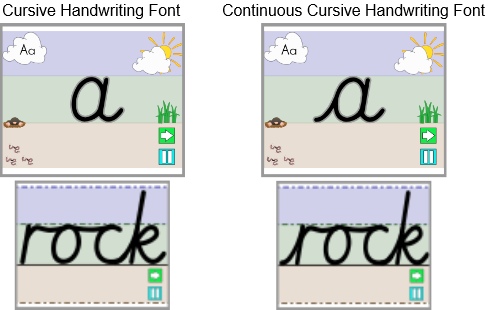
When to Introduce Joined Handwriting

CC & Cursive 1

Here at Teach Children we believe that a child is only ready to start learning to join their handwriting when:

  • They have learnt to form all 26 lower case letters correctly
  • Letters are of a consistent and suitable size (not necessarily the perfect size, remember big is beautiful)
  • Letters are positioned appropriately on the writing line as well as in relation to one another.

Children generally begin to join letters between the ages of 6 to 7 years old, depending on the handwriting font style being taught. Those taught a continuous cursive font style from the beginning tend to join much earlier due to the nature of this font (for some by the end of their Reception Year).

Children do not need to be able to remember how to correctly form all their capital letters before they are taught how to join their letters. This is because capital letters never join to the lower-case letters in a word. However, for these children correct capital letter formation needs to be taught alongside the introduction of letter joins.

The ultimate aim is for a child to develop a good handwriting style; which means;

  • They can produce and maintain a good speed
  • Have a fluid hand movement that is comfortable
  • Letters are of a consistent and appropriate size, positioned correctly
  • Handwriting is legible (so others can read it easily).

For some children (mainly SEND pupils) this may mean that they will always print or use a single letter form of writing as learning to join is just not appropriate. But that does not mean they will not comply with the bullet points above.

Warm up For Handwriting!

Well the festive holidays are over and we are back at work and school. So it is time to get back into good habits for the New Year!

So, before you try to encourage your little darlings to sit and write, get them to do a few physical handwriting ‘Warm Up Exercises’.  Not only do they help to prepare the hands and fingers for the task ahead, they also help to release any tension that has built up. They are fun to do, which usually brings a smile and often laughter, an added tonic to any learning experience.

The warm up exercises can be accessed through a number of ways:

  • Teachers through the content section for the Key Stage you are teaching by clicking on the Handwriting warm up activities button.
  • Parents through the “Getting the Most from Our Website” section by clicking on the picture under the Taking the tension out of handwriting title.
  • Resources in the “How to Teach Handwriting” section by clicking on the Handwriting warm up activities button.
  • Follow this link: https://www.teachhandwriting.co.uk/handwriting-warm-up-exercises.html

Why do young children love to draw on walls?

Artist with easel

Young children love drawing on walls due to the stage of their physical development. They draw from the shoulder, rather than the elbow and wrist, using large arm movements. At this stage they prefer vertical drawing and painting surfaces as it allows a free range of movements. This is why they will write on walls (often newly decorated), not because they are meaning to be naughty but because it just feels comfortable and so more enjoyable.

Drawing and writing on a vertical surface is important at this stage as it helps young children develop the wrist strength and flexibility they will need later on to hold a pencil correctly for handwriting.

The jump from a vertical to a horizontal writing surface can seem too great for some children; due to their stage of development. If they are still using some large whole arm and/or big elbow movements then they may benefit from the paper being positioned on a sloped board.

If you are not sure whether a child needs a sloped board for handwriting, instead of buying a specialist board, you could make one. Try using a ring binder or lever arch file stuffed with magazines and newspaper to make a sloped board. Tape the edges to stop the papers falling out; you could cover it in sticky back plastic to give a smoother finish to the board. The advantage of this is that you can make them to any angle of slope. Try a few to see which, if any, your child prefers.

A homemade sloped board is just as effective as a bought one. Often a child only requires one for a short amount of time and quickly moves to writing on a horizontal surface. For a few children a sloped surface may be required for a few years, or indefinitely, in which case a purpose bought sloped writing board is a sounder investment.

How to improve your child’s handwriting

School Reports – Handwriting Improvements Needed!

So, the school report has been received and you have been told that your child needs to improve their handwriting.

This is all well and good, but what exactly needs improving?

CC Z 1


What are they finding difficult and how on earth do you write a continuous cursive z?


So, you eventually get some handwriting practice sheets home or off the web. But no amount of time spent doing them seems to make much difference. It seemed to take longer to get them started than they spent practising handwriting. In fact they seemed worse because they were unhappy and frustrated with their own progress, so the more you try to push them the more resistant they become. Eventually you think there has to be a better way than this?

Doing more of what you are already struggling with is not always the answer. Handwriting is a complex skill to learn and there are a number of reasons why a child may be struggling.

To check that your child’s handwriting skill base is appropriate for their age, and/or to find where you are best focusing support at home, check out the parent section of our website, I would suggest looking at the following section first:

Supporting your child’s handwriting development can be fun using physical games and activities. To check if your child needs extra physical strength support or has other specific learning needs check out these areas in the parent section of our website:

With the summer holidays coming up it is a great time for you to be able to observe and assess your child’s key physical strengths and skills. Armed with this knowledge you can play games and do activities which then help them to develop the strengths and skills which may be holding them back and making handwriting a difficult task to master.

warning signIt is important to check and know which letter formations are being taught in school and that this is what you teach at home. Otherwise you will only be causing more frustration and stress for your child.
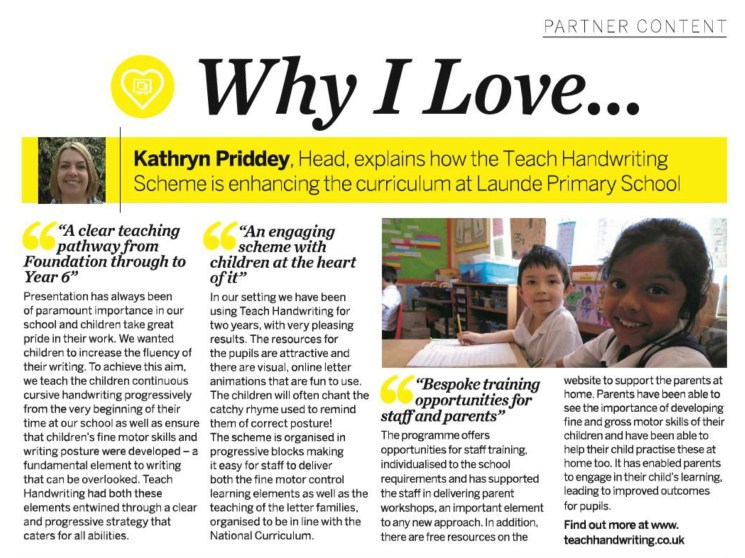
Why I Love … The Teach Handwriting Scheme for Schools

In last months Teach Primary’s Teach Reading & Writing magazine Kathryn Priddey, Head of Launde Primary School in Leicestershire, explained why they love the Teach Handwriting Scheme, course options and free Teach Handwriting website (page 51, published 06/05/19 Maze Media (2000) Ltd).

Kathryn’s article focuses on why she loves the Teach Handwriting Scheme and the three key elements that are important to her school and the learning outcomes for her pupils:

“A clear teaching pathway from Foundation through to Year 6”

“An engaging scheme with children at the heart of it”

“Bespoke training opportunities for staff and parents”

Why I Love 2

Half-term Fun – Clothes Peg Games

Clothes peg games 2

Some fun indoor activities may be the order of the day if the half term weather proves not to be so hot.

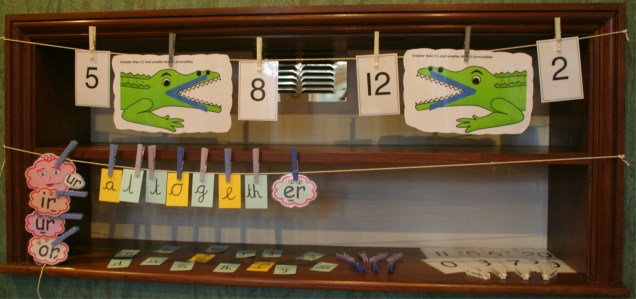
This is a very simple idea which children love because they can take greater ownership of it. The aim of the activity is to help build up hand and finger strength through using the pegs; however it can have a dual purpose, helping to keep track of the week by using it as a timetable or for learning spellings or maths activities, as well as supporting the development of language skills.

You do not need anything fancy, just some string (for the washing line), clothes pegs and pieces of paper or card to peg onto the washing line. The washing line can be a permanent fixture or you can just pop it up when you need to use it.

The clothes line needs to be at a height suitable for your child to peg things on to (placed against a wall is a safe option so that no-one can walk into it by accident and hurt themselves).

There are a whole range of games that can be played using this simple washing line and pegs concept:

  1. Memory games – Get your child to peg up 5 to 10 different pictures or items on the line. Then give them 1 minute to remember the items. Once the time is up ask them to look away, or close their eyes, and then you remove one or more of the items. Get them to look back at the line. Can they work out what is missing?
  • You could try just moving one or two of the items around. Can they figure out which ones are in the wrong place and put them back in their correct place?
  • Try swapping an item for something new, which your child did not hang up on the line. Can they work out which is the new item on the line?
  1. Odd One Out – Hang pictures on the line that belong together. Can they pick out the odd item on the line and explain why it is the odd one out.
  • They could all be pictures of fruit with a picture of some clothing
  • They could be shapes with straight sides and one with curves
  • They could all be animals but all are wild with only one being domestic
  1. Sorting – Ask your child to sort all the pictures or items from a selection and to hang all the identical things on the washing line. They could all be the same;
  • Colour
  • Shape
  • Type
  1. Pattern Work – Using pictures, different colour and shaped paper or items create different patterns. The patterns can be based on colour, size or type of object. You can create a pattern sequence on the washing line and then ask your child to try and copy the sequence. Can they explain the pattern and create their own for you to copy and explain?
  2. Pairing or What is the Same? – Hang a range of pictures or items on the line, making sure that some of the items can be paired together because they are exactly the same. They could match because;
  • They are exactly the same e.g. a pair of socks
  • Match numbers to a picture with the same number of items on
  • Match capital to lower-case letters
  • Or have items that can be put together because they are both from the same set, for example they are types of fruit or are the same colour.

Handwriting Half-term Fun!

Water fun 2

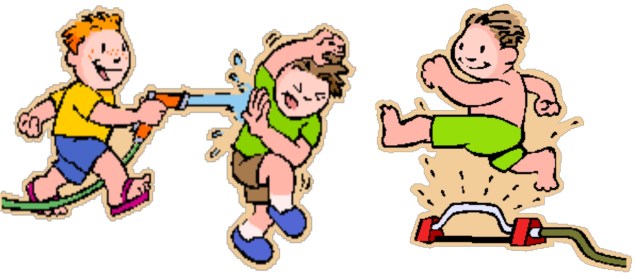
Next week is half-term for many of us and The SUN should be out which makes it time for the water fights and games to begin.

How can water fights and games, where you can get wet, be handwriting homework?

It will soon be June, the weather should be perfect, so why not set up water squirting games in the garden. The kids are waterproof and everything else will dry out, eventually!

You will be encouraging your child to develop their hand strength, co-ordination and eye tracking skills (all handwriting skills), while increasing your cool adult status.

Some fun water games:

  • Try setting up a target wall, using chalk to draw the targets.
    • How many of the targets can you hit with water squirted from a water pistol or squeeze bottle in a set time.
    • How many targets can be washed off.
  • Set up a skittles range.
    • Each skittle hit with water can be worth a certain number of points, or the distance of the skittles may affect their value.
    • A time trial game to hit all the skittles. If you are using plastic bottles as skittles try making some of them a little heavier by putting sand or dirt in them to make it a bit harder to knock them over.
  • Move the object race games.
    • A light toy/ball has to be moved by squirts of water over a distance.
    • A range of objects moved in to target areas to gain points.

The only limitation is you and your child’s imagination and trust me kids never tire of finding new ways to play with water (but then again neither do many adults)!

Homework has never been so much FUN!

Why is it so important to correct a poor body posture for handwriting tasks?

Boy head on desk 2

We expect our children to sit and write at a desk for longer periods of time at school and this can become very challenging for some children. Handwriting is a very physical task requiring good gross and fine motor skills. A weakness in either, or both, of these areas can be why a child struggles with longer handwriting tasks.

Children with a poor body posture often slouched over a desk, laying their head on the table or with their head propped up by their hand and arm or pull their chair in so far that they can rest their tummy on the edge of the table to help them keep a more upright position. This can look as if they are bored and disinterested in what they are doing. However this is not generally the case.

A poor posture position is not always due to boredom or incorrect chair and table height. For many children it is a lack of body strength or core muscle tone (the large muscle groups that control shoulder stability and the trunk of the body that work to enable us to sit and stand upright for sustained periods of time).

This is bad for them, as it puts unnecessary strain on the body, causing neck or backache and discomfort, which in turn makes them fidget as they try to get comfortable. All this can distract them from the task in hand and limit their handwriting ability as it reduces their hand and finger movements.

You can use our simple online Key Strengths assessment to check your child’s core strength (gross motors skills): http://bit.ly/2C7xYwq or use our core strength development games and activities to support your child: http://bit.ly/2FhFkR7