
Hand Swapping Issues?

Hand Swapping is a normal developmental stage in infants and young children and therefore, at this stage, not a sign that a child is uncertain of their dominant hand. However, this is not ideal for a child who has started school.

Hand swapping throughout a task is not necessarily a sign that a child is uncertain of their dominant hand.

There are two routes to tackling the hand swapping issue, the one to use depends on your answers to the following questions.

1. Does the child usually start with the one hand and then swap when that hand gets tired?

You can usually tell if this is the case because they may shake out or rub the tired hand and once it is rested go back to using it again. This is probably because their fine motor skills are weak. Through focused games and activities (https://teachhandwriting.co.uk/handwriting-muscles.html#hand and https://teachhandwriting.co.uk/warm-ups.html ), the muscle strength and dexterity can be gradually built up in the dominant hand, which in turn will build their stamina so that the hand swapping will reduce until they stop it altogether.

Once you are sure of dominance gently discourage swapping hands by taking a break from the activity and coming back to it a couple of minutes later using the preferred hand.

2. Does the child use their left hand if items are presented on their left-hand side and their right hand if they are presented on the right-hand side?

In toddlers and young children this is expected. In older children however it could mean that they have developed a delay in their skill to cross the mid-line point. This developmental bilateral coordination skill is vital to develop and can be addresses through a range of simple games and activities (https://teachhandwriting.co.uk/handwriting-muscles.html#bilat and https://teachhandwriting.co.uk/warm-ups.html ).
Warm up for #Handwriting!

Before starting to work on letter formation, joins or even the pre-handwriting patterns it is a good idea to help focus your child’s body on the activity that it is about to be performed in a fun and relaxed way.

The exercises only take a couple of minutes to do. Not only can they be done at the beginning of the session but throughout and at the end to help relax muscles and release tension that may build up over the session. Tense muscles can make handwriting activities difficult and tiring for your child.

They are fun to do, which usually brings a smile and often laughter, an added tonic to any learning experience.

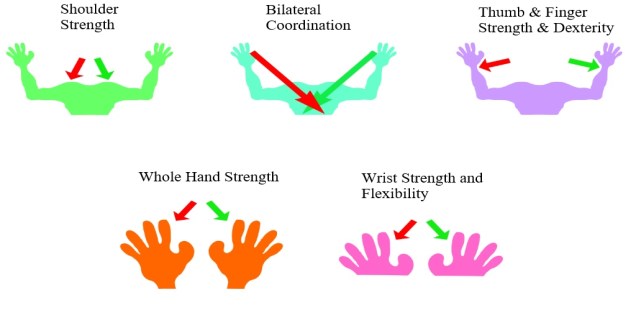
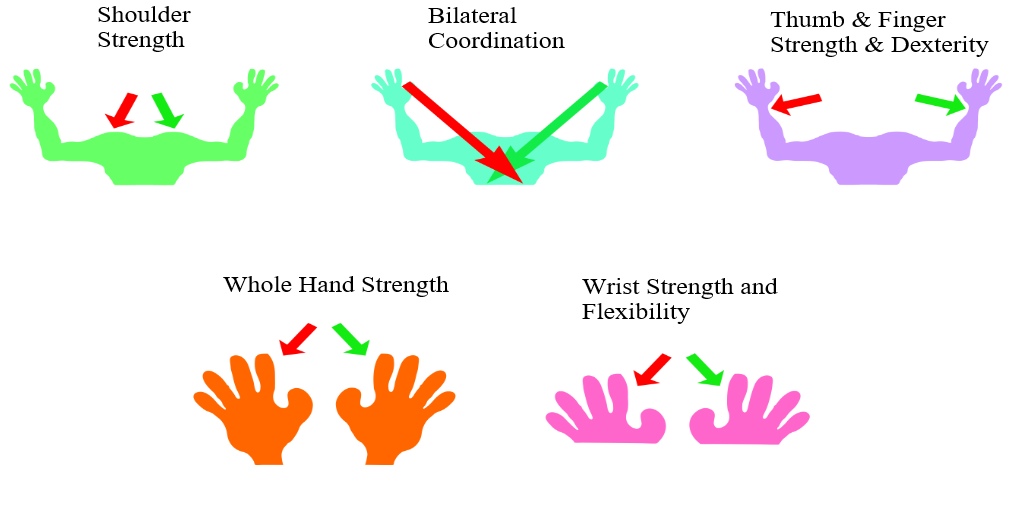
Five areas to support the body with handwriting are covered in the warm up exercises:

  1. Shoulder stability and strength
  2. Crossing the mid-line
  3. Wrist strength and flexibility
  4. Thumb and finger strength and dexterity
  5. Whole hand strength and dexterity

For more information go to our teach handwriting website here is a direct link to the warm up page:  https://teachhandwriting.co.uk/warm-ups.html

Warm up for #Handwriting!

Before starting to work on letter formation, joins or even the pre-handwriting patterns it is a good idea to help focus your child’s body on the activity that it is about to be performed in a fun and relaxed way.

The exercises only take a couple of minutes to do. Not only can they be done at the beginning of the session but throughout and at the end to help relax muscles and release tension that may build up over the session. Tense muscles can make handwriting activities difficult and tiring for your child.

They are fun to do, which usually brings a smile and often laughter, an added tonic to any learning experience.

Five areas to support the body with handwriting are covered in the warm up exercises:

  1. Shoulder stability and strength
  2. Crossing the mid-line
  3. Wrist strength and flexibility
  4. Thumb and finger strength and dexterity
  5. Whole hand strength and dexterity

For more information go to our teach handwriting website here is a direct link to the warm up page:  https://teachhandwriting.co.uk/warm-ups.html

Warm up For Handwriting!

Before starting to work on letter formation, joins or even the pre-handwriting patterns it is a good idea to help focus your child’s body on the activity that it is about to be performed in a fun and relaxed way.

The exercises only take a couple of minutes to do. Not only can they be done at the beginning of the session but throughout and at the end to help relax muscles and release tension that may build up over the session. Tense muscles can make handwriting activities difficult and tiring for your child.

They are fun to do, which usually brings a smile and often laughter, an added tonic to any learning experience.

Five areas to support the body with handwriting are covered in the warm up exercises:

  1. Shoulder stability and strength
  2. Crossing the mid-line
  3. Wrist strength and flexibility
  4. Thumb and finger strength and dexterity
  5. Whole hand strength and dexterity

For more information go to our teach handwriting website here is a direct link to the warm up page:  https://teachhandwriting.co.uk/warm-ups.html

Warm up For Handwriting!

Warm Up Focus Areas

So, before you try to encourage your little darlings to sit and write, get them to do a few physical handwriting ‘Warm Up Exercises’.  Not only do they help to prepare the hands and fingers for the task ahead, they also help to release any tension that has built up. They are fun to do, which usually brings a smile and often laughter, an added tonic to any learning experience. The warm up exercises can be accessed through a number of ways:

The warm up exercises can be accessed through a number of ways:

  • Teachers through the content section for the Key Stage you are teaching:  

https://teachhandwriting.co.uk/handwriting-warm-up-exercises.html    

Warm up For Handwriting!

Well the festive holidays are over and we are back at work and home schooling for many. So it is time to get back into good habits for the New Year!

So, before you try to encourage your little darlings to sit and write, get them to do a few physical handwriting ‘Warm Up Exercises’.  Not only do they help to prepare the hands and fingers for the task ahead, they also help to release any tension that has built up. They are fun to do, which usually brings a smile and often laughter, an added tonic to any learning experience.

The warm up exercises can be accessed through a number of ways: