A Good Sitting Position for #Handwriting

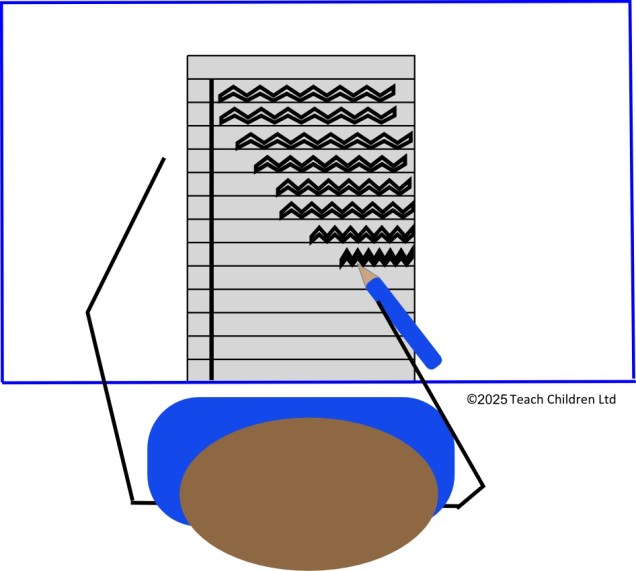
Learning to sit correctly at a table for handwriting type activities is not just important for developing a physically comfortable and maintainable sitting position; it also allows the arms and hands to move freely and enables the paper to be tilted and positioned correctly, helping to improve the quality of the handwriting.

Learning how to sit correctly, so that it becomes second nature, needs training and takes time. Many children do not sit correctly at a desk, when they are asked to do so, because they have not been taught or do not understand what they are meant to do.

For tips and ideas on how to help a child develop a good sitting posture and position for handwriting check out our ‘Sitting’ section on the website: https://www.teachhandwriting.co.uk/handwriting-sitting-position-desk.html

Some children find sitting correctly at a desk difficult because they have not acquired all the gross motor skills needed to sit correctly for long periods of time. These children may require additional posture base and bilateral coordination games and activities to help them build the appropriate gross motor skills.

For more information on developing a child’s core strengths check out the Key Strengths section of our website: https://teachhandwriting.co.uk/handwriting-motor-skills.html

Teaching Letter Joins – A Systematic Approach

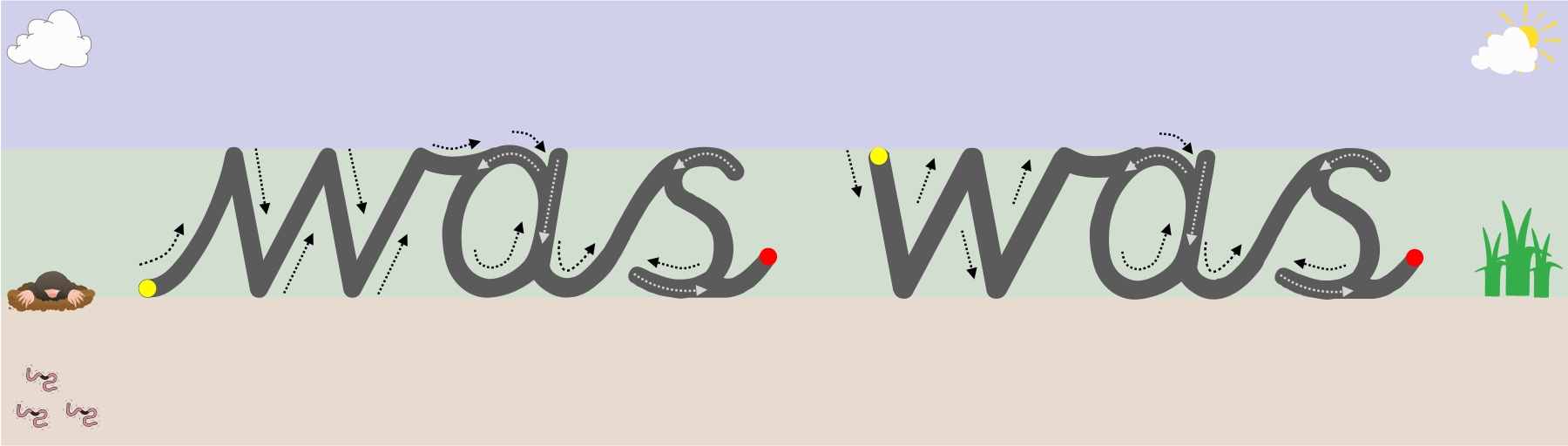
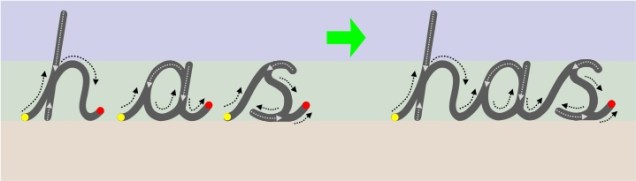
We would recommend teaching joins in join type groups, whether your child has learnt cursive or continuous cursive single letter fonts.

Teaching the join types in their groups helps a child to understand the directional pushes and pulls required to successfully join the different letter combinations.

There are 4 main groups of letter joins; bottom joins, bottom to “c” shape joins, “e” joins (top and bottom join strokes) and top joins.

Moving from Cursive Single Letters to Joining

There are seven join strokes to be taught. Most children will find the bottom joins the easiest to achieve, as it only requires the extension of the exit stroke they already put on the letters. The bottom to “c” shape joins can be tricky at first but soon mastered. The joins that tend to cause the most confusion and difficulty are the “e” joiners and top exit joiners.

I would recommend teaching the bottom joins first, then the ‘e’ joins and finally the top exit letter joins.

Moving from Continuous Cursive Single Letters to Joining

There are three join strokes to be taught. The easiest is the bottom exit letters (the majority of the letters), all a child has to do is write the letters closer together without lifting their pencil off the paper. Only the top to “e” and top joiners need to be taught for continuous cursive, as the nature of the font style means that the lead-in and exit strokes needed to join the majority of letter combinations have already been taught.

I would recommend teaching the bottom joins first, then the top exit to ‘e’ join and finally the top exit letter joins.

The ultimate aim is for a child to develop a good handwriting style; which means;

•     They can produce and maintain a good speed

•     Have a fluid hand movement that is comfortable

•     Letters are of a consistent and appropriate size, positioned correctly

•     Handwriting is legible (so others can read it easily).

It is important to remember that for some children (mainly SEND pupils) this may mean that they will always print or use a single letter form of writing as learning to join is just not appropriate. But that does not mean they will not comply with the bullet points above.

Have you got your Free Join Animations & Worksheets?

For Teachers: https://teachhandwriting.co.uk/key-stage-2-handwriting-routes.html

For Parents: https://teachhandwriting.co.uk/parents.html

Stage 3 to #Handwriting Success – Joining

Here at Teach Children we believe that a child is only ready to start learning to join their handwriting when:

  • They have learnt to form all 26 single lower-case letters correctly.
  • Letters are of a consistent and suitable size (not necessarily the perfect size, remember big is beautiful).
  • Letters are positioned appropriately on the writing line as well as in relation to one another.

The “Department of Education; The writing framework: July 2025; page 33; https://www.gov.uk/government/publications/the-writing-framework , for Year 2 states:

“Joined handwriting should not be taught until pupils can form these unjoined letters (print forms) correctly and consistently.”

This suggests that schools need to ensure children can write all their letters in a print from before moving to a single letter cursive or continuous cursive joining form. This view is further supported on page 34 where it states:

“There is no expectation that schools teach lead-ins for joined handwriting from the start and the national curriculum does not require this, but some schools continue to do this. If they do so, they should also consider teaching unjoined handwriting for specific tasks, such as labelling a diagram or data, writing an email address, or for letters in algebra.”

I don’t believe this is something new, just a reminder of the handwritten convention for labelling and mathematical notation.

Children generally begin to learn how to join letters between the ages of 6 to 7 years old, depending on the handwriting font style being taught. Those taught a continuous cursive font style for instance will tend to join much earlier due to the nature of this font.

Children do not need to be able to remember how to correctly form all their capital letters before they are taught how to join their letters. This is because capital letters never join to the lower-case letters in a word. However, for these children correct capital letter formation needs to be taught alongside the introduction of letter joins.

We would recommend teaching joins in join type groups, whether your child has learnt cursive or continuous cursive single letter fonts.

Teaching the join types in their groups helps a child to understand the directional pushes and pulls required to successfully join the different letter combinations.

Have you got your Free Join Animations & Worksheets?

For Teachers: https://teachhandwriting.co.uk/key-stage-2-handwriting-routes.html

For Parents: https://teachhandwriting.co.uk/parents.html

Why it is Important to Teach Correct Letter Formation!

It can often be assumed children will pick up how to write letters if they see them often enough (by osmosis). This is just not the case.  Correct letter formation has to be taught. Seeing a completed letter or word or watching it being typed up and appear on a screen does not show children how to form the letters.

For children to develop a good handwriting style it is important to learn how to form letters correctly to begin with as this makes the transition from single letter formation to joined letter handwriting much easier. This enables them to develop a speedy, fluid and legible handwriting style.

Department of Education; The writing framework: July 2025; page32 & 33; https://www.gov.uk/government/publications/the-writing-framework now recognizes and highlights the importance of teaching correct letter formation from the very beginning, so, starting in foundation stage:

“It should be:

  • • daily, until pupils can write legibly and easily
  • • taught in small steps, with lots of opportunity for practice
  • • cumulative: teachers should build on what pupils have learned previously 
  • • consolidated before teaching moves on so that pupils do not practise letters incorrectly
  • • revisited when further practice is needed
  • • demonstrated by the teacher
  • • additional to any handwriting that forms part of teaching phonics”

Letters are created through joining lines and curve shapes in a particular way. They have a designated start point and set directional pushes and pulls of the pencil to reach the designated finish point. This is why from the very start (2012) Teach Handwriting has always taught letter formation in groups/families rather than in alphabetical order (a Year 1 national curriculum statutory requirement in 2015). Certain groups use the same, or similar, shape and directional push and pulls of the pencil to form the letter, for instance the letter c has the same start point and anti-clockwise directional movement shape that is needed to create the letters a, d, g, o and, though a little more complicated, the letters s and e. Teaching letters in groups and families can also help to limit letter reversals such as b and d.

Another interesting and very important useful point included in the Department of Education; The writing framework: July 2025; page 33; https://www.gov.uk/government/publications/the-writing-framework, for Year 1 is that:

“Wide-lined paper is essential at this stage. Mid-line guides can also help pupils to position letters. Pupils should be introduced to paper with narrower lines once they can write legibly and easily on wide-lined paper.”

Which I believe, acknowledging the fact that children can form their letters correctly if taught correctly but may not be ready for narrow line height paper due to their developmental stage of their fine motor skill.

Also, it explains how in Year 2:

“To join letters easily and legibly, pupils first need to form the shape of each letter correctly, starting and finishing each one at the correct point and ensuring that its size is properly related to other letters in the same family.”

Due to how handwriting has or hasn’t been taught over the generations we all have our own way of handwriting. When supporting and teaching young children we need to develop a consistent approach so that they do not get confused or frustrated by adults giving them conflicting information.

For parents this means finding out from your child’s school which letter font they are teaching so that you can support them more effectively at home. This may mean that you have to learn a new way of writing some letters.

This also applies to teachers and teaching assistants; “Department of Education; The writing framework: July 2025; page 32; https://www.gov.uk/government/publications/the-writing-framework states:

“Teachers’ own handwriting should provide a model of high standards, across the curriculum and not just in handwriting lessons, but particularly when pupils are learning to write.”

As the adults in the situation, we have to accept that it is for us to make the changes. Just because something is different to the way we were taught, or do it, doesn’t mean it is wrong, it is just different! 

Our free letter animations are not just to support children with their learning but also to provide parents and teachers (all adults really) with the knowledge and support to help children develop a consistent handwriting style.

Parent animation link: https://teachhandwriting.co.uk/parents.html

Teacher animation link – click through on the Key Stage you are teaching: https://teachhandwriting.co.uk/teach-handwriting-teachers.html
Stage 1 to #Handwriting Success – Pre-handwriting Patterns

Last week we looked at non-pencil pre-handwriting pattern development, working on large scale movements through play activities.

The next stage in the progression is to move to pencil and paper activities.

Again ‘The writing framework’ states that:

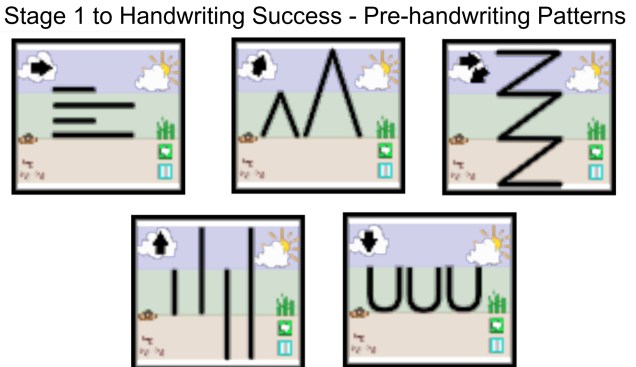
“Teaching should then progress to specific handwriting lessons and practice. This might initially include systematic teaching of and practice in moving the pencil to master the horizontal, diagonal, vertical and circular strokes needed for writing.”

Department of Education; The writing framework: July 2025; page 25; https://www.gov.uk/government/publications/the-writing-framework

Here at Teach Children Ltd we always recommend teaching the handwriting patterns in groups, as this helps to further develop the specific movements (pushes and pulls) required to form the patterns and helps commit them to the motor memory. A child can then recall these motor memories to support them as they begin to form letters.

Pre-handwriting patterns that encourage a child to move their pencil from left to right are very important for left-handed writers. They need to be taught this so that they can make the cross motion in the H, T, J, G and I from left to right, as their natural instinct is to go from right to left. If this is not corrected when writing E and F the cross lines will not be “anchored” to the letter.

Once the handwriting patterns have been mastered a child will have the confidence and skills base necessary to start forming letters, numbers and symbols.

Have you got your Free Pre-handwriting Pattern Animations & Worksheets?

For Teachers: https://teachhandwriting.co.uk/pre-handwriting-patterns.html

For Parents: https://teachhandwriting.co.uk/patterns.html

The Three Stages to Learning #Handwriting

There are three distinct stages for children to progress through to develop a good handwriting style:

Stage 1 – Pre-handwriting Patterns

Pre-handwriting patterns support a child towards handwriting success. They help the them to learn the shapes and directional pushes and pulls required to form letters. All letters are a combination of these shapes and lines.

Stage 2 – Single Letter Formation

For children to develop a good handwriting style it is important to learn how to form the letters correctly.

Beginning with lower-case letters and only the capital letters for the first letter in a child’s name, examples: Peter Rabbit, Sally Green, George Blue or Mary Shell.

Learning the correct lower-case letter formation also makes the transition from single letter formation to joined letter handwriting much easier.

Stage 3 – Joined Handwriting

Learning to join letters for handwriting enables children to develop a speedy, fluid and legible handwriting style.

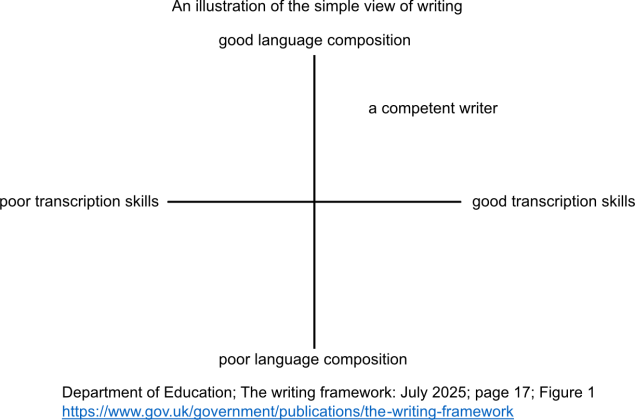
The Simple View of Writing

The writing framework explains, and shares, a simple illustrated example of “The Simple View of Writing” (see the end of this article), which we felt was a little too simplistic as a quick reference guide. So, we have created the one below which adds a little more information to what is in reality a complex set of skill factors.

Please note that criteria should all be considered in relation to the pupil’s age and stage of development.

What are language composition and transcription skills?

Language Composition

The writing framework explains language composition as; being able to express ideas by structuring them into speech and writing, which consists of two main but complex elements:

  1. Executive function (self-regulation, planning, organizing and monitoring) and
  2. Text generation (vocabulary, grammar and punctuation)

Executive function

This is a complex set of skills that have to come together throughout the writing process:

Self-regulation – the ability to keep control of their own thoughts, feelings and behaviors during the writing process. To help them remain focused on the task, to get started and to keep going (stamina to finish the task).

Planning – breaking down a task and organize it in a logical structure based on their knowledge of the topic, the context in which it is to be used, its purpose, and the audience it is intended for.

Organizing – covers a range of tasks such as deciding the best way to present some of the information, the relevance of information, what to keep and what to discard. Taking on new ideas that may conflict with their own thoughts.

Monitoring – their own writing process, reviewing and making amendments where necessary.

Text generation

Is the ability to correctly use grammatical conventions with a wide range of vocabulary and accurate punctuation.

Transcription Skills

The writing framework explains that transcription skills are handwriting and spelling.

Handwriting

The ability to handwriting with speed, fluidity and legibility. This means that the writer has correct letter formation and/or joining skills, placement, spacing, an appropriate consistent letter size for their stage of development and has or is moving to developing an automatic, sub-conscious approach to handwriting.

Spelling

The ability to spell accurately, which means having a good understanding of the alphabetic coding system (phonics) we use for the oral and written English language. This means being able to link the sounds heard in a word to the correct letter or letter combinations required to spell the word correctly. For example, in the word ‘fish’ we hear 3 phonemes ‘f/I/ ʃ’but spelling it correctly we need to know that the ‘ʃ ‘phoneme is represented by two letters ‘s’ and ‘h’=‘sh’.

Handwriting Really Starts with Play

Learning to handwrite does not start with pen and paper but through play, as children explore shape and motion (how the body moves) through their senses – touch, sight and body awareness. Play is such an important element of your child’s physical, emotional, social and academic development.

Young children learn many of the directional pushes, pulls and changes in direction, required for handwriting, on a much larger scale, long before they pick up a pencil, through playing with cars or pretending to cook. These movements become the drawings/scribbles which young children form once they start mark-making, initially as big uncontrolled movements then becoming more controlled and smaller as their gross and fine motor skills develop.

It is through play that you can really engage your child in learning how to correctly form pre-handwriting patterns and letters (the start points, orientation, directional movements and finish points).

Our non-pencil – ‘Big to Small’ activities are an easy fun way to start developing these skills early on through play: https://teachhandwriting.co.uk/big-to-small.html   

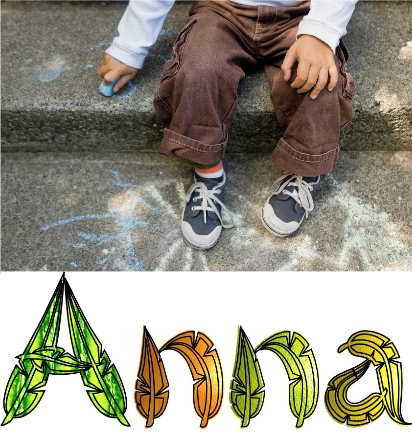
Young children love seeing their name so it is a great way to introduce letter formation; here are some other fun ideas:

  • This activity can be done indoors on large sheets of paper or using chalk on a path or patio (the beach is also a great place to do this). Write your child’s name very big and make a mark on each letter that represents a start point (an arrow showing the direction of travel can also help). Remember to use a capital letter for the first letter of their name and we would suggest lower case letters for the remaining letters. Use the letters as a track for racing cars or toys. If you make the letters big enough your child could walk, hop, jump or skip around the letters. To help them remember the letters, once they have finished a letter, encourage them to say that letter‘s alphabet name (NOT a sound the letter can make).
  • Collect stones, twigs, leaves, etc…  Use them to make the letters of your child’s name. They may only make one or two of the letters, before making a hedgehog house, nest or den for their toys becomes more interesting, but this does not matter, it is all part of the adventure.
  • Feely bag games are a fun way to explore shape and form. Try placing the letters of your child’s name into a bag or box they cannot see into. It is useful to talk through the letter shapes beforehand so they can see them as they move them about in their hands; then place them in the bag. Ask them to put their hands in (both hands, if possible, but if not, then use the dominant hand) the bag, picks up a letter, feels it, identifies it and pulls it out to check only AFTER identifying it. If correct, they get to “keep” it, if wrong, you get to “keep” it. The winner is the one with the most letters at the end. For some children it can help to have another set of the letters outside the bag to help them identify the shape they are handling in the bag. Again, encourage them to use the alphabet name of the letter.
  • Play-dough, clay and Plasticine activities are great for developing hand strength for handwriting and learning how to form letter shapes.

Your child will love these sort of activities as they see it as just playing and they get your undivided attention. You will enjoy it as you are sharing quality time with your child helping them to develop more than just their letter formation ability but also their communication and social skills.

Learning through play is a powerful way of supporting your child’s development. So have fun and play!

For links and more fun Ideas go to: https://teachhandwriting.blog/

Different Types of Play and their Importance

We are always being shown how important play is in the development of young animals’ survival and hunting skills. How many times have you thought how cute or lovely when watching kittens, puppies or polar bears playing?

Humans are also animals which thrive and develop through play; in fact, play is so important the United Nations High Commission for Human Rights state it as a right for every child (Ginsburg, 2013).

We often think of play as a frivolous pastime rather than a practical and meaningful one. However, here at Teach Children we see play as a vital part of a child’s physical, emotional, social and intellectual growth and well-being.

There has been considerable research over the years on play, which supports our point of view, with the consensus being that children need to experience five different types of play (Dr.D Whitebread, 2012). These five types of play are roughly based on the developmental opportunities they provide, especially if it is child driven rather than adult lead:

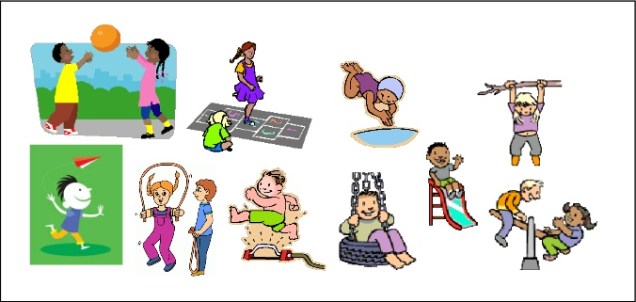
Physical Play – active exercise (running, jumping, skipping etc..), rough & tumble and fine motor skills activities to develop whole body and hand and eye co-ordination strength and endurance. The outdoor element of such play develops independence, resourcefulness and self-regulation while the fine motor skills activities support the development of concentration and perseverance.

Play with Objects – starts as soon as a child can grasp and hold an object; mouthing, biting, turning, stroking, hitting and dropping. It’s how we all learn through the exploration of our senses (sensory-motor play). This type of play develops our abilities to; physically manipulate items, think, reason and problem solve, to set challenges and goals as well as to monitor our own progress.

Symbolic Play – refers to the development of spoken language, visual symbols such as letters and numbers, music, painting, drawing and other media used for communication of thought and ideas. This type of play allows children to develop the abilities to express and reflect on experiences, ideas and emotions. Sound and language play develops phonological awareness required for literacy, while number play that relates to real life situations supports numeracy skills.

Pretence/socio-dramatic Play – Pretend play provides the opportunity to develop cognitive, social, self-regulatory and academic skills. This kind of play means children have to learn and pick up on unspoken rules of interaction, taking on the role of a character and playing within the expected confines of that role.

Games with Rules – physical games such as chase, hide & seek, sport, board and computer games. Develop social skills and the emotional skills of taking turns, winning and losing as well as other people’s perspectives.

                                                             So, to play is to learn!

Bibliography

Kenneth R. Ginsburg, MD, MSEd, 25/07/2013; ‘The Importance of Play in Promoting Healthy Child Development and Maintaining Strong Parent-Child Bonds’: THE AMERICAN ACADEMY OF PEDIATRICS: http://pediatrics.aappublications.org/content/119/1/182.full

Dr.D. Whitebread, April 2012: ‘The Importance of Play’; Commissioned for the Toy Industries of Europe:  http://www.importanceofplay.eu/IMG/pdf/dr_david_whitebread_-_the_importance_of_play.pdf                            

Drawing – a Pre-skill for Handwriting

Drawing pictures is a great way to help your child develop their pre-handwriting strokes and shape forming skills. It is amazing how, by using these simple shapes, you and your child can create fantastic picture.

Try using basic shapes such as circles, rectangles and triangles to begin with and then add some swirls, curves and spiral to give extra detail.

Check out our play resources page for more great pre-handwriting picture ides: https://teachhandwriting.co.uk/more-activities.html