A Good Sitting Position for #Handwriting

Learning to sit correctly at a table for handwriting type activities is not just important for developing a physically comfortable and maintainable sitting position; it also allows the arms and hands to move freely and enables the paper to be tilted and positioned correctly, helping to improve the quality of the handwriting.

Learning how to sit correctly, so that it becomes second nature, needs training and takes time. Many children do not sit correctly at a desk, when they are asked to do so, because they have not been taught or do not understand what they are meant to do.

For tips and ideas on how to help a child develop a good sitting posture and position for handwriting check out our ‘Sitting’ section on the website: https://www.teachhandwriting.co.uk/handwriting-sitting-position-desk.html

Some children find sitting correctly at a desk difficult because they have not acquired all the gross motor skills needed to sit correctly for long periods of time. These children may require additional posture base and bilateral coordination games and activities to help them build the appropriate gross motor skills.

For more information on developing a child’s core strengths check out the Key Strengths section of our website: https://teachhandwriting.co.uk/handwriting-motor-skills.html

Warm up for #Handwriting!

Before starting to work on letter formation, joins or even the pre-handwriting patterns it is a good idea to help focus your child’s body on the activity that it is about to be performed in a fun and relaxed way.

The exercises only take a couple of minutes to do. Not only can they be done at the beginning of the session but throughout and at the end to help relax muscles and release tension that may build up over the session. Tense muscles can make handwriting activities difficult and tiring for your child.

They are fun to do, which usually brings a smile and often laughter, an added tonic to any learning experience.

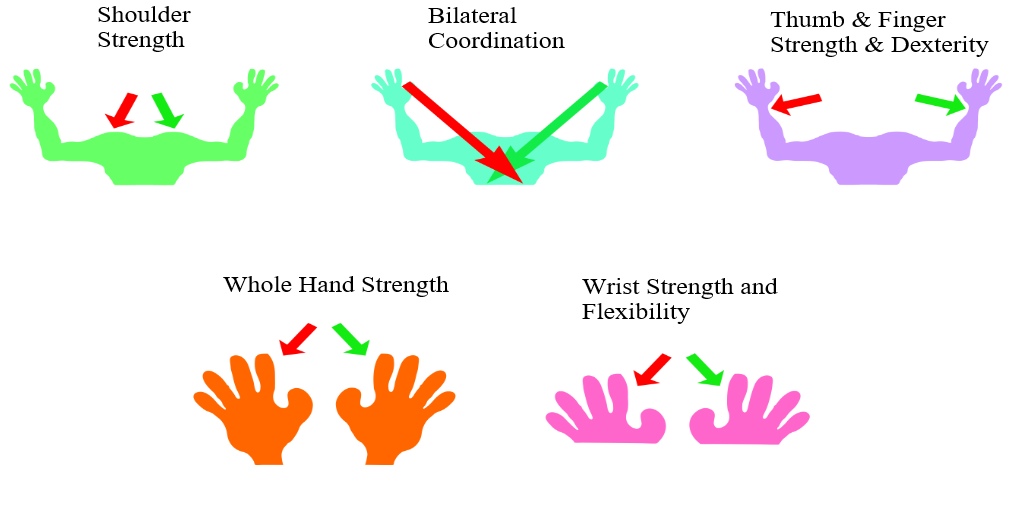
Five areas to support the body with handwriting are covered in the warm up exercises:

  1. Shoulder stability and strength
  2. Crossing the mid-line
  3. Wrist strength and flexibility
  4. Thumb and finger strength and dexterity
  5. Whole hand strength and dexterity

For more information go to our teach handwriting website here is a direct link to the warm up page:  https://teachhandwriting.co.uk/warm-ups.html

Too much Pressure or not Enough – #Handwriting?

Some children may hold a pencil correctly but struggle to maintain and control the pressure required to handwrite.

Here are some additional tips to help support a child who is pressing down too hard with their pencil:

Some children may hold a pencil correctly but struggle to maintain and control the pressure required to handwrite.
Here are some additional tips to help support a child who is pressing down too hard with their pencil:
Focused games and activities can help develop both the physical strength and sensory perception areas.
• Make sure that the pencil isn’t gripped too close to the tip of the pencil (check out the how to teach section for more information).
• Play dough writing – flatten a large piece of play dough/clay on to a desk and using a pencil write or draw onto it. The idea is to create smooth lines, not torn ones, which pressing too hard will create. The advantage of this activity is it gives a child instant feedback about whether they are pressing too hard or not. When a good pressure has been found ask the child to try doing it with their eyes closed and talk through how their body feels when they are using the right amount of pressure.
• Corrugated card – place some corrugated card under the writing paper – the aim is to try not to flatten the bumps in the card.
• Tin foil writing board – wrap a piece of card in tin foil and place the paper on top, the aim is to not rip the foil when writing.
• Carbon copies – use carbon paper to create an extra copy, start with two or three sheets of paper on top of the carbon paper then move to two and then one, so that your child starts developing an understanding of how much pressure is needed for a task and how that feels. Talk through with them how it feels as they need less pressure to create a copy.
• Pattern work – look at and discuss light and dark line patterns and how to create them. Then using different writing tools ask the child to try and create their own. Talk through how it feels when they are making dark lines compared to faint/pale colour lines using the same pencil or crayon.
Here are some additional tips to help support a child who is Not pressing down hard enough with their pencil:

Focused games and activities can help develop the physical strength and sensory perception areas.

• Crayon rubbings – when a good pressure has been found ask the child to try doing it with their eyes closed and talk through how their body feels when they are using the right amount of pressure.
• Wax drawings – rub a wax crayon all over a piece of paper then turn it over on to a plain piece of paper. Draw on the back of the wax crayoned paper and when finished lift and see another copy of the picture. The greater the pressure the more complete the hidden picture will appear.
• Carbon copies – use carbon paper to create an extra copy, start with one sheet of paper on top of the carbon paper then move to two so that the child starts to develop an understanding of how much pressure is needed for a task and how that feels.
• Use a softer pencil such as a B6 or B4 and slowly change the pencils so that they work up to a HB. Each pencil change will mean they have to exert a little more pressure to create the same line mark. B marked pencils are softer than H.
• Pattern work – look at and discuss light and dark line patterns and how to create them. Then using different writing tools ask the child to try and create their own. Talk through how it feels when they are making dark lines compared to faint/pale colour lines using the same pencil or crayon.

  • Make sure that the pencil isn’t gripped too close to the tip of the pencil (check out the how to teach section for more information).
  • Play dough writing – flatten a large piece of play dough/clay on to a desk and using a pencil write or draw onto it. The idea is to create smooth lines, not torn ones, which pressing too hard will create. The advantage of this activity is it gives a child instant feedback about whether they are pressing too hard or not. When a good pressure has been found ask the child to try doing it with their eyes closed and talk through how their body feels when they are using the right amount of pressure.
  • Corrugated card – place some corrugated card under the writing paper – the aim is to try not to flatten the bumps in the card.
  • Tin foil writing board – wrap a piece of card in tin foil and place the paper on top, the aim is to not rip the foil when writing.
  • Carbon copies – use carbon paper to create an extra copy, start with two or three sheets of paper on top of the carbon paper then move to two and then one, so that your child starts developing an understanding of how much pressure is needed for a task and how that feels. Talk through with them how it feels as they need less pressure to create a copy.
  • Pattern work – look at and discuss light and dark line patterns and how to create them. Then using different writing tools ask the child to try and create their own. Talk through how it feels when they are making dark lines compared to faint/pale colour lines using the same pencil or crayon.

Here are some additional tips to help support a child who is Not pressing down hard enough with their pencil:

Focused games and activities can help develop the physical strength and sensory perception areas.

  • Crayon rubbings – when a good pressure has been found ask the child to try doing it with their eyes closed and talk through how their body feels when they are using the right amount of pressure.
  • Wax drawings – rub a wax crayon all over a piece of paper then turn it over on to a plain piece of paper. Draw on the back of the wax crayoned paper and when finished lift and see another copy of the picture. The greater the pressure the more complete the hidden picture will appear.
  • Carbon copies – use carbon paper to create an extra copy, start with one sheet of paper on top of the carbon paper then move to two so that the child starts to develop an understanding of how much pressure is needed for a task and how that feels.
  • Use a softer pencil such as a B6 or B4 and slowly change the pencils so that they work up to a HB. Each pencil change will mean they have to exert a little more pressure to create the same line mark. B marked pencils are softer than H.
  • Pattern work – look at and discuss light and dark line patterns and how to create them. Then using different writing tools ask the child to try and create their own. Talk through how it feels when they are making dark lines compared to faint/pale colour lines using the same pencil or crayon.

#Handwriting Letter & Word Spacing Issues

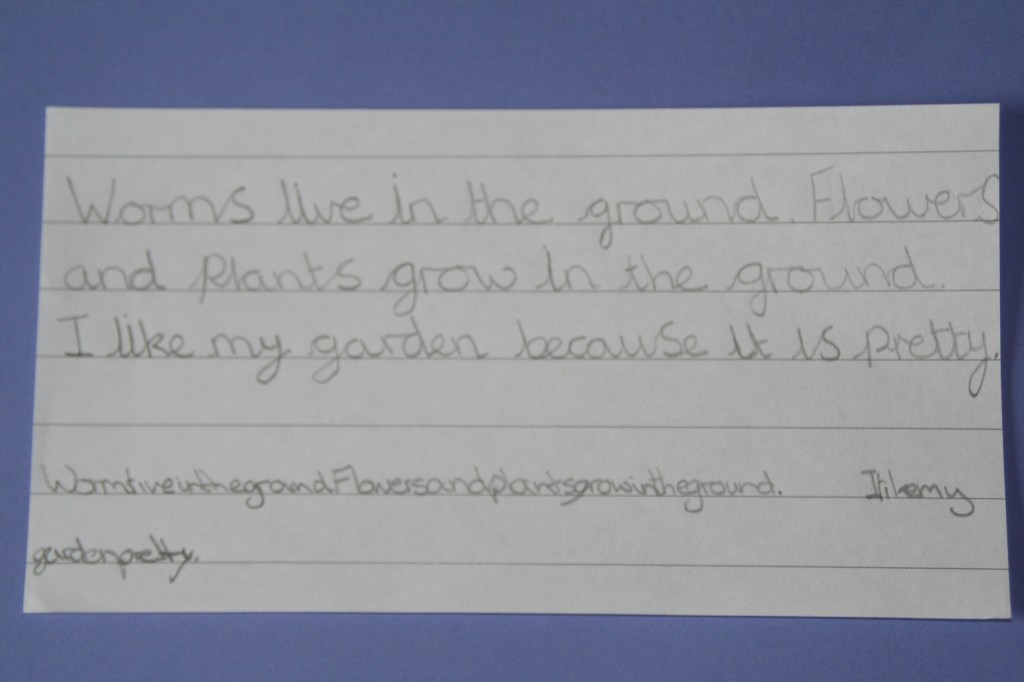
Some children find it difficult to space their letters in words correctly and to show spacing between words. There can be a number of reasons for this:

  1. They may not understand the concept or conventions of spacing words and letters and this needs to be explained.
  2. Other Physical Skills such as poor spatial awareness skills, eye tracking or general eyesight.
  3. Poor Key Strengths and/or Key Abilities elements, required for handwriting, such as sitting position, paper position, pencil grip, hand position and letter formation knowledge may also be hindering them.

 ‘Tips to support letter and word spacing’ will help you to identify if your child is having difficulty in understanding the spacing conventions and how to support them: https://teachhandwriting.co.uk/spacing-difficulties.html

Games and activity ideas to develop a child’s physical skills for handwriting: https://teachhandwriting.co.uk/handwriting-motor-skills.html

#Handwriting Letter & Word Spacing Issues

Some children find it difficult to space their letters in words correctly and to show spacing between words. There can be a number of reasons for this:

  1. They may not understand the concept or conventions of spacing words and letters and this needs to be explained.
  2. Other Physical Skills such as poor spatial awareness skills, eye tracking or general eyesight.
  3. Poor Key Strengths and/or Key Abilities elements, required for handwriting, such as sitting position, paper position, pencil grip, hand position and letter formation knowledge may also be hindering them.

 ‘Tips to support letter and word spacing’ will help you to identify if your child is having difficulty in understanding the spacing conventions and how to support them: https://teachhandwriting.co.uk/spacing-difficulties.html

Games and activity ideas to develop a child’s physical skills for handwriting: https://teachhandwriting.co.uk/handwriting-motor-skills.html

Handwriting Letter & Word Spacing Issues

Some children find it difficult to space their letters in words correctly and to show spacing between words. There can be a number of reasons for this:

  1. They may not understand the concept or conventions of spacing words and letters and this needs to be explained.
  2. Other Physical Skills such as poor spatial awareness skills, eye tracking or general eyesight.
  3. Poor Key Strengths and/or Key Abilities elements, required for handwriting, such as sitting position, paper position, pencil grip, hand position and letter formation knowledge may also be hindering them.

 ‘Tips to support letter and word spacing’ will help you to identify if your child is having difficulty in understanding the spacing conventions and how to support them: https://teachhandwriting.co.uk/spacing-difficulties.html

Games and activity ideas to develop a child’s physical skills for handwriting: https://teachhandwriting.co.uk/handwriting-motor-skills.html

#Handwriting Letter & Word Spacing Issues

Some children find it difficult to space their letters in words correctly and to show spacing between words. There can be a number of reasons for this:

  1. They may not understand the concept or conventions of spacing words and letters and this needs to be explained.
  2. Other Physical Skills such as poor spatial awareness skills, eye tracking or general eyesight.
  3. Poor Key Strengths and/or Key Abilities elements, required for handwriting, such as sitting position, paper position, pencil grip, hand position and letter formation knowledge may also be hindering them.

 ‘Tips to support letter and word spacing’ will help you to identify if your child is having difficulty in understanding the spacing conventions and how to support them: https://teachhandwriting.co.uk/letter-and-word-formation-difficulties.html  

Our ‘Other Physical Skills’ assessment will help you to identify if your child’s spatial awareness or eye tracking skills may be affecting their spacing skills: https://teachhandwriting.co.uk/other-physical-skills-assessment.html

If you are not sure then book an eye test for your child, just to be on the safe side, it could be they need glasses.

Our step by step ‘Overcoming Handwriting Difficulties’ guide will support you in identifying other possible reasons for your child’s letter and spacing issues: https://teachhandwriting.co.uk/overcoming-handwriting-difficulties.html

The Quadrupod Grip for #Handwriting

Last week we explained, that this grip is classified as an efficient grip for handwriting.

This grip may not put as much stress on the finger joints as other inefficient grips but it does restrict finger movements and therefore the fluidity of the handwriting.

The Quadrupod Grip is where the pencil is held between the top of the thumb, index and middle fingers and rests on the ring finger with the little finger slightly curled in.

I would normally see this as a developmental transitional pencil grip in younger children as they then move on to develop a Dynamic Tripod Grip, considered the most appropriate grip for handwriting.

Older children who have not moved on to develop the tripod grip may require more focused support in developing gross and/or fine motor skills. It is important to check that they are sitting correctly at the table and that the paper is positioned and tilted correctly for them. If they have a poor sitting posture it may be that extra work needs to be done on helping them to develop their gross motor skills. If this area seems fine then it could be that their fine motor skills require additional attention. See our ‘Key strengths needed for handwriting’ section for more information: https://www.teachhandwriting.co.uk/handwriting-key-strengths.html

It can be very difficult to get an older child to change their pencil grip especially if the old grip, like the Quadrupod Grip, is very similar to the new Dynamic Tripod Grip. This is when it becomes difficult to know whether to continue to try and make a child change their pencil grip or not.

I think what we have to remember is:

“A pencil hold that provides speed, legibility is comfortable and will not cause harm to the joints of the hand over time. If a hold satisfies these criteria there is no need to change it”

(Benrow 2002, cited A Wagenteld, J Kaldenberg (co-editors), 2005: Foundation of Paediatric Practice for the Occupational Therapy Assistant; Pub: Slack Incorporated, ISBN-10:1-55642-629-1)

So if the child is complaining that their hand or fingers hurt or ache when they use the Quadrupod Grip, or that it is hindering their handwriting fluidity and speed, then we do need to support them in changing their grip. For some it may be more appropriate to introduce them to the Adaptive Tripod Grip rather than trying to force them to use the Dynamic Tripod Grip.

We have to remember that every child is different and try our best to cater to their needs rather than our own preferences.  

Handwriting is a Physical Activity

Handwriting with fluidity, speed, accuracy and over longer periods of time requires a complex range of whole body and hand strengths and skills. So it is not surprising that many children find handwriting challenging.

For a good handwriting style children need to develop their:

  • Gross Motor Skills – so they can sit correctly for periods of time.
  • Fine Motor Skills – so that they can hold and control the pencil and move the paper up the table as they write.
  • Motor Memory Skills – so they can recall how to form the letters.
  • Visual Memory Skills – so they recall what a particular letter looks like.
  • Spatial Awareness Skills– so they can place the letters correctly on the paper and in relation to one another.
  • Eye Tracking Skills– scanning from left to right so that the letters are formed and placed correctly.

If a child is struggling with handwriting it is important to take a closer look at their physical abilities. If they do not have all the appropriate key physical strengths to support their handwriting development getting them to do more of the paper and pencil activities is not the answer.

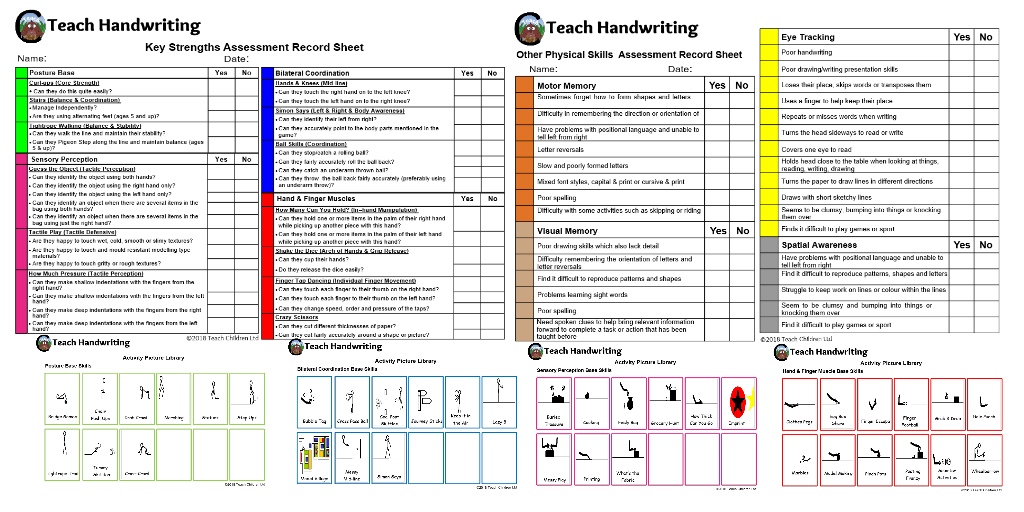
Our assessments are simple to complete and do not need any specialist equipment. The important elements are; your knowledge of the child and your observations of them at play and while they are engaged in normal day to day task.

You will find our assessments on the ‘Key Strengths needed for handwriting’ page: http://bit.ly/2D1RKKs

A better understanding of a child’s key skills abilities enables you to focus more effectively, through targeted physical games and activities, to help them build and develop their skills.

You will find ‘Games to build gross and fine motor skills’ here: http://bit.ly/2FhFkR7  and ‘Games for the other physical skills’ such as visual memory and eye tracking here: http://bit.ly/2M350S1

Handwriting is such an important skill as it engages the neurological pathways and working memory in a way that pressing a keyboard just doesn’t; so once mastered it helps to open up the doorways to other literacy skills such as phonics, reading, spelling and composition.

Why do Children Fidget or Appear Bored When Handwriting?

There are two key elements that can cause a child to fidget or appear bored when handwriting, both relate to being able to sit correctly:

  1. The height of the table and chair
  2. The child’s physical core strength

Table and Chair Height

A poor and uncomfortable sitting position that causes a child to fidget and wriggle about affects their ability to concentrate and pay attention; for example, when listening to a teacher, as well as distracting them from the task and breaking their train of thought. It also puts unnecessary strain on the body, making sitting tasks such as handwriting more tiring.

When a child is sitting on a chair too high for them they may sit swinging their legs, causing the body to rock slightly. They might wrap their legs around the legs of the chair to stop them aching, which is not good for their circulation and can cause them to lean back away from the table top. Some children will sit with their legs underneath their bottom which often causes them to lean too far over the table due to being off balance, once again not good for their circulation or for handwriting and other fine motor skill activities such as eating or drawing.

If a table is too high for a child they will have their arms raised too high, causing tension in the upper arms and shoulders or they may rest their head on the table. Both have a profound effect on a child’s ability to handwrite with fluidity, comfort and for any period of time. Another result of this is a child fidgets as they try to readjust their position to get comfortable, which in turn distracts them from the task at hand. 

For tips and ideas on how to help a child develop a good sitting posture and position for handwriting check out our ‘Sitting’ section on the website: https://www.teachhandwriting.co.uk/handwriting-sitting-position-desk.html

Sitting and Core Strength

We often see children slouched over a desk, laying their head on the table or with their head propped up by their hand and arm, or fidgeting about while they are sitting at the desk writing. This can look as if they are bored and disinterested in what they are doing. However, this is not generally the case.

A poor posture position is not always due to boredom or incorrect chair and table height. For some children it is a lack of body strength or core muscle tone (the large muscle groups that control shoulder stability and the trunk of the body) that work to enable us to sit and stand upright for sustained periods of time.

We expect our children to sit at a desk for long periods of time at school. To be able to maintain a good sitting position for writing over any length of time requires good core strength. Those who lack strong core strength tend to slouch over the desk, lay their head on the desk, hold their head in their hand or pull their chair in so far that they can rest their tummy on the edge of the table to help them keep a more upright position.

This is bad for them, as it puts unnecessary strain on the body, causing neck or backache and discomfort, which in turn make them fidget as they try to get comfortable. All this can distract them from the task in hand and limit their handwriting ability as it reduces their hand and fingers movements to handwrite freely.

For more information, games and activities on developing a child’s core strengths check out the Key Strengths section of our website: https://www.teachhandwriting.co.uk/handwriting-key-strengths.html