Good Handwriting is …

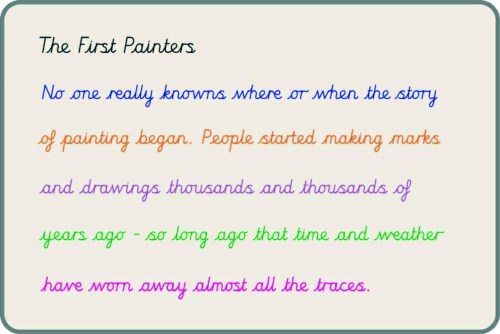
join sentences

Often good handwriting is associated with how neat and lovely it looks. Beautiful penmanship is not a guarantee of quality. Some children will spend ages forming their letters so that the piece looks great but have not produced a well composed piece of work.

So, what do we consider the important elements to a good handwriting style:

  • a fluid hand movement that is comfortable;
  • letters are of a consistent and appropriate size and positioned correctly;
  • that the writer can produce and maintain a good handwriting speed;
  • that it is completely legible to others.

Here at Teach Handwriting we believe that learning to join letters increases the accuracy, fluidity, speed and legibility of handwriting. However, we also recognise that for some SEND children learning to join their handwriting may not be a logical option. However, this does not mean that using a single letter font style stops them from handwriting with accuracy, fluidity, speed and legibility (though it may never be as fast as a joined font).

Making it Easier to Copy from the Board

Copy 1.jpg

Copying accurately and quickly from a board at the front of a classroom can be a challenge at the best of times. For young children and those with specific learning difficulties it can be near on impossible. It is amazing how many children lose some, if not all, of a break time because they could not complete the copying task quickly enough in the lesson time.

The practise of taking information off the board has its uses and there are times when there is just no other alternative but it can be made more manageable, here are a few ideas which may help.

  • Make sure the child is sitting facing the board.
  • That they can see the board clearly.
  • That light is not reflecting off the board so that the writing disappears.
  • Try using a different colour marker pen for each line of writing (this way a child will be able to quickly locate the line they were copying from).
  • Or try numbering the lines so the child can more effectively find their way around the text.
  • Leave more of a gap between each line of writing so that each line is clearly visible from the back of the room.
  • Ask those children, who struggle copying, to start the first line of writing as you transfer the text to a smaller board which can then be placed at a more appropriate distance and level for them to continue copying from.
  • If you know the information that will need to be transferred to the child’s book then pre-prepare a text that can be given to the child to copy from. It may be in a different order or layout to that on the board; but it is the information and the child’s ability to access it, that is important.
  • Is a full sentence explanation always required or could the information be presented in another way such as a mind map or diagram which would be equally, or even more, useful to the child.

It can be surprising how frustrating and upsetting being asked to copy from the board can be for many children. So anything that can help to alleviate these emotions and difficulties has got to be worth a try!

Handwriting Letter & Word Spacing Issues

spacing issues 8729

Some children find it difficult to space their letters in words correctly and to show spacing between words. There can be a number of reasons for this:

  1. They may not understand the concept or conventions of spacing words and letters and this needs to be explained.
  2. Other Physical Skills such as poor spatial awareness skills, eye tracking or general eyesight.
  3. Poor Key Strengths and/or Key Abilities elements, required for handwriting, such as sitting position, paper position, pencil grip, hand position and letter formation knowledge may also be hindering them.

1. ‘Tips to support letter and word spacing’ will help you to identify if your child is having difficulty in understanding the spacing conventions and how to support them: http://bit.ly/2LynVrn

2. Our ‘Other Physical Skills’ assessment will help you to identify if your child’s spatial awareness or eye tracking skills may be affecting their spacing skills: http://bit.ly/2P5jS44

If you are not sure then book an eye test for your child, just to be on the safe side, it could be they need glasses.

3. Our step by step ‘Overcoming Handwriting Difficulties’ guide will support you in identifying other possible reasons for your child’s letter and spacing issues: http://bit.ly/2C7xYwq

Identifying Poor Motor Memory and Visual Memory Skills in Handwriting

Motor & Visual Memory 2.jpg

Motor memory and visual memory difficulties can have a dramatic effect on a child’s handwriting ability. Possible signs of poor motor memory or visual memory skills can be that their handwriting is slow and deliberate or fast and messy (as they try to hide their letter formation issues), making it difficult to read. They can spend so much time on trying to remember how to form the letters, they have no working memory space left for the important tasks of composing their writing and spelling.

Poor motor memory skills can make handwriting difficult as shapes and letter formation movements are often forgotten, causing letter reversals and incorrectly formed letter shapes, which can make joining a very slow process to learn. A poor and often slow handwriting style can develop as font styles are mixed and capital letters are used inappropriately. Combined, these difficulties can cause poor presentation, spelling and legibility issues.

Poor visual memory skills make handwriting difficult as the ability to recall how letters look and reproduce them with appropriate spacing and positioning is partially or completely lost. This leads to poor letter formation skills, letter reversal along with spelling and presentation difficulties.

Visual memory and motor memory skills are linked and so a game or activity that supports one is likely to support the other.

For more information on how to identify motor memory and visual memory difficulties see our Other Physical Skills Assessment: http://bit.ly/2P5jS44

For games and activities to help support and develop these skills use this links: http://bit.ly/2M350S1

Identifying Poor Eye Tracking and Spatial Awareness Skills in Handwriting

Eyes

Eye tracking and/or spatial awareness difficulties can have a dramatic effect on a child’s handwriting ability.  Weak skills in these key areas make it difficult for children to form letters correctly (curves and lines often not joining to complete the letter shape), as well as being unable to appropriately space letters in words and words in sentences. Other poor presentation skills include being unable to write on lines and often missing lines out when following on with a sentence.

It is also worth pointing out that a child with poor eye tracking and/or spatial awareness skills will also find reading difficult.

For more information on how to identify eye tracking and spatial awareness difficulties as well as activities to help support and develop these skills use these links:

Helping to Overcome Handwriting Difficulties

Step by Step overcoming difficulties 1

It can be difficult to identify why a child is having trouble learning to handwrite fluidly and with speed. This is because handwriting is a complex skill, requiring both physical skills (Key Strengths) and the knowledge (Key Abilities) of how to form and join letters correctly.

Where do you start?

Follow our step by step guide to identify where the problem may lie and then work with the child using our suggested solutions: http://bit.ly/2uFcUJF

Don’t miss the early steps, even though you think they may not be relevant to an older learner, as the child may be struggling because they have either missed an earlier stage of physical development or teaching.

Sometimes children need to be taken back before they can move forward.

The Move from Pencil to Pen

pens 1

Last week we looked at why pencils, rather than pens, are a good first tool for learning to handwrite.

Children can’t wait however for that magic day when the teacher moves them from pencil to pen. It really is a big moment and means more than just “I can write neatly”, for them it is an acknowledgement of their maturity (growing up) and a status symbol of intellect and ability in their eyes and those of their peers.

Moving from pencil to pen can have a dramatic effect on a child’s confidence and self-esteem.  I have seen how moving a child from pencil to pen can give them a new found confidence and self-belief in their own ability, because I showed my belief in them by making that gesture. They may not have had the perfect font style in pencil but moving to pen did improve their ability to form letters more freely and become more consistent in their formation.

It is difficult to put an age on when a child should move from pencil to pen because every child is different. Schools have different policies on when this should happen, with most tending to make the move at around the age of 8/9 years old. It should really depend on the child’s ability rather than their age, as well as the potential benefits the move may have to confidence and self-esteem.

It does not make sense to keep a child working with pencil until they have a perfect handwriting style because that may never happen. For many a neat, beautiful handwriting style may never be a reality.

Advantages of pens:

  • A good quality pen will give an even ink flow.
  • A more consistent hand pressure is required, helping to develop and maintain a fluid handwriting style (reducing hand strain).
  • Fibre tip and roller pens can give the same look and writing experience as a good quality fountain pen, but are far less messy (especially for left handed people).
  • With the right pen everyone’s handwriting can look good, (I love my fountain pen for that reason).

Limitations:

  • Cheap biro pens require a lot of hand pressure and give an inconsistent ink flow (so not very different from pencils).
  • Cheap fountain pens can be scratchy and messy
  • Some schools will insist on using a particular type of pen which is not always good for all.

My tip would be to test a few pen types and weights to find out which ones your child finds the most comfortable and enjoyable to use. I realise this can be an issue if your child’s school insist on one type of pen. But if you can prove your child’s handwriting ability is great with a different style I think it is worth talking to them about it.

Moving from pencil to pen is an important point in a child’s education, affecting their confidence and self-esteem, and like any transition stage it should be approached with thought and care.

Handwriting is a Physical Activity


assessment 2

Handwriting with fluidity, speed, accuracy and over longer periods of time requires a complex range of whole body and hand strengths and skills. So it is not surprising that many children find handwriting challenging.

For a good handwriting style children need to develop their:

  • Gross Motor Skills – so they can sit correctly for periods of time.
  • Fine Motor Skills – so that they can hold and control the pencil and move the paper up the table as they write.
  • Motor Memory Skills – so they can recall how to form the letters.
  • Visual Memory Skills – so they recall what a particular letter looks like.
  • Spatial Awareness Skills– so they can place the letters correctly on the paper and in relation to one another.
  • Eye Tracking Skills– scanning from left to right so that the letters are formed and placed correctly.

If a child is struggling with handwriting it is important to take a closer look at their physical abilities. If they do not have all the appropriate key physical strengths to support their handwriting development getting them to do more of the paper and pencil activities is not the answer.

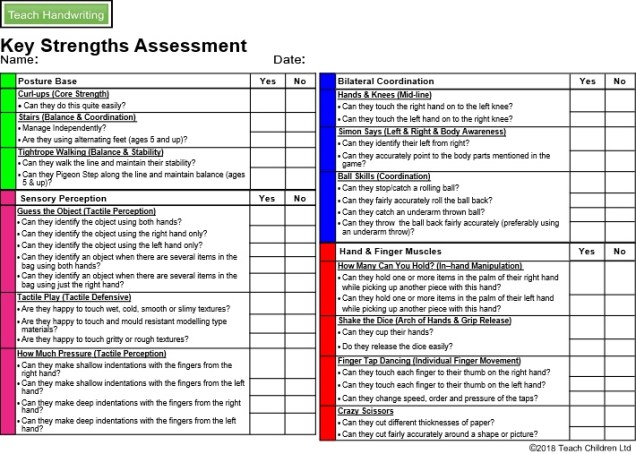
Our assessments are simple to complete and do not need any specialist equipment. The important elements are; your knowledge of the child and your observations of them at play and while they are engaged in normal day to day task.

You will find our assessments on the ‘Key Strengths needed for handwriting’ page: http://bit.ly/2D1RKKs

A better understanding of a child’s key skills abilities enables you to focus more effectively, through targeted physical games and activities, to help them build and develop their skills.

You will find ‘Games to build gross and fine motor skills’ here: http://bit.ly/2FhFkR7  and ‘Games for the other physical skills’ such as visual memory and eye tracking here: http://bit.ly/2M350S1

Handwriting is such an important skill as it engages the neurological pathways and working memory in a way that pressing a keyboard just doesn’t; so once mastered it helps to open up the doorways to other literacy skills such as phonics, reading, spelling and composition.

Warm up For Handwriting!

tommy-thumb

Well the festive holidays are over and many of us are back at work and school. So it is time to get back into good habits for the New Year!

So, before you try to encourage your little darlings to sit and write, get them to do a few physical handwriting ‘Warm Up Exercises’.  Not only do they help to prepare the hands and fingers for the task ahead, they also help to release any tension that has built up. They are fun to do, which usually brings a smile and often laughter, an added tonic to any learning experience.

The warm up exercises can be accessed through a number of ways:

  • Teachers through the content section for the Key Stage you are teaching by clicking on the Handwriting warm up activities button.
  • Parents through the getting the most from our website section by clicking on the picture under the Taking the tension out of handwriting title.
  • Resources in the How to Teach Handwriting section by clicking on the Handwriting warm up activities button.
  • Follow this link: https://www.teachhandwriting.co.uk/handwriting-warm-up-exercises.html

The Best Type of Paper for Teaching Handwriting

Just as the writing tool used by children changes as they develop, so does the paper they write on.

Informal Pre-handwriting Pattern and Initial Letter Development

If your child is just starting out on the handwriting adventure then any type of plain paper (no ruled lines) is considered the best option, as many children find it less restrictive.

Young children, due to the stage of their physical development, use large movements to draw (from the shoulder rather than the wrist) which often creates larger shapes and lines; you don’t want to restrict this movement as it can cause handwriting difficulties later. As their gross and fine motor skills develop so does their pencil grip and ability to draw and write at a smaller scale, moving more from the shoulder to elbow and wrist.

Formal Pre-handwriting Pattern and Letter Development

When your child is ready to refine their pre-handwriting pattern skills, or move on to forming letters, it is a good idea to use plain paper. The aim at this stage is to learn how to form the letters correctly, not size or neatness as that comes later.

Before moving to lined paper, to help children to start to appreciate the letter proportions and positioning, paper with picture clues can be used.

On our website the free writing paper and animations reinforce the idea of letter proportions and positioning by splitting the backgrounds into three colour zones to represent the sky, grass and earth. There are a number of reasons why this can be beneficial:

  • It can create a sub-conscious memory in a child’s mind of where particular letters sit in relation to others without the constraints of lines or obvious boundaries, especially as the picture can be any size. Children remember where to place the sun, grass or worms in their drawings; so why not letters?
  • It can be easier to talk through the formation of how a shape or letter is formed with pictorial and colour clues to guide and inform the direction of the movements required.
  • As a child’s fine motor skills develop so the size of the picture/colour clues can be reduced to match their progress.

As a child’s fine motor skills develop it enables them to form smaller more refined versions of the letters and this is when it is more appropriate to use lined paper.

Transferring their handwriting skills from worksheets to paper 

The aim is to try and move children off the worksheets as soon as possible by encouraging them to transfer their skills to plain or lined paper which is appropriate for their ability. I realise that it is not possible to buy paper with the appropriate line height in all cases, so would recommend creating your own on the computer.

We realise that printing off our worksheets and coloured lined paper can become costly so, here are our recommendations for helping to reduce the costs:

  • Suggestion 1 – Use a colour version of the appropriate worksheet initially and then try printing in grey scale. Children usually make the adjustment to grey scale well once they are used to how the picture clues and colours work. You could also use the grey scale worksheets and colour the start of each row with the appropriate colour.
  • Suggestion 2 – Use a combination of worksheets and lined paper in each handwriting session with a child:
  1. Use the colour worksheet, or a grey scale version, and complete one or two rows.
  2. Then encourage the child to try the same patterns or letters on appropriately lined paper, again try one or two rows only.


Hopefully the worksheet will last over a couple of handwriting sessions and you and the child will see an improvement over the time. The sooner they learn to transfer their skills to paper the better.

For different types of pre-handwriting pattern and letter formation paper go to our animations and worksheet page and scroll down to the end of the page: http://bit.ly/1PKXB46