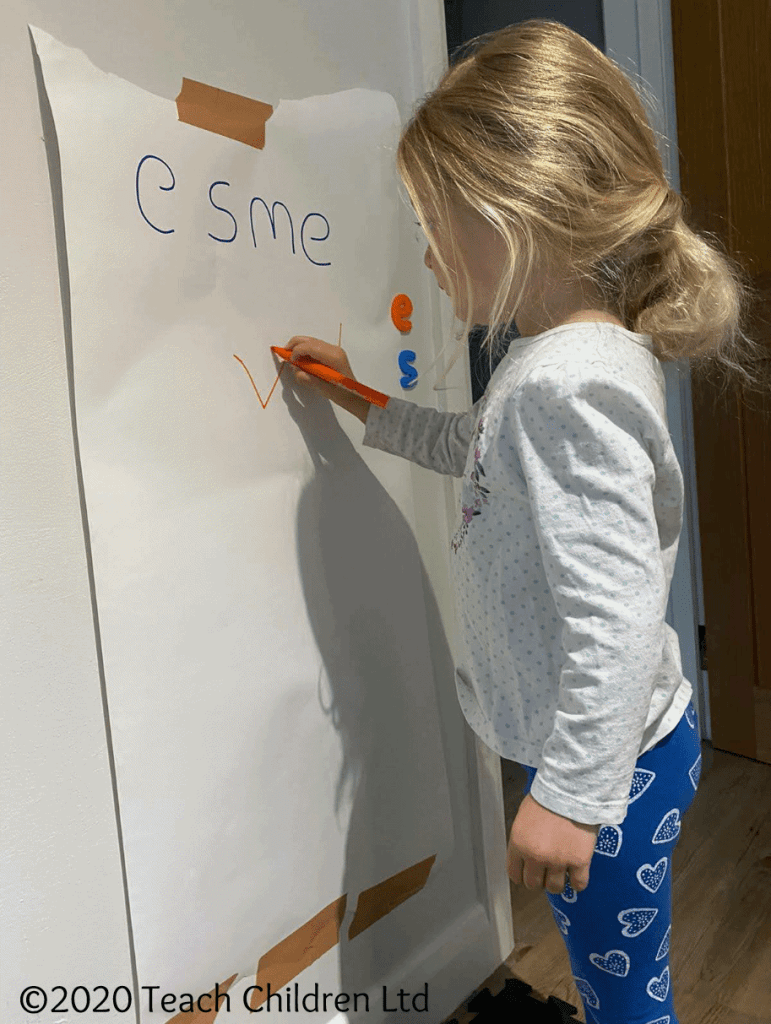
Poor hand position can cause a poor pen grip

We often talk about the most appropriate grip for handwriting being the tripod grip; but this usually only refers to finger position. It is easy to forget the importance of the actual hand position in relation to the pen and paper for handwriting.

The ideal position is for the hand, wrist and elbow to be below the tip of the pencil and under the writing line for both left and right-handed writers.

Some children will hold the pencil in a tripod grip but develop a hooked hand position or move the elbow too far up the table, causing the forearm and wrist to be nearly horizontal with the table edge, because they feel they can see what they are writing more clearly.

A hooked grip puts unnecessary strain on the hand ligaments and forces the body into a poor sitting position, again putting extra strain on the body. This in turn makes handwriting a tiring and uncomfortable task, impacting on a child’s overall learning experience.

It takes time to correct a poor hand position but it is well worth the perseverance as it will enable a child to write freely and more comfortably.

When writing normally, encourage children to angle the paper appropriately as this will also help to correct a poor hand position. With the correct paper tilt they will always be able to see what they are writing. If the paper is tilted at the correct angle for them, they will find a hooked hand position, or having their forearm further up the table, more difficult and uncomfortable to maintain.

Some children will find writing on a sloped desk helpful. Not all are comfortable writing or drawing on a flat surface and may benefit from the paper being positioned on an angled or sloped board. If you are not sure, instead of buying a specialist board, you could make one. Try using a ring binder or lever arch file stuffed with magazines and newspaper to make a sloped board. Tape the edges to stop the papers falling out or you could cover it in sticky back plastic to give a smoother finish to the board. The advantage of this is that you can make them to any angle of slope. Try a few to see which, if any, your child prefers. You may find that they only need the sloped board for a short while. It may also help to reduce the angle of the slope over time so that they gradually get used to moving from a sloped to horizontal writing plane.

The Adaptive Tripod Pencil Grip for #Handwriting

The Adaptive Tripod pencil grip is identical to the Dynamic Tripod grip (still considered the most appropriate for handwriting) in that the pencil is held between the tip of the thumb and index finger and rests on the middle finger. The main difference is that the shaft of the pencil rests in the ‘V between the index and middle finger. This gives an open web space which allows the fingers to move freely so that a fluid handwriting style can be achieved.

This grip is often more appropriate for children who have low muscle tone or hyper mobility of the finger joints. It can also benefit older children who:

  • Continue to hold a pencil too tightly
  • Hold the pencil lightly using just their fingertips (often writing using whole arm movements)
  • Hold a pencil with their thumb wrapped around and across the pencil and index finger.

Changing to the Adaptive Tripod grip is not a quick fix for children who have poor hand and finger strength. These strengths still need to be developed to make handwriting more comfortable.

How to form the Adaptive Tripod Grip for Right & Left-handed Writers

From the research I have done I cannot find any information that the grip needs to be adapted for left-handed writers. So, our step by step guide applies to both left and right-handed writers and can be accessed using the following link and scrolling down the page:  http://bit.ly/2XpuI8I

The Quadrupod Grip for #Handwriting

Last week we explained, that this grip is classified as an efficient grip for handwriting.

This grip may not put as much stress on the finger joints as other inefficient grips but it does restrict finger movements and therefore the fluidity of the handwriting.

The Quadrupod Grip is where the pencil is held between the top of the thumb, index and middle fingers and rests on the ring finger with the little finger slightly curled in.

I would normally see this as a developmental transitional pencil grip in younger children as they then move on to develop a Dynamic Tripod Grip, considered the most appropriate grip for handwriting.

Older children who have not moved on to develop the tripod grip may require more focused support in developing gross and/or fine motor skills. It is important to check that they are sitting correctly at the table and that the paper is positioned and tilted correctly for them. If they have a poor sitting posture it may be that extra work needs to be done on helping them to develop their gross motor skills. If this area seems fine then it could be that their fine motor skills require additional attention. See our ‘Key strengths needed for handwriting’ section for more information: https://www.teachhandwriting.co.uk/handwriting-key-strengths.html

It can be very difficult to get an older child to change their pencil grip especially if the old grip, like the Quadrupod Grip, is very similar to the new Dynamic Tripod Grip. This is when it becomes difficult to know whether to continue to try and make a child change their pencil grip or not.

I think what we have to remember is:

“A pencil hold that provides speed, legibility is comfortable and will not cause harm to the joints of the hand over time. If a hold satisfies these criteria there is no need to change it”

(Benrow 2002, cited A Wagenteld, J Kaldenberg (co-editors), 2005: Foundation of Paediatric Practice for the Occupational Therapy Assistant; Pub: Slack Incorporated, ISBN-10:1-55642-629-1)

So if the child is complaining that their hand or fingers hurt or ache when they use the Quadrupod Grip, or that it is hindering their handwriting fluidity and speed, then we do need to support them in changing their grip. For some it may be more appropriate to introduce them to the Adaptive Tripod Grip rather than trying to force them to use the Dynamic Tripod Grip.

We have to remember that every child is different and try our best to cater to their needs rather than our own preferences.  

Alternative Pencil Grips for #Handwriting

We thought we would re-run this series of articles due to the number of questions we receive regarding pencil grips and what is OK or NOT.

What is an efficient pencil grip?

“A pencil hold that provides speed, legibility is comfortable and will not cause harm to the joints of the hand over time. If a hold satisfies these criteria there is no need to change it”

(Benrow 2002, cited: Foundation of Paediatric Practice for the Occupational Therapy Assistant, 2005)

The above publication, and those listed at the end of the articles, explain that there are three efficient pencil grips for handwriting:

1. The Dynamic Tripod Grip is still the most appropriate grip for handwriting (we looked at this last week using our ‘Drawbridge Flip’ method), for those with good fine motor skills, as it allows the fingers to move freely; so the writer can form the letters more smoothly.

2. The Quadrupod Grip, this grip is a little more restrictive because the fingers cannot move as freely as they would if using the Tripod grip.

3. The Adaptive Tripod Grip, developed by the Belgian Neurologist Callewaert in 1963 (cited, Ann-Sofie Selin 2003) is a functional though not conventional grip for handwriting. This grip is often more appropriate to use with children who have low muscle tone or hyper mobility of the finger joints. It can also benefit older children who continue to hold a pencil too tightly, or who hold the pencil lightly using just their fingertips (often writing using whole arm movements), as well as those children who hold a pencil with their thumb wrapped around and across the pencil and index finger.

Over the next couple of weeks we will look more closely at grips 2 and 3.

Bibliography

Ann-Sofie Selin, 2003: Pencil Grip A Descriptive Model and Four Empirical Studies; Abo Akademi University Press

A Wagenteld, J Kaldenberg (co-editors), 2005: Foundation of Paediatric Practice for the Occupational Therapy Assistant; Pub: Slack Incorporated, ISBN-10:1-55642-629-1

Web-sites:

https://www.ot-mom-learning-activities.com/correct-pencil-grasp.html

https://www.otplan.com/articles/pencil-grasp-patterns.aspx

https://www.pediastaff.com/resources-pencil-grasp-patterns–may-2009

The Best Pencil Grip for #Handwriting – Tripod Grip

Left-handed Writer & Right-handed Writer

The Drawbridge Flip Method is a simple way of helping your child pick up a pencil and hold it correctly in the tripod grip for handwriting.

Follow this link for an instructional video for both left and right-handed writers on how to use the Drawbridge Flip method: https://bit.ly/2JiJrfH

Drawbridge Flip instructions:

  • Place the pencil on the table in front of the writing hand, so it forms a straight line up the table with the writing tip of the pencil pointing towards you.
  • Then using your thumb and index finger pinch the pencil either side of the shaft about 2 cm up from the tip for a right-handed writer and about 3 cm up for a left-handed writer. Dots or sticker may be placed on the pencil to help thumb and finger placement.
  • Pick the pencil up off the table and place the fingernail of the middle finger on to the pencil just above the tip.
  • Keep the ring and little finger gently curled in.
  • Push down with the middle finger so that the pencil moves up and over like a drawbridge, keep pushing until the pencil is supported in the cup (web of skin that joins the thumb, hand and index finger) and the pencil is resting on the inner edge of middle finger.
  • When writing, the end of the pencil will be angled towards the shoulder for right-handed writers and the elbow for left-handed writers.

Handwriting is a Physical Activity

Handwriting with fluidity, speed, accuracy and over longer periods of time requires a complex range of whole body and hand strengths and skills. So it is not surprising that many children find handwriting challenging.

For a good handwriting style children need to develop their:

  • Gross Motor Skills – so they can sit correctly for periods of time.
  • Fine Motor Skills – so that they can hold and control the pencil and move the paper up the table as they write.
  • Motor Memory Skills – so they can recall how to form the letters.
  • Visual Memory Skills – so they recall what a particular letter looks like.
  • Spatial Awareness Skills– so they can place the letters correctly on the paper and in relation to one another.
  • Eye Tracking Skills– scanning from left to right so that the letters are formed and placed correctly.

If a child is struggling with handwriting it is important to take a closer look at their physical abilities. If they do not have all the appropriate key physical strengths to support their handwriting development getting them to do more of the paper and pencil activities is not the answer.

Our assessments are simple to complete and do not need any specialist equipment. The important elements are; your knowledge of the child and your observations of them at play and while they are engaged in normal day to day task.

You will find our assessments on the ‘Key Strengths needed for handwriting’ page: http://bit.ly/2D1RKKs

A better understanding of a child’s key skills abilities enables you to focus more effectively, through targeted physical games and activities, to help them build and develop their skills.

You will find ‘Games to build gross and fine motor skills’ here: http://bit.ly/2FhFkR7  and ‘Games for the other physical skills’ such as visual memory and eye tracking here: http://bit.ly/2M350S1

Handwriting is such an important skill as it engages the neurological pathways and working memory in a way that pressing a keyboard just doesn’t; so once mastered it helps to open up the doorways to other literacy skills such as phonics, reading, spelling and composition.

Paper Position & Tilt are Important for Good Handwriting

The correct paper position and tilt enables your child to handwrite comfortably while being able to see what they are writing. It also allows the non-writing hand to move the paper up the table so that the writing hand elbow can stay in the same position. The aim is to have the paper move up the table, rather than the writing hand moving down and eventually off the table.

As a class teacher I noticed that by the time children were about 8 or 9 years old it was very difficult to encourage them to move the paper up the table as they wrote. They would very often move their writing hand down the table, keeping the paper still, struggling to write properly as their hand hung over the edge of the table. Bad habits start early and can be difficult to change; good paper position and paper movement training at an early age can make such a difference to a child’s handwriting ability.

So why is paper position and tilt often ignored when teaching handwriting?

Maybe it is because experts disagree on what is the most appropriate paper tilt for right and left-handed writers. As there is no clear guidance people become uncomfortable about giving advice and so brush over the value of angling the paper for handwriting.

The most appropriate paper tilt angle is generally suggested as anywhere between 20 to 45 degrees anti-clockwise for right-handed writers and 30 to 45 degrees clockwise for left-handed writers.

For more tips and advice on developing a good paper tilt angle checkout this section of our website: http://bit.ly/2QSssWQ

Why do Children Fidget or Appear Bored When Handwriting?

There are two key elements that can cause a child to fidget or appear bored when handwriting, both relate to being able to sit correctly:

  1. The height of the table and chair
  2. The child’s physical core strength

Table and Chair Height

A poor and uncomfortable sitting position that causes a child to fidget and wriggle about affects their ability to concentrate and pay attention; for example, when listening to a teacher, as well as distracting them from the task and breaking their train of thought. It also puts unnecessary strain on the body, making sitting tasks such as handwriting more tiring.

When a child is sitting on a chair too high for them they may sit swinging their legs, causing the body to rock slightly. They might wrap their legs around the legs of the chair to stop them aching, which is not good for their circulation and can cause them to lean back away from the table top. Some children will sit with their legs underneath their bottom which often causes them to lean too far over the table due to being off balance, once again not good for their circulation or for handwriting and other fine motor skill activities such as eating or drawing.

If a table is too high for a child they will have their arms raised too high, causing tension in the upper arms and shoulders or they may rest their head on the table. Both have a profound effect on a child’s ability to handwrite with fluidity, comfort and for any period of time. Another result of this is a child fidgets as they try to readjust their position to get comfortable, which in turn distracts them from the task at hand. 

For tips and ideas on how to help a child develop a good sitting posture and position for handwriting check out our ‘Sitting’ section on the website: https://www.teachhandwriting.co.uk/handwriting-sitting-position-desk.html

Sitting and Core Strength

We often see children slouched over a desk, laying their head on the table or with their head propped up by their hand and arm, or fidgeting about while they are sitting at the desk writing. This can look as if they are bored and disinterested in what they are doing. However, this is not generally the case.

A poor posture position is not always due to boredom or incorrect chair and table height. For some children it is a lack of body strength or core muscle tone (the large muscle groups that control shoulder stability and the trunk of the body) that work to enable us to sit and stand upright for sustained periods of time.

We expect our children to sit at a desk for long periods of time at school. To be able to maintain a good sitting position for writing over any length of time requires good core strength. Those who lack strong core strength tend to slouch over the desk, lay their head on the desk, hold their head in their hand or pull their chair in so far that they can rest their tummy on the edge of the table to help them keep a more upright position.

This is bad for them, as it puts unnecessary strain on the body, causing neck or backache and discomfort, which in turn make them fidget as they try to get comfortable. All this can distract them from the task in hand and limit their handwriting ability as it reduces their hand and fingers movements to handwrite freely.

For more information, games and activities on developing a child’s core strengths check out the Key Strengths section of our website: https://www.teachhandwriting.co.uk/handwriting-key-strengths.html

Are you Teaching Handwriting or Phonics?

Teaching your child at home can be a big challenge for so many reasons.

So here is a tip that might just help a little.

When confronted with a lesson from school think about what it is that they are asking your child to do.

For instance, if it is a lesson teaching something about phonics then that is all you and your child should be focused on. Yes, you may have been told that your child needs to work on their handwriting but this is not the time to do that. This is pure phonics time.

When supporting your child with their phonics work they will have to write letters and words. The important thing is for your child to have a go at writing the letters correctly, especially those they have been taught or are learning to form them.

Remember they may not have been taught how to form the letters correctly yet. So, ask them to just have a go. Now is not the time to teach them handwriting; it is the phonics skill you are supporting. This way your child will not get confused or frustrated with the sudden changes in focus. The phonics lesson will then be more appropriately focused, quicker and successful.

If your child has been asked to do a handwriting lesson then that is all that you and your child should focus on – learning to form their letters correctly or how to join them. Learning phonics skills or spelling is not the important element in the lesson. The only thing that should be commented on and discussed is the handwriting.

It is important to remember that handwriting and learning the phonics system of a language are two very different skill sets. They should be taught separately, as trying to combine the two can cause your child to become confused and frustrated.  

Warm up For Handwriting!

Well the festive holidays are over and we are back at work and home schooling for many. So it is time to get back into good habits for the New Year!

So, before you try to encourage your little darlings to sit and write, get them to do a few physical handwriting ‘Warm Up Exercises’.  Not only do they help to prepare the hands and fingers for the task ahead, they also help to release any tension that has built up. They are fun to do, which usually brings a smile and often laughter, an added tonic to any learning experience.

The warm up exercises can be accessed through a number of ways: