Summer Fun – Part 1 – Indoor/Outdoor Summer Circuits Ideas

Summer Play A 1

Well, true to form, the Summer Holiday weather is a mixed bag, sunny one minute then pouring with rain the next!

So, here are a couple of ideas to help your child burn off some of that pent-up energy. Best of all you can class it as handwriting homework (working on gross and fine motor skills).

An indoor/outdoor circuit training course does not have to take up much space or be messy (but it might be a good idea if indoors to move ornaments a little further out of the way).

Simple activities can be fun if they are done for short periods of time and children do love a time challenge. Make each activity last anything from 30 seconds to 1 minute.

You could record how many they did in the time and see if they have improved when you try it again.

Why not try:

  • Hopping on one leg and then the other (balance & coordination)
  • Use the bottom step of the stairs for step ups (bi-lateral coordination)
  • Curl ups (Core strength -see our games page)
  • With a cushion balanced on their head can they touch their toes without dropping the cushion (balance, coordination, bi-lateral coordination and core strength)
  • Star Jumps (balance & coordination)

For more fun, simple activity ideas check out our games pages, it is amazing how much fun you can have just hopping, jumping, skipping and dancing on the spot: http://bit.ly/2FhFkR7

If you are feeling really brave why not try building an obstacle course, a lot of the fun is in the designing and making.

Let go and have fun!!!

The Five Common Stages of Play Development

Stage of play 1

Last week we discussed the five types of play necessary to support your children’s physical, intellectual, social and emotional growth and well-being. Here we explain the five common stages of play so that you can better understand your child’s play development and how best to support them through play.

The Five Common Stages of Play:

  1. Watching – A child watches what others are doing but does not join in, they are purely an onlooker.
  2. Solitary Play – They play on their own without regard, or need for others, and enjoy independent activities that do not require others to participate.
  3. Parallel Play– This is when they play near others but do not interact with them, even if they are using the same play materials.
  4. Associative Play – When children play in small groups with no defined rules or assigned roles.
  5. Co-operative Play – Is when children work together in building projects, or pretend play, assigning roles for each member of the group.

Children are all so different and because of this the length of time they spend at each stage varies greatly; but they all find their way in time.

You are your child’s first, and most important, playmate. They just love it when you are silly and play games with them; become a pilot, rally car diver or fairy princess for 10 minutes. Can’t remember how? Then let your child show you!

To Play is to Learn

Play 1

The summer holidays are here!

So, it is the perfect time to go out and play or, as is often the case, stay indoors and play.

We are always being shown how important play is in the development of young animals’ survival and hunting skills. How many times have you thought how cute or lovely when watching kittens, puppies or polar bears playing.

Humans are also animals which thrive and develop through play; in fact, play is so important the United Nations High Commission for Human Rights state it as a right for every child (Ginsburg, 2013).

We often think of play as a frivolous pastime rather than a practical and meaningful one. However, here at Teach Children we see play as a vital part of a child’s physical, emotional, social and intellectual growth and well-being.

There has been considerable research over the years on play, which supports our point of view, with the consensus being that children need to experience five different types of play (Dr.D Whitebread, 2012). These five types of play are roughly based on the developmental opportunities they provide, especially if it is child driven rather than adult lead:

Physical Play – active exercise (running, jumping, skipping etc..), rough & tumble and fine motor skills activities to develop whole body and hand and eye co-ordination strength and endurance. The outdoor element of such play develops independence, resourcefulness and self-regulation while the fine motor skills activities support the development of concentration and perseverance.

Play with Objects – starts as soon as a child can grasp and hold an object; mouthing, biting, turning, stroking, hitting and dropping. It’s how we all learn through the exploration of our senses (sensory-motor play). This type of play develops our abilities to; physically manipulate items, think, reason and problem solve, to set challenges and goals as well as to monitor our own progress.

Symbolic Play – refers to the development of spoken language, visual symbols such as letters and numbers, music, painting, drawing and other media used for communication of thought and ideas. This type of play allows children to develop the abilities to express and reflect on experiences, ideas and emotions. Sound and language play develops phonological awareness required for literacy, while number play that relates to real life situations supports numeracy skills.

Pretence/socio-dramatic Play – Pretend play provides the opportunity to develop cognitive, social, self-regulatory and academic skills. This kind of play means children have to learn and pick up on unspoken rules of interaction, taking on the role of a character and playing within the expected confines of that role.

Games with Rules – physical games such as chase, hide & seek, sport, board and computer games. Develop social skills and the emotional skills of taking turns, winning and losing as well as other people’s perspectives.

So, to play is to learn!

Bibliography

Kenneth R. Ginsburg, MD, MSEd, 25/07/2013; ‘The Importance of Play in Promoting Healthy Child Development and Maintaining Strong Parent-Child Bonds’: THE AMERICAN ACADEMY OF PEDIATRICS: http://pediatrics.aappublications.org/content/119/1/182.full

Dr.D. Whitebread, April 2012: ‘The Importance of Play’; Commissioned for the Toy Industries of Europe:  http://www.importanceofplay.eu/IMG/pdf/dr_david_whitebread_-_the_importance_of_play.pdf

Poor Bilateral Coordination Skills Affects more than Handwriting

Bilateral skills 1

Poor bilateral coordination skills not only have an impact on handwriting but also many other day to day tasks such as the ability to get dressed quickly, pick up and carry objects as well as the use of a knife and fork and scissors.

It can also affect a child’s sporting abilities, hindering their ability to run, skip, catch, throw and kick effectively. The consequence being that they are put off playing sport and participating in physical activities, which in turn hinders their bilateral coordination development, a kind of ‘Catch 22’ situation.

The impact of this is becoming more wide spread with the popularity of fun and engaging computer gaming and a greater use of touch screen devices as children may not be getting the opportunities they would have had in the past to fully develop their bilateral coordination skills.

Bilateral coordination refers to the use of the left and right sides of the body, needed for coordination and well-balanced movement, including those that require movements such as the left arm moving across the body to the right-hand side (crossing the mid-line point).

These skills are learnt and developed through everyday play and activities and need to be practised.

Learning to cross the mid-line point is one of the stages to developing handedness (hand dominance): http://bit.ly/2VlGfDH

To check your child’s bilateral skills and development try our quick and simple bilateral coordination assessment activities: http://bit.ly/2C7xYwq

For fun physical activities to help build and encourage your child’s bilateral coordination skills check out this section in our gross and fine motor skills page: http://bit.ly/2FhFkR7

Making it Easier to Copy from the Board

Copy 1.jpg

Copying accurately and quickly from a board at the front of a classroom can be a challenge at the best of times. For young children and those with specific learning difficulties it can be near on impossible. It is amazing how many children lose some, if not all, of a break time because they could not complete the copying task quickly enough in the lesson time.

The practise of taking information off the board has its uses and there are times when there is just no other alternative but it can be made more manageable, here are a few ideas which may help.

  • Make sure the child is sitting facing the board.
  • That they can see the board clearly.
  • That light is not reflecting off the board so that the writing disappears.
  • Try using a different colour marker pen for each line of writing (this way a child will be able to quickly locate the line they were copying from).
  • Or try numbering the lines so the child can more effectively find their way around the text.
  • Leave more of a gap between each line of writing so that each line is clearly visible from the back of the room.
  • Ask those children, who struggle copying, to start the first line of writing as you transfer the text to a smaller board which can then be placed at a more appropriate distance and level for them to continue copying from.
  • If you know the information that will need to be transferred to the child’s book then pre-prepare a text that can be given to the child to copy from. It may be in a different order or layout to that on the board; but it is the information and the child’s ability to access it, that is important.
  • Is a full sentence explanation always required or could the information be presented in another way such as a mind map or diagram which would be equally, or even more, useful to the child.

It can be surprising how frustrating and upsetting being asked to copy from the board can be for many children. So anything that can help to alleviate these emotions and difficulties has got to be worth a try!

Why I Love … The Teach Handwriting Scheme for Schools

In last months Teach Primary’s Teach Reading & Writing magazine Kathryn Priddey, Head of Launde Primary School in Leicestershire, explained why they love the Teach Handwriting Scheme, course options and free Teach Handwriting website (page 51, published 06/05/19 Maze Media (2000) Ltd).

Kathryn’s article focuses on why she loves the Teach Handwriting Scheme and the three key elements that are important to her school and the learning outcomes for her pupils:

“A clear teaching pathway from Foundation through to Year 6”

“An engaging scheme with children at the heart of it”

“Bespoke training opportunities for staff and parents”

Why I Love 2

Is your child reluctant to handwrite or has a poor writing speed?


Relucant writer 2

Our ‘Tips on encouraging reluctant writers’ is a step by step guide to support you in identifying possible reasons for your child’s reluctance to handwrite or poor handwriting speed: http://bit.ly/2JHgAmE

Some children have a poor handwriting speed or just don’t want to try handwriting because of sensory pressure related difficulties and struggle to maintain and control the pressure required to handwrite. Our ‘Hand dominance, swapping and pressure’ section offers practical advice to help you support your child’s development: http://bit.ly/2VlGfDH

Identifying Poor Motor Memory and Visual Memory Skills in Handwriting

Motor & Visual Memory 2.jpg

Motor memory and visual memory difficulties can have a dramatic effect on a child’s handwriting ability. Possible signs of poor motor memory or visual memory skills can be that their handwriting is slow and deliberate or fast and messy (as they try to hide their letter formation issues), making it difficult to read. They can spend so much time on trying to remember how to form the letters, they have no working memory space left for the important tasks of composing their writing and spelling.

Poor motor memory skills can make handwriting difficult as shapes and letter formation movements are often forgotten, causing letter reversals and incorrectly formed letter shapes, which can make joining a very slow process to learn. A poor and often slow handwriting style can develop as font styles are mixed and capital letters are used inappropriately. Combined, these difficulties can cause poor presentation, spelling and legibility issues.

Poor visual memory skills make handwriting difficult as the ability to recall how letters look and reproduce them with appropriate spacing and positioning is partially or completely lost. This leads to poor letter formation skills, letter reversal along with spelling and presentation difficulties.

Visual memory and motor memory skills are linked and so a game or activity that supports one is likely to support the other.

For more information on how to identify motor memory and visual memory difficulties see our Other Physical Skills Assessment: http://bit.ly/2P5jS44

For games and activities to help support and develop these skills use this links: http://bit.ly/2M350S1

Easter Drawing Ideas – Support Pre-handwriting Patterns

Easter lamb Easter bunny 2 Easter chick & egg

The Easter weekend promises to be warmer and sunny however, if you are unlucky enough to have a wet soggy one, we have put together some quick step by step Easter drawing ideas for you to try, using basic shapes such as circles, rectangles and triangles.

Drawing pictures is a great way to help your child develop their pre-handwriting strokes and shape forming skills. It is amazing how, by using these simple shapes, you and your child can create fantastic Easter cards, pictures or gift tags.

For these and other fun activities check out our ‘More fun handwriting activities’ pages: http://bit.ly/2kyeo3w

Poor hand position can cause a poor pen grip

We often talk about the most appropriate grip for handwriting being the tripod grip; but this usually only refers to finger position. It is easy to forget the importance of the actual hand position in relation to the pen and paper for handwriting.

The ideal position is for the hand, wrist and elbow to be below the tip of the pencil and under the writing line for both left and right-handed writers.

Left hand hook pencil grip

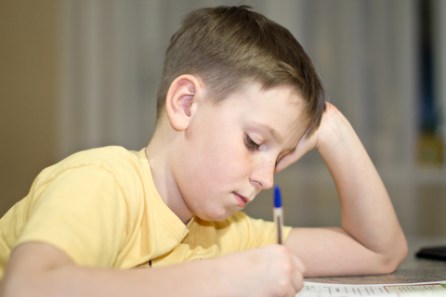
Some children will hold the pencil in a tripod grip but develop a hooked hand position or move the elbow too far up the table, causing the forearm and wrist to be nearly horizontal with the table edge, because they feel they can see what they are writing more clearly.


A hooked grip puts unnecessary strain on the hand ligaments and forces the body into a poor sitting position, again putting extra strain on the body. This in turn makes handwriting a tiring and uncomfortable task, impacting on a child’s overall learning experience.

It takes time to correct a poor hand position but it is well worth the perseverance as it will enable a child to write freely and more comfortably.

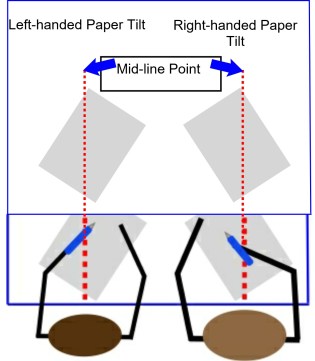
When writing normally, encourage children to angle the paper appropriately as this will also help to correct a poor hand position. With the correct paper tilt they will always be able to see what they are writing. If the paper is tilted at the correct angle for them, they will find a hooked hand position, or having their forearm further up the table, more difficult and uncomfortable to maintain.

Some children will find writing on a sloped desk helpful. Not all are comfortable writing or drawing on a flat surface and may benefit from the paper being positioned on an angled or sloped board. If you are not sure, instead of buying a specialist board, you could make one. Try using a ring binder or lever arch file stuffed with magazines and newspaper to make a sloped board. Tape the edges to stop the papers falling out or you could cover it in sticky back plastic to give a smoother finish to the board. The advantage of this is that you can make them to any angle of slope. Try a few to see which, if any, a child prefers. You may find that they only need the sloped board for a short while. It may also help to reduce the angle of the slope over time so that they gradually get used to moving from a sloped to horizontal writing plane.