Too much Pressure or not Enough – #Handwriting?

Some children may hold a pencil correctly but struggle to maintain and control the pressure required to handwrite.

Here are some additional tips to help support a child who is pressing down too hard with their pencil:

Focused games and activities can help develop both the physical strength and sensory perception areas.

  • Make sure that the pencil isn’t gripped too close to the tip of the pencil (check out the how to teach section for more information).
  • Play dough writing – flatten a large piece of play dough/clay on to a desk and using a pencil write or draw onto it. The idea is to create smooth lines, not torn ones, which pressing too hard will create. The advantage of this activity is it gives a child instant feedback about whether they are pressing too hard or not. When a good pressure has been found ask the child to try doing it with their eyes closed and talk through how their body feels when they are using the right amount of pressure.
  • Corrugated card – place some corrugated card under the writing paper – the aim is to try not to flatten the bumps in the card.
  • Tin foil writing board – wrap a piece of card in tin foil and place the paper on top, the aim is to not rip the foil when writing.
  • Carbon copies – use carbon paper to create an extra copy, start with two or three sheets of paper on top of the carbon paper then move to two and then one, so that your child starts developing an understanding of how much pressure is needed for a task and how that feels. Talk through with them how it feels as they need less pressure to create a copy.
  • Pattern work – look at and discuss light and dark line patterns and how to create them. Then using different writing tools ask the child to try and create their own. Talk through how it feels when they are making dark lines compared to faint/pale colour lines using the same pencil or crayon.

Here are some additional tips to help support a child who is Not pressing down hard enough with their pencil:

Focused games and activities can help develop the physical strength and sensory perception areas.

  • Crayon rubbings – when a good pressure has been found ask the child to try doing it with their eyes closed and talk through how their body feels when they are using the right amount of pressure.
  • Wax drawings – rub a wax crayon all over a piece of paper then turn it over on to a plain piece of paper. Draw on the back of the wax crayoned paper and when finished lift and see another copy of the picture. The greater the pressure the more complete the hidden picture will appear.
  • Carbon copies – use carbon paper to create an extra copy, start with one sheet of paper on top of the carbon paper then move to two so that the child starts to develop an understanding of how much pressure is needed for a task and how that feels.
  • Use a softer pencil such as a B6 or B4 and slowly change the pencils so that they work up to a HB. Each pencil change will mean they have to exert a little more pressure to create the same line mark. B marked pencils are softer than H.
  • Pattern work – look at and discuss light and dark line patterns and how to create them. Then using different writing tools ask the child to try and create their own. Talk through how it feels when they are making dark lines compared to faint/pale colour lines using the same pencil or crayon.

#Handwriting Letter & Word Spacing Issues

Some children find it difficult to space their letters in words correctly and to show spacing between words. There can be a number of reasons for this:

  1. They may not understand the concept or conventions of spacing words and letters and this needs to be explained.
  2. Other Physical Skills such as poor spatial awareness skills, eye tracking or general eyesight.
  3. Poor Key Strengths and/or Key Abilities elements, required for handwriting, such as sitting position, paper position, pencil grip, hand position and letter formation knowledge may also be hindering them.

 ‘Tips to support letter and word spacing’ will help you to identify if your child is having difficulty in understanding the spacing conventions and how to support them: https://teachhandwriting.co.uk/spacing-difficulties.html

Games and activity ideas to develop a child’s physical skills for handwriting: https://teachhandwriting.co.uk/handwriting-motor-skills.html

Letter and Join Formation Issues

Single Letter Formation

Some children will have poor letter formation skills because they have missed or just have not been taught how to form their letter correctly.

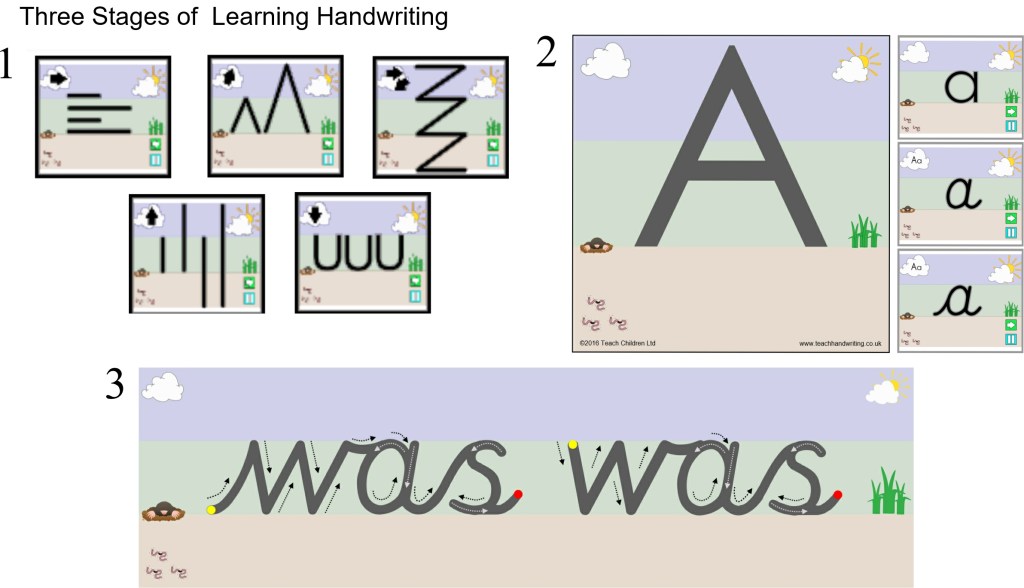
If your child is struggling with correctly forming their single letters, it can be a good idea to take a step back and check that they can form the pre-handwriting patterns. You might find that they are struggling with some of the line directional pushes and pulls that the patterns support in developing and are needed for forming letters – Parents: https://teachhandwriting.co.uk/parents.html Teachers: https://teachhandwriting.co.uk/pre-handwriting-patterns.html

It is surprising how often the pre-handwriting patterns stage in developing handwriting is skimmed over or just missed out completely.

Unfortunately, the pressure on school to focus on phonics and introducing handwriting as part of the scheme means that children who cannot draw or have experienced pre-handwriting patterns are being asked to form letters. I can’t work out the logic of this approach.

If you take a close look at your child’s lower-case single letter formation you may find that it particular letters that they struggle with.  What you may find is that these letters fall into certain letter family group. So, I would recommend working on the letter family in which the child has the most letter formation difficulties first.

If it is all the letter of the alphabet then I suggest teaching the letter families in the order shown on the website – Parents: https://teachhandwriting.co.uk/parents.html Teachers: https://teachhandwriting.co.uk/key-stage-1-handwriting-routes.html

We recommend focusing on developing a child’s lower-case single letter formation skills first as this about 95% of letter usage they need for writing and reading. Then introduce capital formation.

Why do some children struggle with letter reversal issues?

It is normal for young children to reverse letters and numbers when writing. This should stop by the time they are 6 /7 years old.

Older children can reverse their letters and numbers, when writing, for the following reasons:

  • They have poor visual and motor memory skills and so can’t remember how to form the letters correctly.
  • They have poor bilateral coordination skills.

Games and activities can help them overcome these issues: https://teachhandwriting.co.uk/games.html and https://teachhandwriting.co.uk/warm-ups.html

Teaching the letters in letter families can reduce letter reversal as the reinforcement of the pencil movements helps cement the letter shapes in the visual and motor memory.

We have grouped the letters together in families based on their shape and the directional pushes and pulls of the pencil needed to form them.

By teaching the letters in these families the letters that are most commonly reversed such as ‘b’ and ‘d’ are in different letter families as their start points and initial pushes or pulls of the pencil for them is different, so are reinforced, making it easier for your child to remember them.

Joining Issues

Some children struggle with learning to join because:

  • They may not be forming the single letters correctly. It is best to correct their single letter formation first before moving on to tackle any joining issues. You may find once they have corrected their single letter formation, many of the joining issues have rectified themselves.
  • Some children will find the join strokes a little tricky to start with, so try using the joins section in pre-handwriting patterns to help them learn the additional pencil strokes needed.
  • Some children may not remember which join strokes to use. So, teach the joins in groups, and build up their confidence by starting with the easiest joins – Parents: https://teachhandwriting.co.uk/parents.html Teachers: https://teachhandwriting.co.uk/key-stage-1-handwriting-routes.html
  • Begin by joining 2 or 3 letters together at a time rather than long lines of joins that go across the page. It is best to match the number of letters joining to a sensible word length.
  • Remind your child that the aim is not to take their pencil off the paper until the number of letters in a word has been completed, then they dot the i’s and j’s and cross the t’s and x’s.

Hand Swapping Issues?

Hand Swapping is a normal developmental stage in infants and young children and therefore, at this stage, not a sign that a child is uncertain of their dominant hand. However, this is not ideal for a child who has started school.

Hand swapping throughout a task is not necessarily a sign that a child is uncertain of their dominant hand.

There are two routes to tackling the hand swapping issue, the one to use depends on your answers to the following questions.

1. Does the child usually start with the one hand and then swap when that hand gets tired?

You can usually tell if this is the case because they may shake out or rub the tired hand and once it is rested go back to using it again. This is probably because their fine motor skills are weak. Through focused games and activities (https://teachhandwriting.co.uk/handwriting-muscles.html#hand and https://teachhandwriting.co.uk/warm-ups.html ), the muscle strength and dexterity can be gradually built up in the dominant hand, which in turn will build their stamina so that the hand swapping will reduce until they stop it altogether.

Once you are sure of dominance gently discourage swapping hands by taking a break from the activity and coming back to it a couple of minutes later using the preferred hand.

2. Does the child use their left hand if items are presented on their left-hand side and their right hand if they are presented on the right-hand side?

In toddlers and young children this is expected. In older children however it could mean that they have developed a delay in their skill to cross the mid-line point. This developmental bilateral coordination skill is vital to develop and can be addresses through a range of simple games and activities (https://teachhandwriting.co.uk/handwriting-muscles.html#bilat and https://teachhandwriting.co.uk/warm-ups.html ).