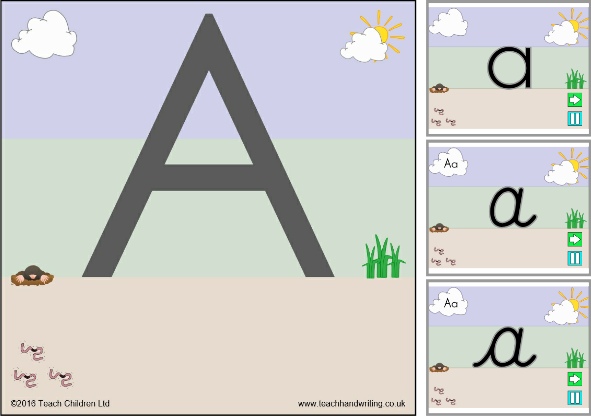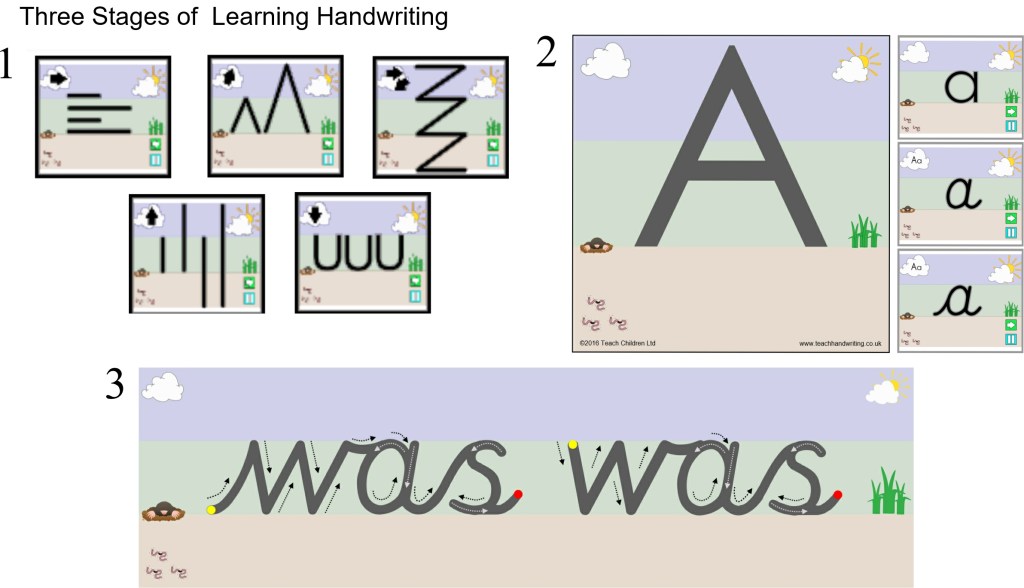
The Importance of Using Letter Names for Developing Handwriting, Phonics and Reading Skills

Here at Teach Children we have always promoted the importance and power of teaching the correct letter names to begin with; through our Teach Handwriting website, Schemes and Teach Phonics website. Unfortunately, some schools, teacher and parents still seem to be concerned that this is not consistent with the teaching of phonics, which is just not correct.

A myth which became popular, in the early years of introducing synthetic phonics into schools, is that children should not be taught the alphabet letter names as they find it too confusing. However, in recent years this has started to change as phonics schemes have adjusted some of their approaches to teaching phonics to include the use of letter names.

Learning the unique letter names of the alphabet is a pre-phonics skill; as well as an early learning goal. It has to be remembered that a letter is a shape which only represents a sound when it is placed within a word or sentence (has a context). Also, a letter or combination of letters can represent more than one sound and so the only unique way of identifying alphabet letters when we talk about them is to use their names.

It is important to remember that just because a child can correctly recite the ‘Alphabet’ song it does not mean they know the letters of the alphabet. It is surprising how many children can do this but when shown letters from the alphabet cannot name them at all. They may be able to tell you the sound the letter makes but have no idea of the letters name.

Learning the correct letter names helps to reinforce that when talking about the letter ‘a’ (ay) for example it has a set shape regardless of the sound that it will be representing in the word. This further supports children’s handwriting development as the communication of your requirements is unambiguous.

Teaching the correct letter names is important when supporting handwriting as this can in turn affect a child’s phonics understanding later on. For example, it can seem very easy when explaining to a child which letter to write when they ask which one is making a ‘kuh’ sound in a word such as cat to say a ‘curly kuh’. There is no such letter in the alphabet called ‘curly kuh’ it is the letter ‘c’ (cee). By adding the ‘kuh’ sound to the letter it reinforces incorrect phonics knowledge. The letter ‘c’ does not make a ‘kuh’ sound in words such as: city, circle, cycle and centre.

Some children will then only ever refer to the letter ‘c’ as ‘curly kuh’ and the letter ‘k’ as’ kicking kuh’. As I say these are not letter names of the alphabet and also devalue the power of phonics at the same time.

How can the education establishment get hot under the collar about not using the correct terminology in the teaching of English in schools such as: phonemes, graphemes, digraphs, modal verbs etc… yet still refer to the letter’s ‘c’ and ‘k’ as ‘curly or kicking kuh’!

Phonics is a powerful decoding and encoding tool. However, so is the alphabet letter naming system. Both need to working side by side to support our children, especially in those early years of their educational journey.

The English phonic system is very complex but this is why our language is so rich. Young children need to use letter names as an additional tool, as it takes many years for them to be introduced to the more complex phonics coding system.

Alphabet Name animation (scroll to the bottom of the page): https://www.teachphonics.co.uk/phonics-graphemes.html

How to get your child interested in drawing and colouring!

Not all children enjoy drawing and colouring and it can be difficult to encourage them. There are a number of reasons why some children seem reluctant to draw, paint or colour. For instance, some will not like the smell of the paint or crayons, while others may find the pencils, brushes or crayons too thin, long or heavy. Others may be reluctant due to past negative experiences. It can be tricky to work out exactly why a child doesn’t want to draw or write.

Here we have some tips and ideas that may help you to get started:

Paper Size– Some children like large pieces of paper to work on while others can be daunted by the prospect. Start off by having a range of paper sizes and colours for your child to choose from, this way you can find out which size of paper they prefer to work on.

Vertical surface – Having the paper pinned vertically on a drawing board or wall may also help encourage your child to have a go at drawing more than if the paper is laid flat on a table.

Drawing & Writing Tools – Have a range of pencil and crayon thicknesses, lengths and colours so that your child can choose the ones they feel most comfortable using. Try to make sure that the pencils are sharp enough to be used effectively as picking up and using a blunt pencil can be a negative experience which can turn a child off drawing or writing.

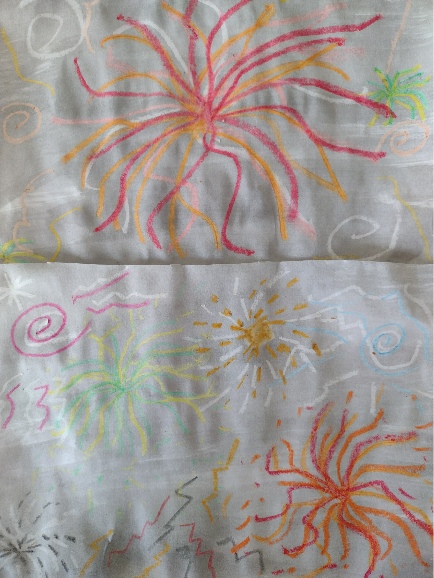
You could try using different drawing tools to start with such as chalks or special glass pens (which are great fun and designed to clean off easily).

Draw Together – Before you start drawing think about the kind of things that will interest your child, for instance drawing a train may be ideal for your little boy but not necessarily for your little girl. Use simple shapes to draw the objects so that over time your child will be able to copy so they too can draw successfully the train, cat or car. Practise by yourself so that when you are doing the drawing with your child it comes easily to you so that you can talk through what you are doing.

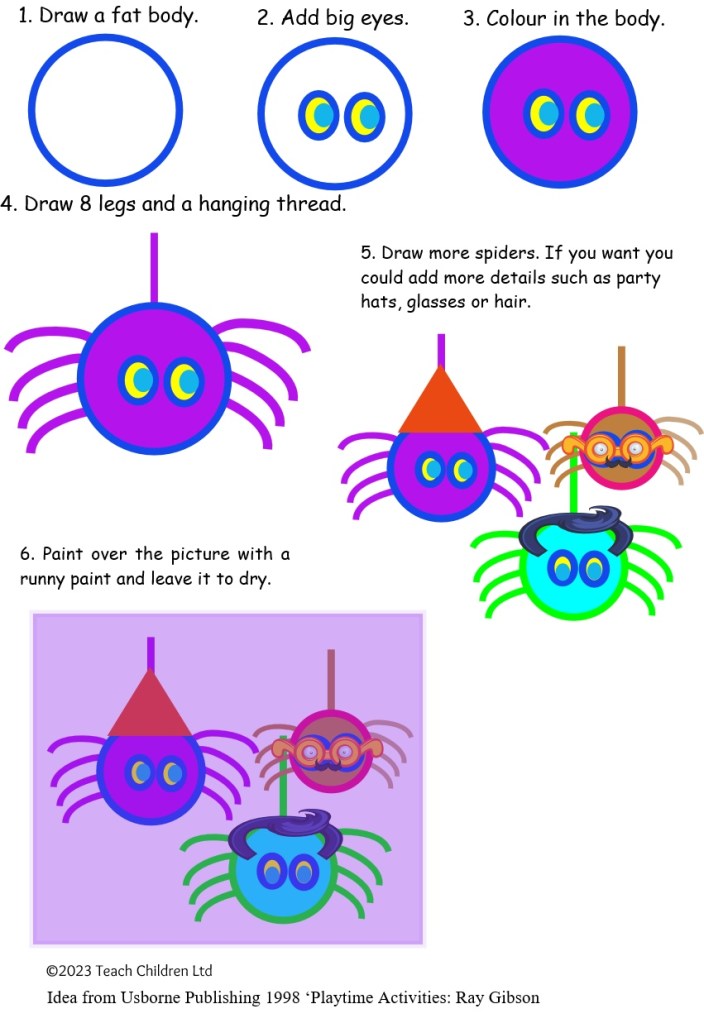
We have created some new drawings using simple shapes which you may find helps you to get started. Follow this link and scroll down the page a little you will find them under the ‘Activities to help hand development’:  https://teachhandwriting.co.uk/more-activities.html

Tips:

Pick a time and place where you can start to draw in the same room/area as your child is playing. Start off by just sitting and drawing without actively involving your child. It is surprising how often a child will come to checkout and ask you what you are doing. They may just stand and watch for a while and go back to playing, just carry on and complete the picture without them. Leave the picture for them to see, you could let them know you have drawn it for them and have a little chat about it.

It may take a few goes but hopefully you will find that your child will watch for longer, maybe even asking you to draw different things in the picture, use certain colours, or want to help you colour or draw things.

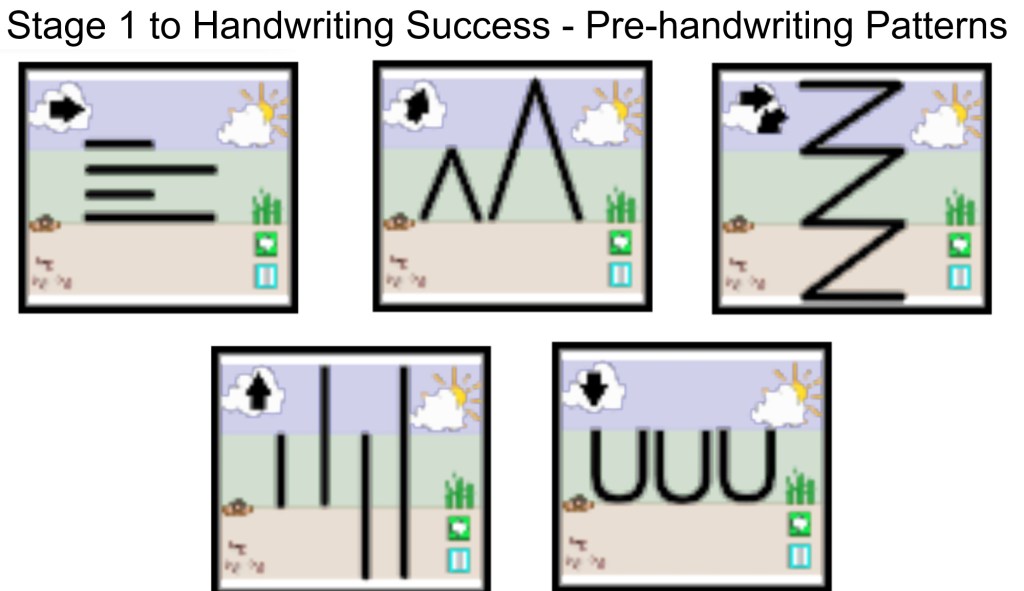
At this stage it can help to explain what you are doing, for instance, if you are drawing a straight line or a wavy line to make a shape or pattern.

Other language you may use:

Straight, short, long, diagonal, up towards …, down towards …, across, curvy, wavey, zig zag, squiggly, swirling, dots, dashes.

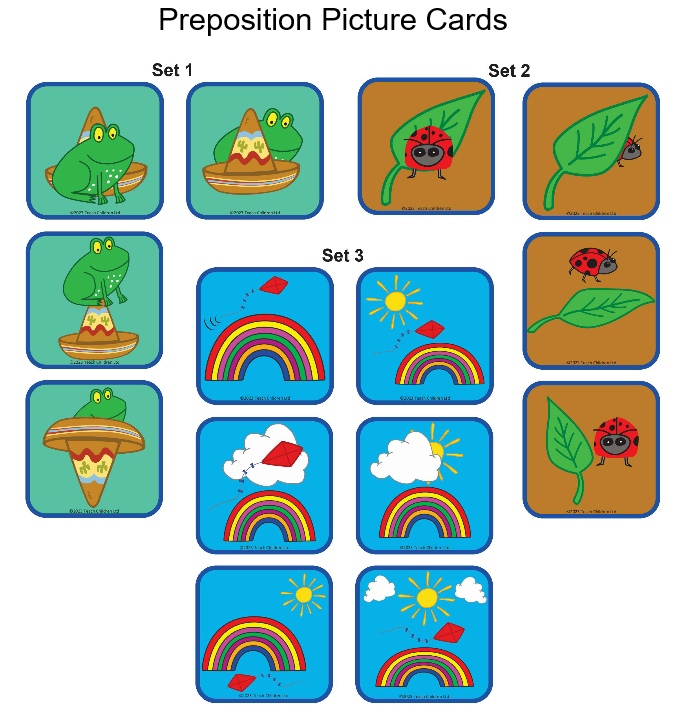
A couple of weeks ago we talked about placement (preposition) and directional vocabulary which would also be great to use and help your child to develop as part of drawing activities.

By sharing and showing your child how to draw shapes and make pictures it gives them a positive and successful drawing experience, which encourages and gives them confidence to have ago for themself.

Handwriting Begins with Mark Making & Simple Drawings

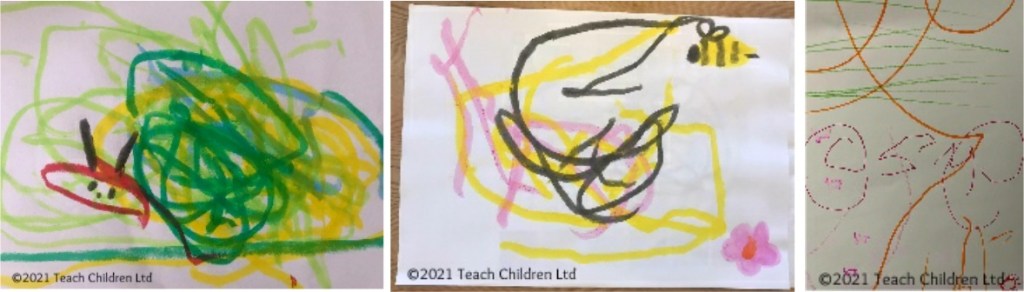
Young children’s first experience on the handwriting journey is through mark-making and simple drawings, whether it is with finger-paints, writing in sand or with pencils and crayons.

From about the age of 2, children start to move from a simple grasping (primitive) grip to one that secures the writing tool between the fingers and the thumb. In the early stages of mark-making and drawing young children will try different grips and holds, which is part of their normal development for handwriting and drawing.

As young children’s body (gross motor skills), hand strength and dexterity (fine motor skills) are developing they need a range of pencil, crayon and paint brush thicknesses. Young children need the thicker drawing tools as they can grip them more easily, helping them to mark-make. If the pencil is too thin, they find it difficult to grasp and have little control over it, making the drawing experience unsuccessful, which can lead to frustration and discourage them from trying again.

Due to the stage of their physical development young children use large movements to draw (from the shoulder rather than the wrist) which often creates larger shapes and lines.

During the early stages a vertical drawing and painting surface is important as it allows the child the freedom of movement to fully explore their mark-making potential. It also helps young children to develop the wrist strength and flexibility which they will need later to hold a pencil correctly for handwriting.

Using plain paper and surfaces is considered best for young children as they find it less restrictive. It has been widely acknowledged that a child who is forced to hold a writing tool using the dynamic tripod grip, before they are developmentally ready, can be turned off engaging in the drawing/writing process as well as developing a poor pencil grip later on. Remember some children do not develop the ability to use the dynamic tripod grip until the age of 5/6 years old.

As a child’s gross and fine motor skills develop so does their pencil grip and ability to draw and write at a small scale moving more from the elbow and wrist and progressing through the grip stages.

For more information on pencil grip development use this link: https://teachhandwriting.co.uk/grip-development.html

How to improve your child’s handwriting: School Reports – Handwriting Improvements Needed!

So, the school report has been received and you have been told that your child needs to improve their handwriting.

This is all well and good, but what exactly needs improving?

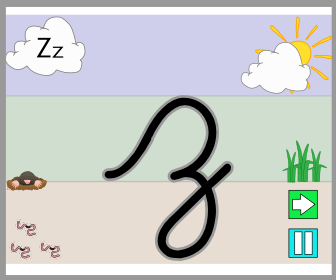
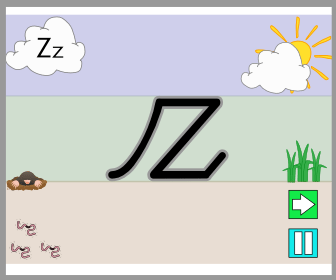
What are they finding difficult and how on earth do you write a continuous cursive z? 

So, you eventually get some handwriting practice sheets home or off the web. But no amount of time spent doing them seems to make much difference. It seemed to take longer to get them started than they spent practising handwriting. In fact they seemed worse because they were unhappy and frustrated with their own progress, so the more you try to push them the more resistant they become. Eventually you think there has to be a better way than this?

Doing more of what you are already struggling with is not always the answer. Handwriting is a complex skill to learn and there are a number of reasons why a child may be struggling.

There is a wealth of information in the Parent’s section of the https://teachhandwriting.co.uk/parents.html  website.

To begin with I would suggest looking at the following:

  • your child’s pencil grip
  • their sitting position
  • Their paper position and tilt.

Then I would look at letter formation skills, our free animations and worksheets may help. If you think your child needs something more structured then take a look at our Parents shop (https://teachhandwriting.co.uk/shop.html ).

It is important to check and know which letter formations are being taught in school and that this is what you teach at home. Otherwise, you will only be causing more frustration and stress for your child

Many children and some teenagers struggle with handwriting because, they just haven’t developed all the gross and fine motor required. For older students it often relates to weak/poor fine motor skills. In younger ones it maybe they have not had enough experience of certain physical activities which is affecting the level of their gross and fine motor skills development.

There are many games and activities that can support gross and fine motor skills development. A number can be found in our ‘Learning Through Play’ section and the ‘Warm ups’: https://teachhandwriting.co.uk/warm-ups.html ’ activities are suitable for teenagers as well.

The summer holidays are a great time for you to be able to observe and support your child’s gross and fine motor skills and strengths. Armed with this knowledge you can play games and do activities which then help them to develop the strengths and skills which may be holding them back and making handwriting a difficult task to master.

Transferring handwriting skills from worksheets to paper 

At Teach Children our aim is to move children off of worksheets as soon as possible. To achieve this, it is important to encourage them to transfer their skills to plain or lined paper whichever is most appropriate to their ability level. We realise that it is not always possible to buy paper with the appropriate line height in all cases, so would recommend creating your own on the computer.

  • Use a combination of worksheets and lined paper in each handwriting session with your child:
  • Use the colour worksheet, or a grey scale version, and complete one or two rows.
  • Then encourage the child to try the same patterns or letters on appropriately lined paper, again try one or two rows only.

Hopefully the worksheet will last over a couple of handwriting sessions and you and the child will see an improvement over the time. The sooner they learn to transfer their skills to paper the better.

We realise that printing off our worksheets and coloured lined paper can become costly so, to help reduce the costs:

  • Use a colour version of the appropriate worksheet initially and then try printing in grey scale. Children usually make the adjustment to grey scale well once they are used to how the picture clues and colours work.
  • You could also use the grey scale worksheets and colour the start of each row with the appropriate colour.

How Poor Eye Tracking and Spatial Awareness Skills Impact on #Handwriting!

Eye tracking and/or spatial awareness difficulties can have a dramatic effect on a child’s handwriting ability.  Weak skills in these key areas make it difficult for children to form letters correctly (curves and lines often not joining to complete the letter shape), as well as being unable to appropriately space letters in words and words in sentences. Other poor presentation skills include being unable to write on lines and often missing lines out when following on with a sentence.

It is also worth pointing out that a child with poor eye tracking and/or spatial awareness skills will also find reading difficult.

Eye tracking is the ability to control and coordinate the fine eye movements needed:

  • For left to right eye movements, without moving the head, needed to follow a line of writing as the letters are formed or for reading a line of print.
  • To focus and move the eyes to follow an object without moving the head, in all directions.
  • To track/follow objects near and far.
  • To focus on one object without moving the eyes.

Poor eye tracking skills can make handwriting very difficult, causing letter formation, spacing and positioning problems, leading to poor presentation. Often words are missed out or repeated, causing composition and legibility issues.

Activities that help to build these strengths and skills are: Swing Ball, target games and catching games.

Game idea: Goal post skittles

You need: Posts/marker, large plastic drink bottles/skittles and a range of ball sizes.

How to do it:

Place the posts about 2 metres away from the start position and about half a metre apart. Place the skittles about half a metre behind the posts but directly between them. The child starts by rolling a large ball through the posts to knock the skittles over. Before they roll the ball explain to get a maximum score, they need to knock all the skittles over in one roll and that the best way to do this is to look directly ahead through the posts at the skittles, NOT at the ball or their hand.

It may take a little practise, as they improve, they can use a different size ball or move the skittles so that they form different patterns which means they have to be more accurate with the roll.

This game can also be used as a foot and eye activity, the same rules apply, they must look to where they want the ball to end up not at their feet or the ball, tricky!

Spatial awareness is the ability to be aware of:

  • The space around you and your position in that space.
  • The position and relationship of other objects in relation to one another and yourself.

Poor spatial awareness skills make handwriting difficult as it affects the ability to understand and produce the directional pushes and pulls required to form letters; as well as difficulties with spacing and positioning. Combined, these difficulties can cause poor presentation and possible legibility issues.

Activities that help to build these strengths and skills are: games such as ‘Twister’ or ‘Simon Says’ and jigsaws and pattern making.

Games idea: Pattern making

You need: Beads, building blocks, Lego or shapes.

How to do it:

Talk through the process of making the same pattern as shown on a card or already produced; for instance, the red square goes on the right of the blue square and the yellow square is below the blue square. Ask the child to verbalise what they see and are doing to recreate the pattern.

Patterns can be created and copied with all sorts of items – beads, building blocks, Lego and shapes.

As skill levels improve tessellation (a pattern of shapes that fit perfectly together) activities and square or patterned paper for colouring and creating their own pattern designs are enjoyable.

What is an efficient pencil grip?

“A pencil hold that provides speed, legibility is comfortable and will not cause harm to the joints of the hand over time. If a hold satisfies these criteria there is no need to change it”

(Benrow 2002, cited: Foundation of Paediatric Practice for the Occupational Therapy Assistant, 2005)

The above publication, and those listed at the end of the articles, explain that there are three efficient pencil grips for handwriting:

1. The Dynamic Tripod Grip is still the most appropriate grip for handwriting (we looked at this last week using our ‘Drawbridge Flip’ method), for those with good fine motor skills, as it allows the fingers to move freely; so, the writer can form the letters more smoothly.

2. The Quadrupod Grip, this grip is a little more restrictive because the fingers cannot move as freely as they would if using the Tripod grip.

3. The Adaptive Tripod Grip, developed by the Belgian Neurologist Callewaert in 1963 (cited, Ann-Sofie Selin 2003) is a functional though not conventional grip for handwriting. This grip is often more appropriate to use with children who have low muscle tone or hyper mobility of the finger joints. It can also benefit older children who continue to hold a pencil too tightly, or who hold the pencil lightly using just their fingertips (often writing using whole arm movements), as well as those children who hold a pencil with their thumb wrapped around and across the pencil and index finger.

Bibliography

Ann-Sofie Selin, 2003: Pencil Grip A Descriptive Model and Four Empirical Studies; Abo Akademi University Press

A Wagenteld, J Kaldenberg (co-editors), 2005: Foundation of Paediatric Practice for the Occupational Therapy Assistant; Pub: Slack Incorporated, ISBN-10:1-55642-629-1

Web-sites:

https://www.ot-mom-learning-activities.com/correct-pencil-grasp.html

https://www.otplan.com/articles/pencil-grasp-patterns.aspx

https://www.pediastaff.com/resources-pencil-grasp-patterns–may-2009

The Five Stages of Pencil Grip Development

The Five Stages of Pencil Grip Development

There are 5 developmental stages, that a child needs to go through, before they can successfully use a mature tripod grip. They need to work through each stage and as their hand, shoulder and arm strength and mobility increases so does their ability to move to the next developmental stage of the grip. Children develop through these grip stages over time with new experiences using different tools and drawing/writing mediums especially in the early years (0 to 4 years old).

You will find that young children will move between, or have slightly different versions of, the grips depending on the task or the effect they are trying to achieve. This is exactly what we want to happen.

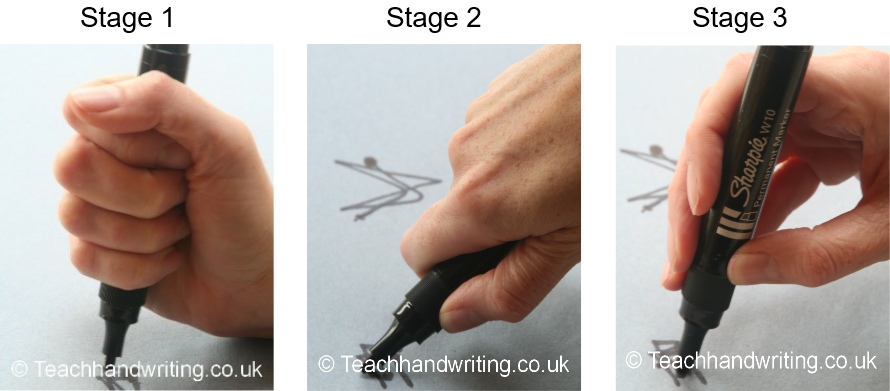
Stage 1. Palmer-supinate grasp

Holds the crayon/pencil in fist (whole hand) like a dagger. They use whole arm movements from the shoulder to mark-make. Due to this whole arm movement they prefer to work on a vertical surface.

Stage 2. Palmer or digital-pronate grasp

Holds a crayon/pencil with the palm of the hand facing down towards the paper. The crayon/pencil is held by all finger and the thumb. The movement comes from the shoulder and elbow. Again, due to the way the arm moves a vertical surface is preferred.

Stage 3. Four finger and thumb grip

Holds the crayon/pencil between the thumb and four fingers with the crayon/pencil nearly vertical up right position. Movement comes from the elbow and wrist.

Stage 4. Static Quadruped or tripod grip

Holds the pencil in very nearly in the correct position however the web space is narrower than it would be if held in a mature tripod grip. This means that the movement is coming from the wrist and large finger movements.

Stage 5. Mature/Dynamic tripod grip

This is traditionally considered the most appropriate pencil grip for handwriting. Holding the pencil between the thumb and index finger with pencil supported on the middle finger. The ring and little fingers are gently curled inwards. This give an open wide web space which means the movement comes from the fingers. For more information on the five stages of pencil grip development click on the following link: https://teachhandwriting.co.uk/pencil-grip-development-foundation-stage.html

Case Studies

For example, young Billy here is using a variation of a stage 1 – 3 throughout these colouring activities:

In this example it might look as if Billy has gone backwards in his grip development but he has not, he has learnt that the grip he is using offers him greater control:

Young William here is using different variations of stages 2 and 3 for gluing and painting activities:

Esme and Issy have both moved to stage 4 although for some activities such as drawing/painting they may use a different grip, but that is what we would expect to see.

Treasure or Easter Egg Hunts Develop both Handwriting & Language Skills

The Easter Holidays have started, so here are some fun activities to keep children of all ages entertained whether we have rain or sunshine.

An Easter egg, or treasure, hunt is a great way to teach children directional language. Being able to understand directional and placement (prepositions) vocabulary is important for understanding everyday instructions such as ‘put your cup on the table’; ‘go along the hall and stop at the door in front of you’.

We also use this directional language to explain how to draw patterns and write letters, which is another reason why it is important for young children to be introduced to, and have a good understanding of, this kind of vocabulary.

Through Easter egg, or treasure, hunts you can introduce new directional and placement language in a fun and exciting way. There are a number of different ways to approach this:

  • You can give verbal instructions to the hidden egg/treasure.
  • You could create a map for them to follow and ask them to talk you through the map, supporting them with new language as necessary.
  • You could use a mixture of verbal and map clues.
  • For older children get them to hide the egg/treasure and give you instructions, or draw a map.
  • If you have more than one egg/treasure and they are of different sizes make the larger ones more difficult to find.

The important thing is the language shared. Words and phrases to use are: left, right, straight on, forward, backwards, about turn, turn around, up, down, higher, lower, stop, next to, in front, beside, underneath, on top of, behind, on the left of, on the right of, outside, and inside.

Easter egg, or treasure, hunts are a great whole family activity and you are never too young or too old to join in!

Spring/Easter Drawing Activity Ideas – Supporting Language & Pre-handwriting Pattern Development

Easter holiday break starts next week!

So, we have put together some quick step by step Easter drawing ideas for you to try, using basic shapes such as circles, rectangles and triangles. It is amazing how, by using these simple shapes, you and your child can create fantastic Spring/Easter: cards, pictures mobiles or bunting: https://teachhandwriting.co.uk/more-activities.html

Drawing pictures is a great way to help your child develop their pre-handwriting strokes and shape forming skills. As well as supporting language development by sharing and using words and phrases as you draw, colour, paint or stick with your child. Here are some suggestions for you: next to, above, underneath, on top of, on the left of, on the right of, different colour names, different shape names and line style such as straight, curved, wiggly, thick, thin, short or long.

Have fun!