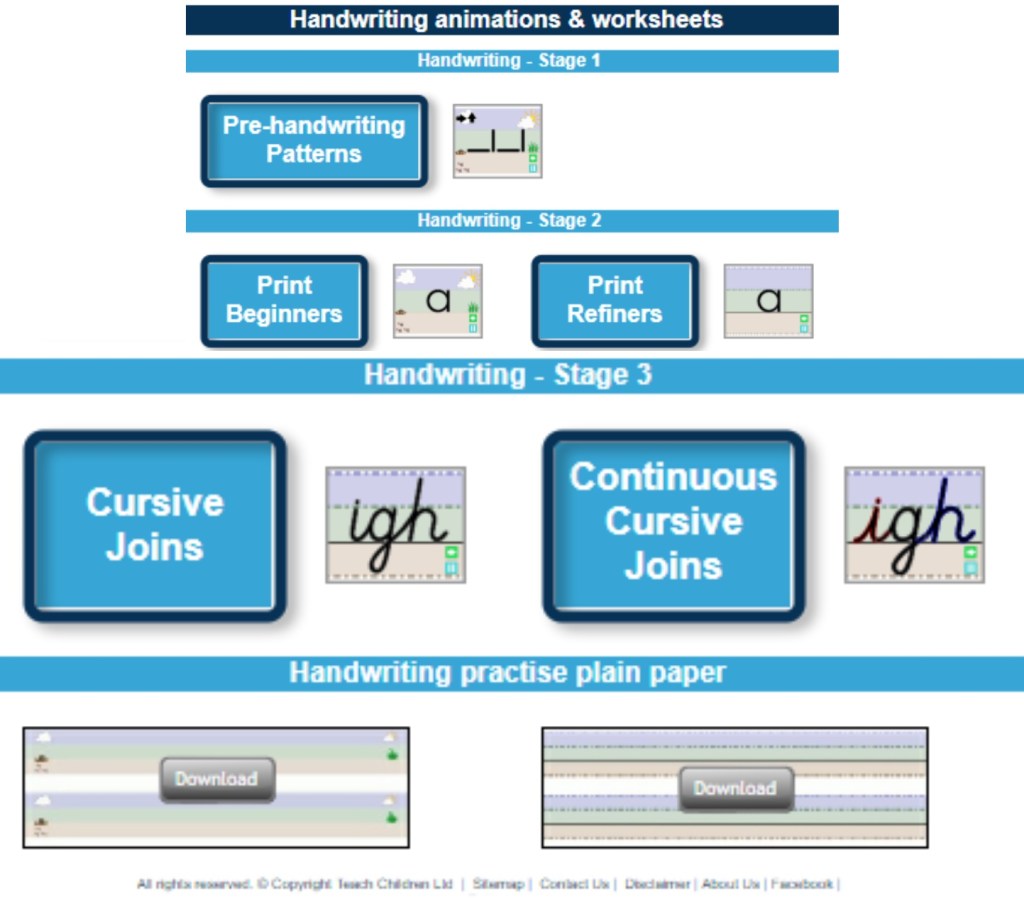
Here at Teach Children we recommend teaching letter formation in family groups rather than in alphabetical order.
The letters of the alphabet have been sorted by shape, start points, directional push and pulls of the pencil and finish point to create the different family groups. It makes it easier for children to develop and remember the correct letter formation, this is because they do not have to constantly remember a whole range of start points or directional movement at one time. For instance, the letter c has the same start point and anti-clockwise directional movement shape that is needed to create the letters a, d, g, o and, although a little more complicated, the letters s and e,
Teaching letters in groups or families can also help to limit letter reversals such as b and d.
Also, by teaching letter groups in the order shown on the website children are able to write whole words, which have meaning to them, and this in turn encourages them to write more.
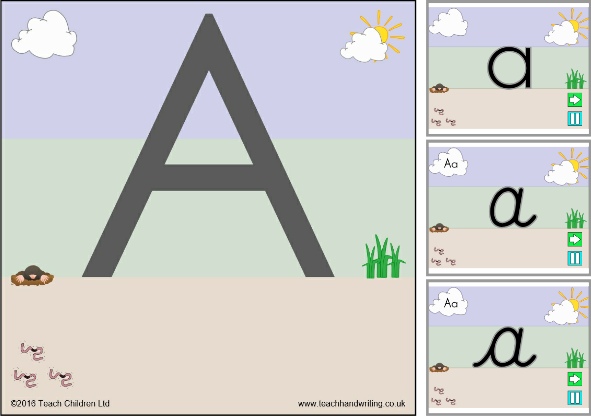
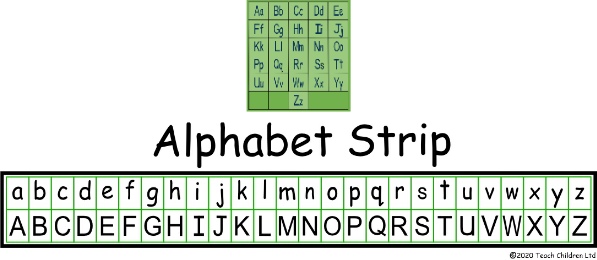
Click here to see our free Letter Family animations and supporting worksheets: http://bit.ly/2F9P7cI
It can often be assumed children will pick up how to write letters if they see them often enough (by osmosis). This is just not the case. Correct letter formation has to be taught. Seeing a completed letter or word or watching it being typed up and appear on a screen does not show children how to form the letters.
For children to develop a good handwriting style it is important to learn how to form letters correctly to begin with as this makes the transition from single letter formation to joined letter handwriting much easier. This enables them to develop a speedy, fluid and legible handwriting style.
Letters are created through joining lines and curve shapes in a particular way. They have a designated start point and set directional pushes and pulls of the pencil to reach the designated finish point. This is why at Teach Handwriting we teach letter formation in groups/families rather than in alphabetical order. Certain groups use the same, or similar, shape and directional push and pulls of the pencil to form the letter, for instance the letter c has the same start point and anti-clockwise directional movement shape that is needed to create the letters a, d, g, o and, though a little more complicated, the letters s and e. Teaching letters in groups and families can also help to limit letter reversals such as b and d.
Due to how handwriting has or hasn’t been taught over the generations we all have our own way of handwriting. When supporting and teaching young children we need to develop a consistent approach so that they do not get confused or frustrated by adults giving them conflicting information.
For parents this means finding out from your child’s school which letter font they are teaching so that you can support them more effectively at home. This may mean that you have to learn a new way of writing some letters. This also applies to teachers and teaching assistants. As the adults in the situation we have to accept that it is for us to make the changes. Just because something is different from the way we were taught, or do it, doesn’t mean it is wrong, it is just different!
Our free letter animations are not just to support children with their learning but also to provide parents and teachers (all adults really) with the knowledge and support to help children develop a consistent handwriting style.
Last week we explained that pre-handwriting patterns are the first stage of learning to handwrite. Once a child has mastered theses, they are ready to start learning how to form letters.
But where do you start?
Our view is to focus on lower-case letters first and only the capital letters for the first letter in a child’s, examples: Peter Rabbit, Sally Green, George Blue or Mary Shell.
Why?
One reason is that about 95% of what children write, and are exposed to, is in a lower-case form and only 5% in capital.
Lower-case letters are far less complicated, requiring fewer pencil lifts to complete the letters.
As both lower-case and capital letters require a child to form curved lines, a skill which most children have to practise, writing lower-case letters is no more difficult than writing capitals.
In a young child’s writing all the letters are initially the same size, whether they are capitals or lower case; it is part of the normal developmental path of handwriting. So, the view that teaching capitals letters is easier because they are bigger is not true.
Young children who have learnt mostly capital letters first find it difficult to stop, as it is so ingrained into the memory, often using them half way through words and sentences. Even when they are older this inappropriate use of capitals creeps back into their work especially if they are tired or concentrating hard on composing their work.
A child’s first major achievement, in their eyes, is to write their name. So, although concentrating on lower-case letters, teach them how to form the capital letter for the first letters of their name to get them excited about handwriting.
As they master the lower-case letters introduce the remainder of the capital letters. It is important that both are taught so that a child can develop a speedy, fluid and legible handwriting style.
On our Teach Handwriting website and Scheme, as well as on our Teach Phonics website, children are taught the letter names to begin with. Some schools, teacher and parents still seem to be concerned that this is not consistent with the teaching of phonics.
A myth which seems to have become popular, since the introduction of phonics into schools, is that children should not be taught the alphabet letter names as they find it too confusing. However, there is no evidence to suggest this is true. The Independent review of the teaching of early reading, final report, Jim Rose March 2006 states:
“The teaching of letter names is often left until after the sounds of the letters have been learned, in the belief that it can be confusing for children to have to learn both together. However, research indicates that children often learn letter names earlier than they learn letter sounds and that five year olds who know more letter names also know more letter sounds. The reasons for this are not fully understood by researchers’.
Given that children will meet many instances outside, as well as within, their settings and schools where letter names are used, it makes sense to teach them within the programme of early phonic work.
It appears that the distinction between a letter name and a letter sound is easily understood by the majority of children.” (Page 26)
Rose, cites Professor Morag Stuart who suggests that:
‘…children expect things to have names and are accustomed to rapidly acquiring the names of things.’ (Independent review of the teaching of early reading’ final report, Jim Rose March 2006, page 27.)
Learning the unique letter names of the alphabet is a pre-phonics skill; as well as an early learning goal. It has to be remembered that a letter is a shape which only represents a sound when it is placed within a word or sentence. Also a letter or combination of letters can represent more than one sound and so the only unique way of identifying alphabet letters when we talk about them is to use their names.
Learning the correct letter names helps to reinforce that when talking about the letter ‘a’ (ay) for example it has a set shape regardless of the sound that it will be representing in the word. This further supports children’s handwriting development as the communication of your requirements is unambiguous.
One of the first things we like a child to be able to write correctly is their name, however most names are impossible to spell using the simple phonics code taught to young children. A name does not have to be long in length to be phonetically difficult to spell such as Christopher or Charlotte. Shorter names such as Lucy or Liam also cause a problem.
The only logical answer I suggest is to use the letter names until a child has been introduced to the more complex phonics coding system.
Today you can check if your child knows how to write the letters and if they are writing them correctly. If you know your child cannot form the letters in the letter family then show them the letter animations and then let them have a go.
Tuesday & Wednesday – Specific letter practise days
Each day focuses on different sets of letters from the letter family.
Thursday & Friday – Letter practise days
On these days letters from the letter family being taught and some letters from letter families already introduced are practised.
There are also “Rainbow” worksheets where your child can share with others what they have learnt and achieved over the week as well as appropriately sized practise paper for them.
We hope you find these useful. If you have any questions about this 5 week handwriting program please feel free to contact us through the contact us page and we will do our best to help.
Curves to start (available until Sunday 10th May 2020).
Top exit
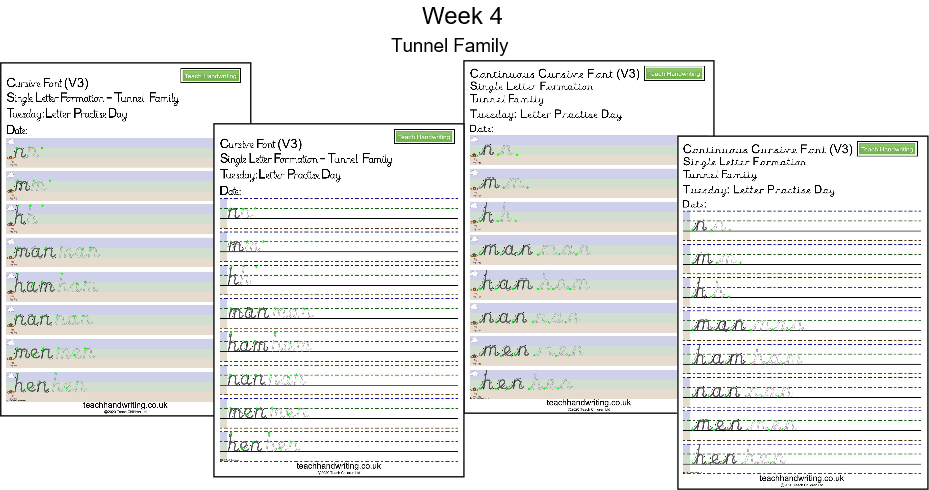
Tunnel
Hooks, loops and lines
There is a separate worksheet for each day:
Monday – Have a go worksheet
Today you can check if your child knows how to write the letters and if they are writing them correctly. If you know your child cannot form the letters in the letter family then show them the letter animations and then let them have a go.
Tuesday & Wednesday – Specific letter practise days
Each day focuses on different sets of letters from the letter family.
Thursday & Friday – Letter practise days
On these days letters from the letter family being taught and some letters from letter families already introduced are practised.
There are also “Rainbow” worksheets where your child can share with others what they have learnt and achieved over the week as well as appropriately sized practise paper for them.
We hope you find these useful. If you have any questions about this 5 week handwriting program please feel free to contact us through the contact us page and we will do our best to help.
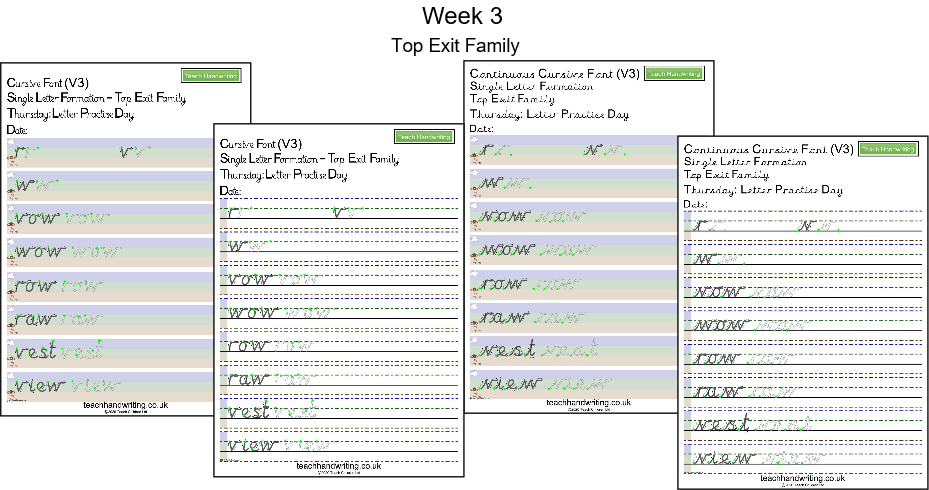
The third week of our handwriting program is ready for you to download. Today it introduces the ‘Top Exit Letters’ and revisits letters from the letter families already taught in week 1 – ‘Straight lines family’ and Week 2 – ‘Curves to start family’.
The free weekly set of worksheets can be downloaded, printed off and used alongside our letter formation animations.
Click on this link and it will take you to correct page of our website:
Straight lines (available until Sunday 3rd May 2020).
Curves to start
Top exit
Tunnel
Hooks, loops and lines
There is a separate worksheet for each day:
Monday – Have a go worksheet
Today you can check if your child knows how to write the letters and if they are writing them correctly. If you know your child cannot form the letters in the letter family then show them the letter animations and then let them have a go.
Tuesday & Wednesday – Specific letter practise days
Each day focuses on different sets of letters from the letter family.
Thursday & Friday – Letter practise days
On these days letters from the letter family being taught and some letters from letter families already introduced are practised.
There are also “Rainbow” worksheets where your child can share with others what they have learnt and achieved over the week as well as appropriately sized practise paper for them.
We hope you find these useful. If you have any questions about this 5 week handwriting program please feel free to contact us through the contact us page and we will do our best to help.
We posted the first week of our 5 Week Handwriting Lesson Program on 19th April 2020 which introduced the ‘straight lines family’. It is free 5 week, easy to use, handwriting program for you.
The second week of this handwriting program will be ready for you to download on Friday 24/04/20 and introduces the ‘curves to start family’.
The free weekly set of worksheets can be downloaded, printed off and used alongside our letter formation animations.
Click on this link and it will take you to correct page of our website:
Today you can check if your child knows how to write the letters and if they are writing them correctly. If you know your child cannot form the letters in the letter family then show them the letter animations and then let them have a go.
Tuesday & Wednesday – Specific letter practise days
Each day focuses on different sets of letters from the letter family.
Thursday & Friday – Letter practise days
On these days letters from the letter family being taught and some letters from letter families already introduced are practised.
There are also “Rainbow” worksheets where your child can share with others what they have learnt and achieved over the week as well as appropriately sized practise paper for them.
We hope you find these useful. If you have any questions about this 5 week handwriting program please feel free to contact us through the contact us page and we will do our best to help.
Due to the unusual times we find ourselves in, we have created an easy to use free 5 weeks handwriting program for you.
Starting from Monday 20th April 2020 and over the next 5 weeks we will provide you with a free weekly set of worksheets which can be downloaded, printed off and used alongside our letter formation animations.
Click on this link and it will take you to correct page of our website:
We would recommend teaching joins in join type groups, whether your child has learnt cursive or continuous cursive single letter fonts.
Teaching the join types in their groups helps a child to understand the directional pushes and pulls required to successfully join the different letter combinations.
There are 4 main groups of letter joins; bottom joins, bottom to “c” shape joins, “e” joins (top and bottom join strokes) and top joins.
Moving from Cursive Single Letters to Joining
There are seven join strokes to be taught. Most children will find the bottom joins the easiest to achieve, as it only requires the extension of the exit stroke they already put on the letters. The bottom to “c” shape joins can be tricky at first but soon mastered. The joins that tend to cause the most confusion and difficulty are the “e” joiners and top exit joiners.
I would recommend teaching the bottom joins first, then the ‘e’ joins and finally the top exit letter joins.
Moving from Continuous Cursive Single Letters to Joining
There are three join strokes to be taught. The easiest is the bottom exit letters (the majority of the letters), all a child has to do is write the letters closer together without lifting their pencil off the paper. Only the top to “e” and top joiners need to be taught for continuous cursive, as the nature of the font style means that the lead-in and exit strokes needed to join the majority of letter combinations have already been taught.
I would recommend teaching the bottom joins first, then the top exit to ‘e’ join and finally the top exit letter joins.