Well, true to form, the half term holiday weather is a mixed bag, sunny one minute then pouring with rain the next!
So, here are a couple of ideas to help your child burn off some of that pent-up energy. Best of all you can class it as handwriting homework (working on gross and fine motor skills).
An indoor/outdoor circuit training course does not have to take up much space or be messy (but it might be a good idea if indoors to move ornaments a little further out of the way).
Simple activities can be fun if they are done for short periods of time and children do love a time challenge. Make each activity last anything from 30 seconds to 1 minute.
You could record how many they did in the time and see if they have improved when you try it again.
Why not try:
Hopping on one leg and then the other (balance & coordination)
Use the bottom step of the stairs for step ups (bilateral coordination)
Curl ups (Core strength)
With a cushion balanced on their head can they touch their toes without dropping the cushion (balance, coordination, bilateral coordination and core strength)
Star Jumps (balance & coordination)
It is amazing how much fun you can have just hopping, jumping, skipping and dancing on the spot.
If the weather is fine then set out a bike or skateboard track for racing. When out on a bike ride (if safe to do so) have mini time trials on the flat or up hills.
If you are feeling really brave why not try building an obstacle course, a lot of the fun is in the designing and making. It is amazing the communication and language skills required as well.
To help young children to store pattern and letter shape formations into their motor memory it is important that the tools used provide a resistance rather than one that flows effortlessly over the writing/drawing surface. The greater the resistance the more the body can neurologically acknowledge (feel) the movement and help to send appropriate information to the brain.
Some of the best surfaces/papers and tools for young children to begin learning to draw patterns, shapes and correctly write letters:
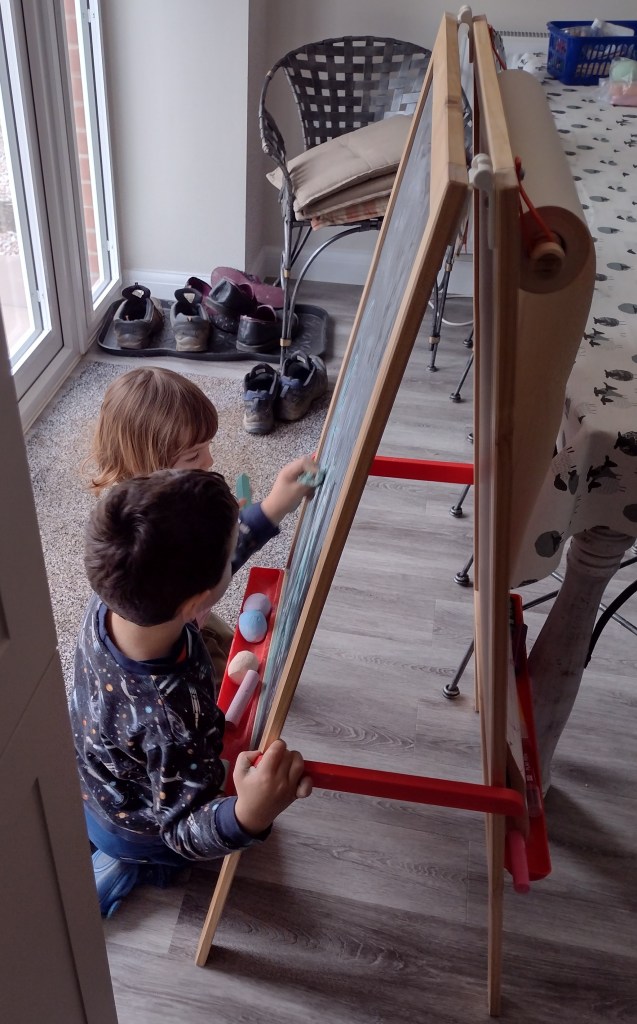
• Chalk on boards, walls or paths
• Flip chart pens or large felt tips on course paper such as sugar paper
• Using appropriately sized paint brushes on course paper (such as sand paper) or surfaces
• Finger painting or finger drawing in sand, paint or corn flour mix
• Finger tracing and then trying to draw the pattern, shape or letter straight afterwards.
• Try chalking the shape or letter onto a blackboard and have the child use a damp sponge to wipe it off again (make sure the child starts in the correct place and moves correctly around the shape or letter to the correct finish point).
• Appropriately sized crayons and pencils on course paper or card (non-shiny side of cereal boxes and corrugated card can be good fun and different to use).
Crayoning and printing activities are great ways for a child to experience and experiment with pressure and the amount needed to create different effects. These activities will also encourage and support a child in helping them to understand, and for you to model, the language associated with pressure and how the pressure used feels. By linking the words used to the feelings and the outcome of using the pressure they can start to understand what is needed when asked to press gently or to press harder.
When supporting a child to understand what we want when we ask them to press harder, we need to model how our body reacts to make this happen. You may need to exaggerate the actions but as you do this you also need to talk about what your body is doing and how it feels. Then point out the effect that this has had on the crayoning for instance.
When we press hard, we tend to lean our body forward over the table slightly as this allows us to put more force down on to the paper through the crayon. We may feel our arm and hand tense and often the movements made are slower and in small strokes. If it is something we are not used to doing it can make our hand and fingers ache and it will feel like hard work. The crayon marks will be thick and dark.
When we want to be gentler with the crayon, so that the crayoning is lighter in texture and colour, we tend to sit back away from the table. This way the hand moves across the paper more easily and often the strokes are longer and quicker, which sometimes feels as if we have less control over the colouring. This is why young children tend to be a bit heavy handed initially with colouring because their fine motor control skills have not reached a point that enables them to have control.
There are many creative ideas to be found on the internet and in books published by companies such as Usborne.
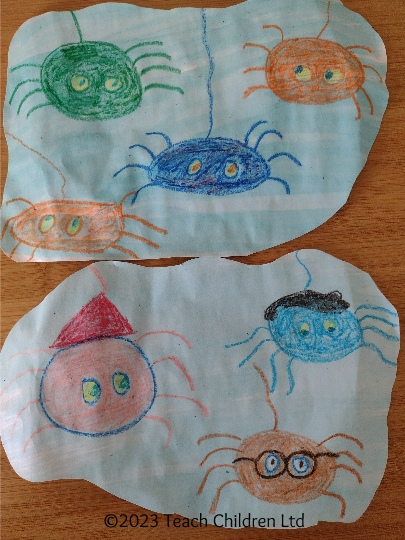
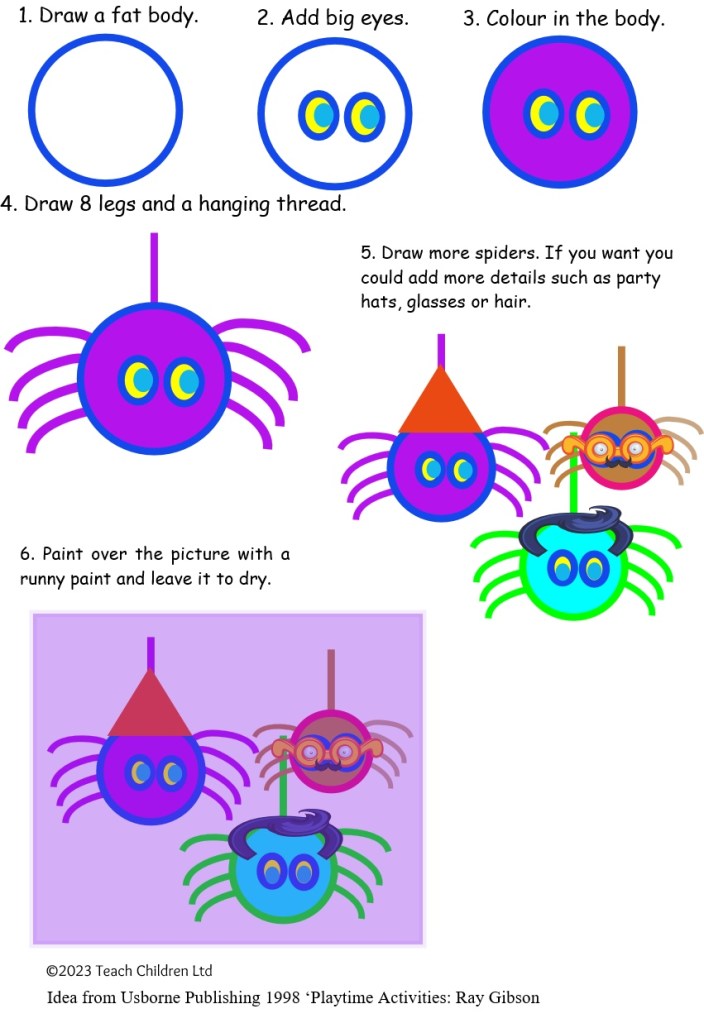
This crayon technique can be used to create a vast range of pictures. Here are just a couple of ideas to get you started:
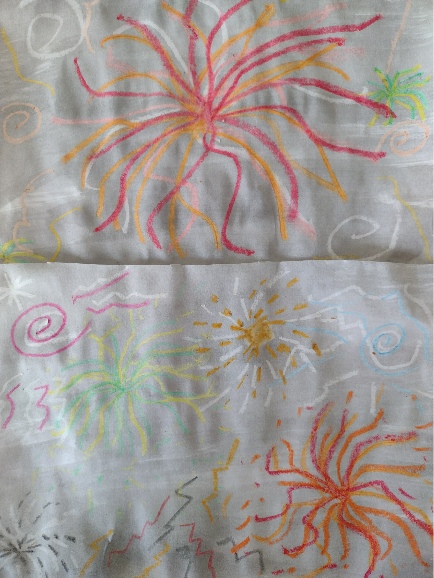
The same technique can also be used to create great firework pictures:
It is also worth remembering that drawing also helps to develop a range of different line formations, also needed for developing a good handwriting style.
The weather this Autumn has been unseasonably warm, making it easier to go out and explore our local green and wild spaces.
It is amazing how much quality time you can spend with children just looking, talking about and collecting different leaves. The amount of language shared and new vocabulary introduced is invaluable.
It is suitable for all age groups and you don’t need a vast knowledge of plants and trees to make this fun; just remember not to take whole plants or leaves from endangered or dangerous plants and watch out for thorny, spikey and prickly leaves (if you are not sure leave the plant alone). Make sure when collecting leaves, you do not trespass on to other people’s property, or pick from their gardens!
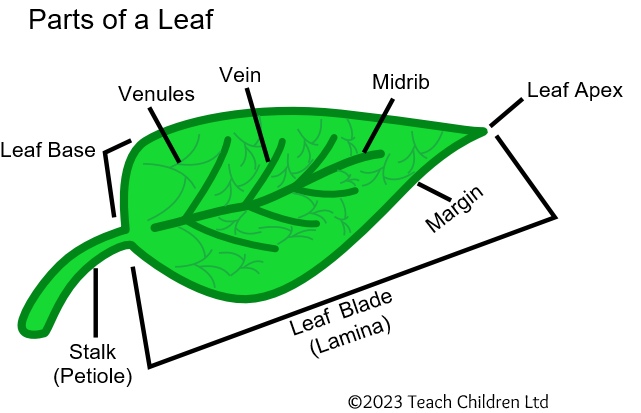
The aim is to look at and talk about the different shapes, sizes, textures, colours and parts of the leaves. There are so many new words you can share. It is important to make sure the words used, especially if new, are age appropriate and help develop the child’s understanding:
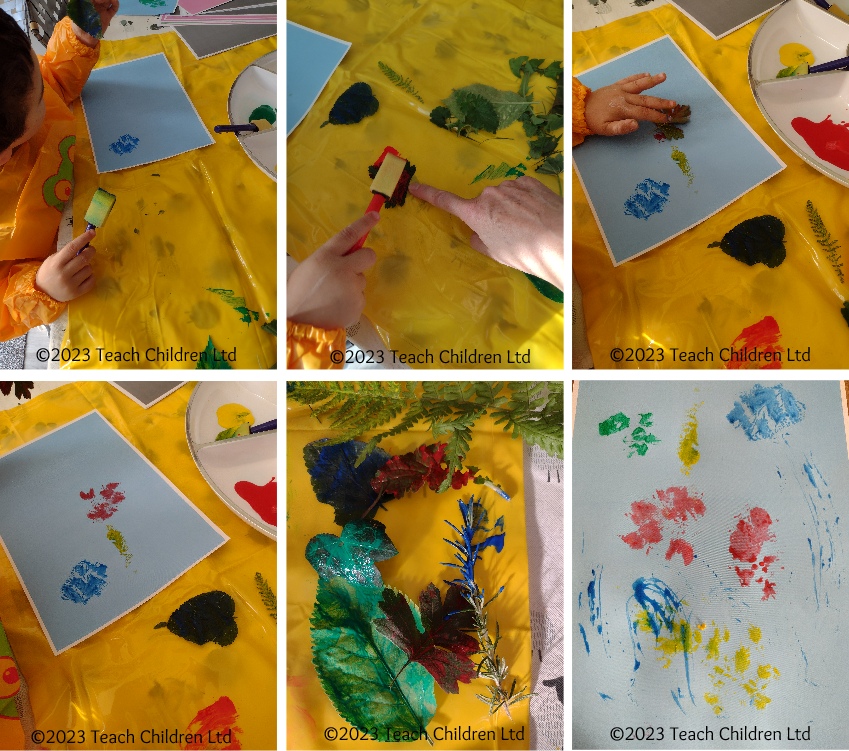
If you have been able to collect some leaves, they can be used to create lovely leaf print pictures and patterns.
The printing activity is a great way of helping children to understand, and for you to model, the language associated with pressure and to experience how the pressure used feels. By linking the words used to the feelings and the outcome of using the pressure they can start to understand what is needed when asked to press gently or harder.
Materials:
Paper, child safe poster paints, brushes or sponges, leaves collected from walk
Method.
Protect the surface being used for painting and aprons for the children
Put paint in to trays/tubs
It can help to tape the corners of the paper down before you start printing to stop the paper lifting when you lift the painted leaf off.
Paint one side of the leaf. This is when we can talk about how much paint (not too thick) and how gentle we need to be. If the leaf tears, due to too much pressure being used, we can support by explaining and helping the child to try again; with maybe a different painting tool or using their finger to give a great sense of feeling.
Then pick up the leaf by the stalk, or at one end, and place it paint side down on the paper
Encourage the child to gently tap the leaf down on the paper. Help them, if necessary, by demonstrating.
Then using the stalk, or from one end, gently peal the leaf off the paper.
The important thing to remember is to chat about what you are doing and have fun!
Not all children enjoy drawing and colouring and it can be difficult to encourage them. There are a number of reasons why some children seem reluctant to draw, paint or colour. For instance, some will not like the smell of the paint or crayons, while others may find the pencils, brushes or crayons too thin, long or heavy. Others may be reluctant due to past negative experiences. It can be tricky to work out exactly why a child doesn’t want to draw or write.
Here we have some tips and ideas that may help you to get started:
Paper Size– Some children like large pieces of paper to work on while others can be daunted by the prospect. Start off by having a range of paper sizes and colours for your child to choose from, this way you can find out which size of paper they prefer to work on.
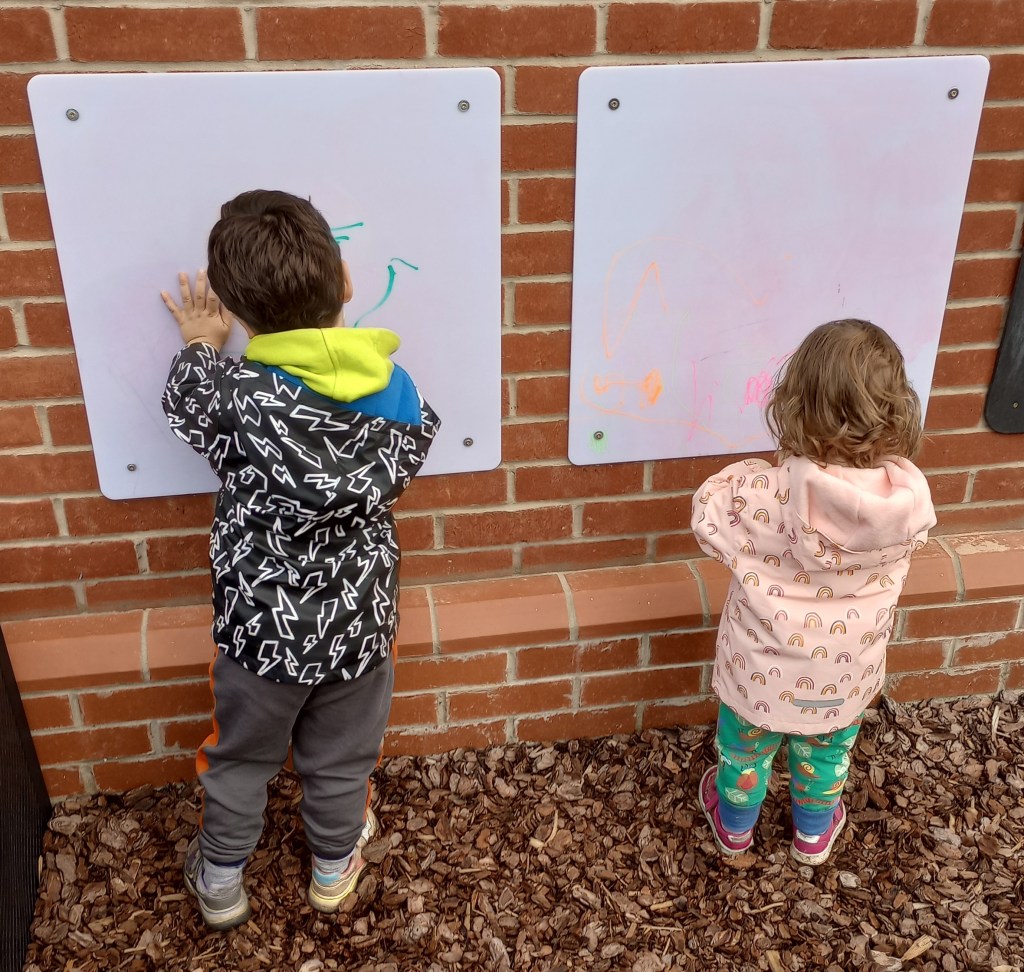
Vertical surface – Having the paper pinned vertically on a drawing board or wall may also help encourage your child to have a go at drawing more than if the paper is laid flat on a table.
Drawing & Writing Tools – Have a range of pencil and crayon thicknesses, lengths and colours so that your child can choose the ones they feel most comfortable using. Try to make sure that the pencils are sharp enough to be used effectively as picking up and using a blunt pencil can be a negative experience which can turn a child off drawing or writing.
You could try using different drawing tools to start with such as chalks or special glass pens (which are great fun and designed to clean off easily).
Draw Together – Before you start drawing think about the kind of things that will interest your child, for instance drawing a train may be ideal for your little boy but not necessarily for your little girl. Use simple shapes to draw the objects so that over time your child will be able to copy so they too can draw successfully the train, cat or car. Practise by yourself so that when you are doing the drawing with your child it comes easily to you so that you can talk through what you are doing.
We have created some new drawings using simple shapes which you may find helps you to get started. Follow this link and scroll down the page a little you will find them under the ‘Activities to help hand development’: https://teachhandwriting.co.uk/more-activities.html
Tips:
Pick a time and place where you can start to draw in the same room/area as your child is playing. Start off by just sitting and drawing without actively involving your child. It is surprising how often a child will come to checkout and ask you what you are doing. They may just stand and watch for a while and go back to playing, just carry on and complete the picture without them. Leave the picture for them to see, you could let them know you have drawn it for them and have a little chat about it.
It may take a few goes but hopefully you will find that your child will watch for longer, maybe even asking you to draw different things in the picture, use certain colours, or want to help you colour or draw things.
At this stage it can help to explain what you are doing, for instance, if you are drawing a straight line or a wavy line to make a shape or pattern.
Other language you may use:
Straight, short, long, diagonal, up towards …, down towards …, across, curvy, wavey, zig zag, squiggly, swirling, dots, dashes.
A couple of weeks ago we talked about placement (preposition) and directional vocabulary which would also be great to use and help your child to develop as part of drawing activities.
By sharing and showing your child how to draw shapes and make pictures it gives them a positive and successful drawing experience, which encourages and gives them confidence to have ago for themself.
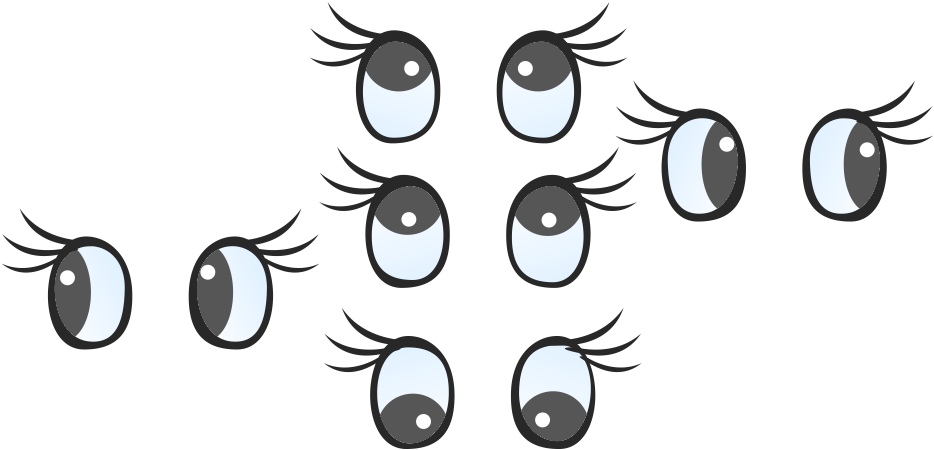
Eye tracking and/or spatial awareness difficulties can have a dramatic effect on a child’s handwriting ability. Weak skills in these key areas make it difficult for children to form letters correctly (curves and lines often not joining to complete the letter shape), as well as being unable to appropriately space letters in words and words in sentences. Other poor presentation skills include being unable to write on lines and often missing lines out when following on with a sentence.
It is also worth pointing out that a child with poor eye tracking and/or spatial awareness skills will also find reading difficult.
Eye tracking is the ability to control and coordinate the fine eye movements needed:
For left to right eye movements, without moving the head, needed to follow a line of writing as the letters are formed or for reading a line of print.
To focus and move the eyes to follow an object without moving the head, in all directions.
To track/follow objects near and far.
To focus on one object without moving the eyes.
Poor eye tracking skills can make handwriting very difficult, causing letter formation, spacing and positioning problems, leading to poor presentation. Often words are missed out or repeated, causing composition and legibility issues.
Activities that help to build these strengths and skills are: Swing Ball, target games and catching games.
Game idea: Goal post skittles
You need: Posts/marker, large plastic drink bottles/skittles and a range of ball sizes.
How to do it:
Place the posts about 2 metres away from the start position and about half a metre apart. Place the skittles about half a metre behind the posts but directly between them. The child starts by rolling a large ball through the posts to knock the skittles over. Before they roll the ball explain to get a maximum score, they need to knock all the skittles over in one roll and that the best way to do this is to look directly ahead through the posts at the skittles, NOT at the ball or their hand.
It may take a little practise, as they improve, they can use a different size ball or move the skittles so that they form different patterns which means they have to be more accurate with the roll.
This game can also be used as a foot and eye activity, the same rules apply, they must look to where they want the ball to end up not at their feet or the ball, tricky!
Spatial awareness is the ability to be aware of:
The space around you and your position in that space.
The position and relationship of other objects in relation to one another and yourself.
Poor spatial awareness skills make handwriting difficult as it affects the ability to understand and produce the directional pushes and pulls required to form letters; as well as difficulties with spacing and positioning. Combined, these difficulties can cause poor presentation and possible legibility issues.
Activities that help to build these strengths and skills are: games such as ‘Twister’ or ‘Simon Says’ and jigsaws and pattern making.
Games idea: Pattern making
You need: Beads, building blocks, Lego or shapes.
How to do it:
Talk through the process of making the same pattern as shown on a card or already produced; for instance, the red square goes on the right of the blue square and the yellow square is below the blue square. Ask the child to verbalise what they see and are doing to recreate the pattern.
Patterns can be created and copied with all sorts of items – beads, building blocks, Lego and shapes.
As skill levels improve tessellation (a pattern of shapes that fit perfectly together) activities and square or patterned paper for colouring and creating their own pattern designs are enjoyable.
These fun activities can be done indoors or outdoors, so whatever the weather throws at us this half-term you have got it covered.
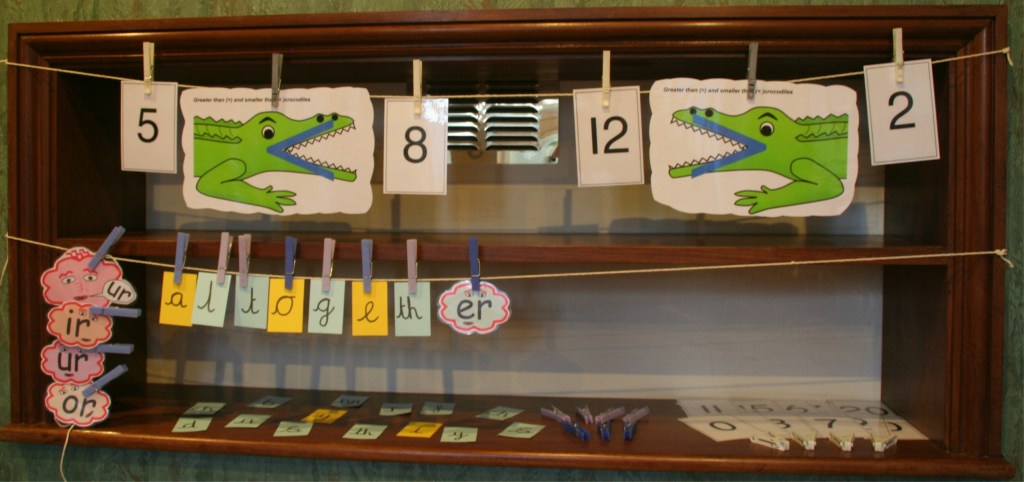
This is a very simple idea which children love because they can take greater ownership of it. The aim of the activity is to help build up hand and finger strength through using the pegs; however, it can have a dual purpose, helping to keep track of the week by using it as a timetable or for learning spellings or maths activities, as well as supporting the development of language skills.
You do not need anything fancy, just some string (for the washing line), clothes pegs and pieces of paper or card to peg onto the washing line. The washing line can be a permanent fixture or you can just pop it up when you need to use it.
The clothes line needs to be at a height suitable for your child to peg things on to (placed against a wall is a safe option so that no-one can walk into it by accident and hurt themselves).
There are a whole range of games that can be played using this simple washing line and pegs concept:
Memory games – Get your child to peg up 5 to 10 different pictures or items on the line. Then give them 1 minute to remember the items. Once the time is up ask them to look away, or close their eyes, and then you remove one or more of the items. Get them to look back at the line. Can they work out what is missing?
You could try just moving one or two of the items around. Can they figure out which ones are in the wrong place and put them back in their correct place?
Try swapping an item for something new, which your child did not hang up on the line. Can they work out which is the new item on the line?
Odd One Out – Hang pictures on the line that belong together. Can they pick out the odd item on the line and explain why it is the odd one out.
They could all be pictures of fruit with a picture of some clothing
They could be shapes with straight sides and one with curves
They could all be animals but all are wild with only one being domestic
Sorting – Ask your child to sort all the pictures or items from a selection and to hang all the identical things on the washing line. They could all be the same;
Colour
Shape
Type
Pattern Work – Using pictures, different colour and shaped paper or items create different patterns. The patterns can be based on colour, size or type of object. You can create a pattern sequence on the washing line and then ask your child to try and copy the sequence. Can they explain the pattern and create their own for you to copy and explain?
Pairing or What is the Same? – Hang a range of pictures or items on the line, making sure that some of the items can be paired together because they are exactly the same. They could match because;
They are exactly the same e.g., a pair of socks
Match numbers to a picture with the same number of items on
Match capital to lower-case letters
Or have items that can be put together because they are both from the same set, for example they are types of fruit or are the same colour.
Well, true to form, the Easter Holiday weather is a mixed bag, sunny one minute then pouring with rain the next!
So, here are a couple of ideas to help your child burn off some of that pent-up energy. Best of all you can class it as handwriting homework (working on gross and fine motor skills).
An indoor/outdoor circuit training course does not have to take up much space or be messy (but it might be a good idea if indoors to move ornaments a little further out of the way).
Simple activities can be fun if they are done for short periods of time and children do love a time challenge. Make each activity last anything from 30 seconds to 1 minute.
You could record how many they did in the time and see if they have improved when you try it again.
Why not try:
Hopping on one leg and then the other (balance & coordination)
Use the bottom step of the stairs for step ups (bilateral coordination)
Curl ups (core strength)
With a cushion balanced on their head can they touch their toes without dropping the cushion (balance, coordination, bilateral coordination and core strength)
If you are feeling really brave why not try building an obstacle course, a lot of the fun is in the designing and making. It is amazing the communication and language skills required as well.
The Easter Holidays have started, so here are some fun activities to keep children of all ages entertained whether we have rain or sunshine.
An Easter egg, or treasure, hunt is a great way to teach children directional language. Being able to understand directional and placement (prepositions) vocabulary is important for understanding everyday instructions such as ‘put your cup on the table’; ‘go along the hall and stop at the door in front of you’.
We also use this directional language to explain how to draw patterns and write letters, which is another reason why it is important for young children to be introduced to, and have a good understanding of, this kind of vocabulary.
Through Easter egg, or treasure, hunts you can introduce new directional and placement language in a fun and exciting way. There are a number of different ways to approach this:
You can give verbal instructions to the hidden egg/treasure.
You could create a map for them to follow and ask them to talk you through the map, supporting them with new language as necessary.
You could use a mixture of verbal and map clues.
For older children get them to hide the egg/treasure and give you instructions, or draw a map.
If you have more than one egg/treasure and they are of different sizes make the larger ones more difficult to find.
The important thing is the language shared. Words and phrases to use are: left, right, straight on, forward, backwards, about turn, turn around, up, down, higher, lower, stop, next to, in front, beside, underneath, on top of, behind, on the left of, on the right of, outside, and inside.
Easter egg, or treasure, hunts are a great whole family activity and you are never too young or too old to join in!
So, we have put together some quick step by step Easter drawing ideas for you to try, using basic shapes such as circles, rectangles and triangles. It is amazing how, by using these simple shapes, you and your child can create fantastic Spring/Easter: cards, pictures mobiles or bunting: https://teachhandwriting.co.uk/more-activities.html
Drawing pictures is a great way to help your child develop their pre-handwriting strokes and shape forming skills. As well as supporting language development by sharing and using words and phrases as you draw, colour, paint or stick with your child. Here are some suggestions for you: next to, above, underneath, on top of, on the left of, on the right of, different colour names, different shape names and line style such as straight, curved, wiggly, thick, thin, short or long.