School Reports – Handwriting Improvements Needed!

So, the school report has been received and you have been told that your child needs to improve their handwriting.

This is all well and good, but what exactly needs improving?

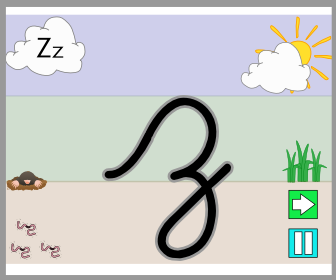
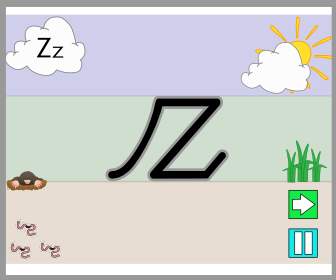
What are they finding difficult and how on earth do you write a continuous cursive z? 
So, you eventually get some handwriting practice sheets home or off the web. But no amount of time spent doing them seems to make much difference. It seemed to take longer to get them started than they spent practising handwriting. In fact they seemed worse because they were unhappy and frustrated with their own progress, so the more you try to push them the more resistant they become. Eventually you think there has to be a better way than this?

Doing more of what you are already struggling with is not always the answer. Handwriting is a complex skill to learn and there are a number of reasons why a child may be struggling.

There is a lot of information and free resources on our ‘Parent’ page which has been designed to help you: https://teachhandwriting.co.uk/parents.html

Try not to get over whelm, take things slowly and keep it simple.

Some things you might want to check and work on first before thinking about your child’s letter or join formation:

  • How are they sitting, is it a good position, it makes a difference;
  • Paper position and tilt can have a real impact especially if they are left-handed writers;
  • Are they using an efficient pencil grip for their age.

If your child is finding some or all of these elements difficult it might be that you need to work on their physical strength as well. Again, you will find information and games to help build this at the same time. And with the summer holidays coming up it is a great time for you to play games and do activities which then help them to develop the strengths and skills which may be holding them back and making handwriting a difficult task to master.

It is important to check and know which letter formations are being taught in school and that this is what you teach at home. Otherwise, you will only be causing more frustration and stress for your child.

Please note that if the letter formation being shown in the @Parent@ section is not the one being taught in school, check our @Teacher@ section of the website as you may find it there: https://teachhandwriting.co.uk/key-stage-1-handwriting-routes.html

Making it Easier to Copy from the Board

Copying accurately and quickly from a board at the front of a classroom can be a challenge at the best of times. For young children and those with specific learning difficulties it can be near on impossible. It is amazing how many children lose some, if not all, of a break time because they could not complete the copying task quickly enough in the lesson time.

The practise of taking information off the board has its uses and there are times when there is just no other alternative but it can be made more manageable, here are a few ideas which may help.

  • Make sure the child is sitting facing the board.
  • That they can see the board clearly.
  • That light is not reflecting off the board so that the writing disappears.
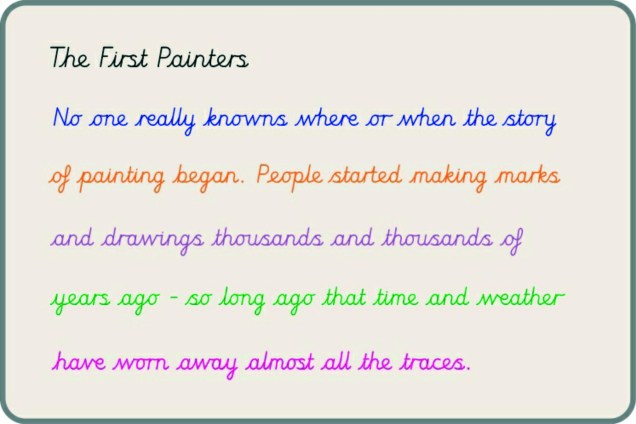
  • Try using a different colour marker pen for each line of writing (this way a child will be able to quickly locate the line they were copying from).
  • Or try numbering the lines so the child can more effectively find their way around the text.
  • Leave more of a gap between each line of writing so that each line is clearly visible from the back of the room.
  • Ask those children, who struggle copying, to start the first line of writing as you transfer the text to a smaller board which can then be placed at a more appropriate distance and level for them to continue copying from.
  • If you know the information that will need to be transferred to the child’s book then pre-prepare a text that can be given to the child to copy from. It may be in a different order or layout to that on the board; but it is the information and the child’s ability to access it, that is important.
  • Is a full sentence explanation always required or could the information be presented in another way such as a mind map or diagram which would be equally, or even more, useful to the child.

It can be surprising how frustrating and upsetting being asked to copy from the board can be for many children. So, anything that can help to alleviate these emotions and difficulties has got to be worth a try!

Handwriting is a Physical Activity

Handwriting with fluidity, speed, accuracy and over longer periods of time requires a complex range of whole body and hand strengths and skills. So, it is not surprising that many children find handwriting challenging.

For a good handwriting style children need to develop their:

  • Gross Motor Skills – so they can sit correctly for periods of time.
  • Fine Motor Skills – so that they can hold and control the pencil and move the paper up the table as they write.
  • Motor Memory Skills – so they can recall how to form the letters.
  • Visual Memory Skills – so they recall what a particular letter looks like.
  • Spatial Awareness Skills– so they can place the letters correctly on the paper and in relation to one another.
  • Eye Tracking Skills– scanning from left to right so that the letters are formed and placed correctly.

If a child is struggling with handwriting it is important to take a closer look at their physical abilities. If they do not have all the appropriate key physical strengths to support their handwriting development getting them to do more of the paper and pencil activities is not the answer.

Our assessments are simple to complete and do not need any specialist equipment. The important elements are; your knowledge of the child and your observations of them at play and while they are engaged in normal day to day task.

For information on how to assess your child at home follow this link: https://teachhandwriting.co.uk/parent-assessment.html   

For information on how to assess at child at school follow this link: https://teachhandwriting.co.uk/teacher-assessment.html

A better understanding of a child’s key skills abilities enables you to focus more effectively, through targeted physical games and activities, to help them build and develop their skills.

You will find ‘Games to build gross and fine motor skills’ here: https://teachhandwriting.co.uk/games.html

Handwriting is such an important skill as it engages the neurological pathways and working memory in a way that pressing a keyboard just doesn’t; so once mastered it helps to open up the doorways to other literacy skills such as phonics, reading, spelling and composition.