Tips for Supporting #Left-handed Writers

Surprisingly there are few differences when teaching left and right-handed children to handwrite. A left-handed child needs a slightly different pencil grip, and needs to hold the pencil slightly higher up the shaft, as well as a different paper position and tilt. Some left-handed children do find handwriting challenging to start with because they naturally want to draw straight lines right to left rather than left to right.

Check out our Left-handed Writers Page for more information and tips on how to support them: https://teachhandwriting.co.uk/left-handed.html

Paper Position & Tilt are Important for Good Handwriting

The paper position and tilt on the desk, for both right and left-handed writers, can make a big difference to a child’s handwriting experience and comfort and yet it is an element which is often neglected.

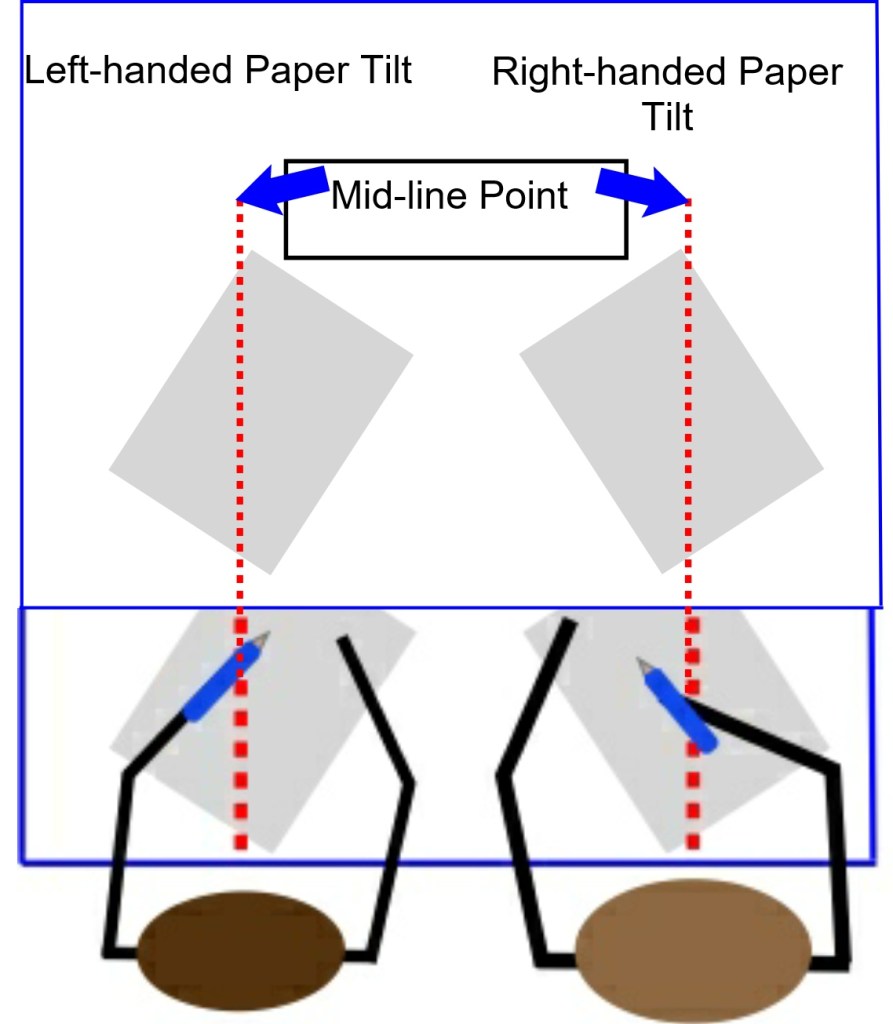
The correct paper position and tilt enables your child to handwrite comfortably while being able to see what they are writing. It also allows the non-writing hand to move the paper up the table so that the writing hand elbow can stay in the same position. The aim is to have the paper move up the table, rather than the writing hand moving down and eventually off the table.

With the non-writing hand moving the paper up the table the writing line stays in the same place which means eye movements are less, helping to make the writing experience less tiring and stressful.

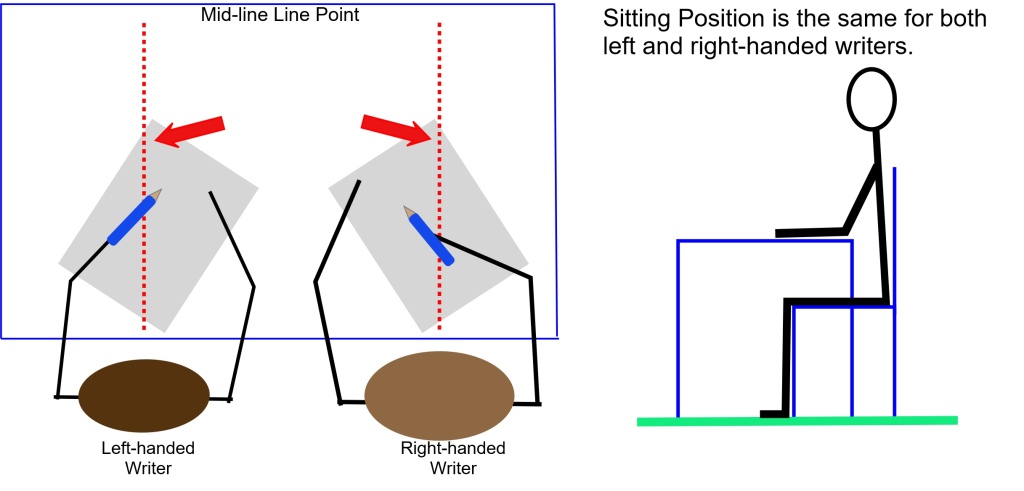
If the paper is positioned and tilted correctly, with their writing hand under the writing line, they will also be able to see more easily what they have just written and where to place the next letter, word or section of text on the page. This is especially important for left-handed writers.

The most appropriate paper tilt angle is generally suggested as anywhere between 20 to 45 degrees anti-clockwise for right-handed writers and 30 to 45 degrees clockwise for left-handed writers.

For more tips and advice on developing a good paper position and tilt:

For Parents: https://teachhandwriting.co.uk/paper-position.html

For Teachers: https://teachhandwriting.co.uk/paper-position-for-comfortable-handwriting.html

Tips for Supporting #Left-handed Writers

Surprisingly there are few differences when teaching left and right-handed children to handwrite. A left-handed child needs a slightly different pencil grip, and needs to hold the pencil slightly higher up the shaft, as well as a different paper position and tilt. Some left-handed children do find handwriting challenging to start with because they naturally want to draw straight lines right to left rather than left to right.

Check out our Left-handed Writers Page for more information and tips on how to support them: https://teachhandwriting.co.uk/left-handed.html

Paper Position & Tilt are Important for Good Handwriting

The paper position and tilt on the desk, for both right and left-handed writers, can make a big difference to a child’s handwriting experience and comfort and yet it is an element which is often neglected.

The correct paper position and tilt enables your child to handwrite comfortably while being able to see what they are writing. It also allows the non-writing hand to move the paper up the table so that the writing hand elbow can stay in the same position. The aim is to have the paper move up the table, rather than the writing hand moving down and eventually off the table.

With the non-writing hand moving the paper up the table the writing line stays in the same place which means eye movements are less, helping to make the writing experience less tiring and stressful.

If the paper is positioned and tilted correctly, with their writing hand under the writing line, they will also be able to see more easily what they have just written and where to place the next letter, word or section of text on the page. This is especially important for left-handed writers.

The most appropriate paper tilt angle is generally suggested as anywhere between 20 to 45 degrees anti-clockwise for right-handed writers and 30 to 45 degrees clockwise for left-handed writers.

For more tips and advice on developing a good paper position and tilt:

For Parents: https://teachhandwriting.co.uk/paper-position.html

For Teachers: https://teachhandwriting.co.uk/paper-position-for-comfortable-handwriting.html

Stage 1 to #Handwriting Success – Pre-handwriting Patterns

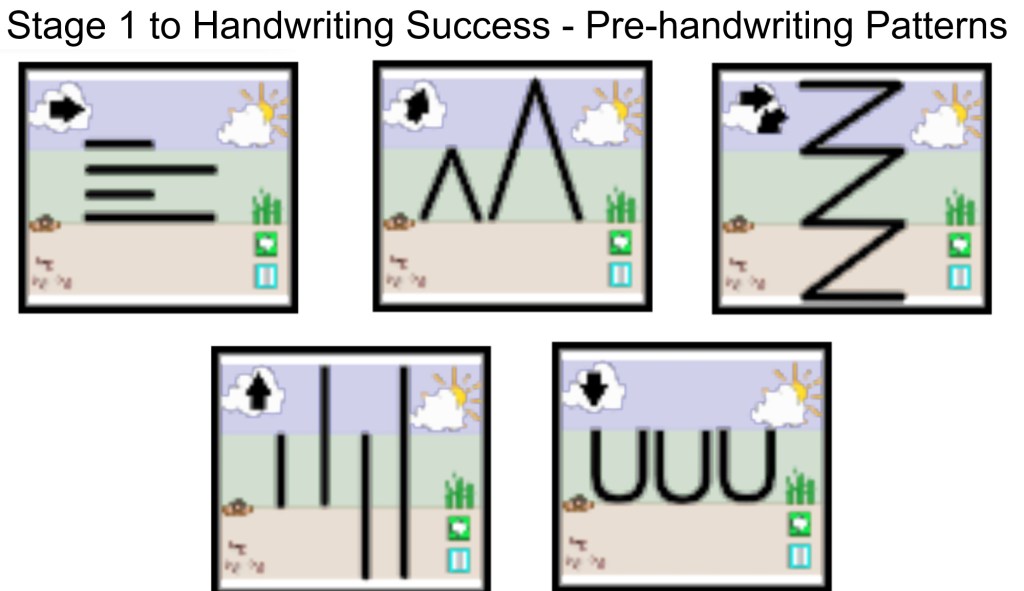
Pre-handwriting patterns are the first stage in supporting a child to handwriting success. They help the child to learn the shapes and directional pushes and pulls required to form letters. All letters are a combination of these shapes and lines.

Young children can start to learn these patterns through their play, long before they are ready to pick up a pencil, moving toys back and forth across the floor or whirling them around in the air. To a child it is just play and fun, but you are doing something far more powerful and constructive by helping them to develop the motor memory patterns and directional movement skills they will need for handwriting.

Later, as their coordination and gross motor skills develop, they make more controlled and varied movement patterns in their play. Changing directions, speed and size are all prerequisite skills needed for learning pre-handwriting patterns.

These handwriting patterns do not need to be taught as worksheet activities (though they do help to perfect shape and pattern formation), drawing pictures and patterns in sand, paint and with other writing tools are all fun ways to practise.

Teaching the handwriting patterns in groups helps to further develop the specific movements (pushes and pulls) required to form them and help commit them to the motor memory. A child can then recall these motor memories to support them as they begin to form letters.

Pre-handwriting patterns that encourage a child to move their pencil from left to right are very important for left-handed writers. They need to be taught this so that they can make the cross motion in the H, T, J, G and I from left to right, as their natural instinct is to go from right to left. If this is not corrected when writing E and F the cross lines will not be “anchored” to the letter.

Once the handwriting patterns have been mastered a child will have the confidence and skills base necessary to start forming letters, numbers and symbols.

Have you got your Free Pre-handwriting Pattern Animations & Worksheets?

For Teachers: https://teachhandwriting.co.uk/pre-handwriting-patterns.html

For Parents: https://teachhandwriting.co.uk/patterns.html
Back to School – Ways to Support Your Child’s Pencil Grip Development

After such a long break from school it is good to take some time to check your child has not slipped back into some old, poor pencil grip habits.

Here is a recap of the things which may help them if they are still finding it difficult to form and maintain an appropriate pencil grip.

Remember it is important that you do not force a child to use the tripod grip if they are not developmentally ready. Just because they are starting school doesn’t mean they are ready to hold a pencil in the tripod grip for handwriting.

Have they reached the appropriate stage in their pencil grip development?

Every child develops at a different time and pace; find out which stage of development your child is at: https://teachhandwriting.co.uk/grip-development.html  

Have they been taught, & do they understand, how to form a Tripod pencil grip?

It may have been explained to them, but that does not mean your child has understood. ‘Drawbridge Flip’ videos may help them to learn more easily how to form a tripod grip for handwriting: https://teachhandwriting.co.uk/teaching-tripod-pencil-grip.html

You may find our Pencil Grip Frequently Asked Question page helpful:  https://teachhandwriting.co.uk/grip-faq.html

Are they left or right-handed?

If they are of school age and do not have a clear hand dominance this can make it difficult to develop a good pencil grip. Our hand dominance information may help you here: https://teachhandwriting.co.uk/hand-dominance.html

Is your child left-handed? 

If your child is left-handed for writing then you may find this link useful: https://teachhandwriting.co.uk/left-handed.html

You may find our Hand Dominance Frequently Asked Questions page helpful: https://teachhandwriting.co.uk/hand-dominance-faq.html

Good Sitting Position for #HandwritingPaper Position & Tilt are Important for Good

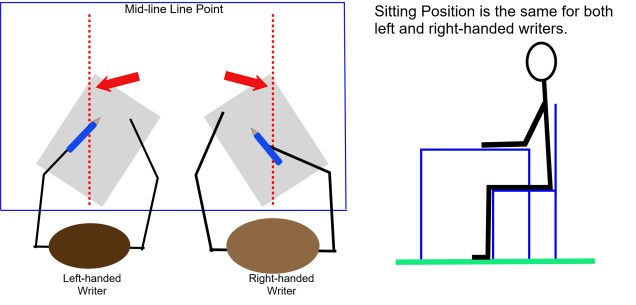
The paper position and tilt on the desk, for both right and left-handed writers, can make a big difference to a child’s handwriting experience and comfort and yet it is an element which is often neglected.

The correct paper position and tilt enables your child to handwrite comfortably while being able to see what they are writing. It also allows the non-writing hand to move the paper up the table so that the writing hand elbow can stay in the same position. The aim is to have the paper move up the table, rather than the writing hand moving down and eventually off the table.

With the non-writing hand moving the paper up the table the writing line stays in the same place which means eye movements are less, helping to make the writing experience less tiring and stressful.

If the paper is positioned and tilted correctly, with their writing hand under the writing line, they will also be able to see more easily what they have just written and where to place the next letter, word or section of text on the page. This is especially important for left-handed writers.

The most appropriate paper tilt angle is generally suggested as anywhere between 20 to 45 degrees anti-clockwise for right-handed writers and 30 to 45 degrees clockwise for left-handed writers.

For more tips and advice on developing a good paper position and tilt:

For Parents: https://teachhandwriting.co.uk/paper-position.html

For Teachers: https://teachhandwriting.co.uk/paper-position-for-comfortable-handwriting.html

Poor hand position can cause a poor pen grip

We often talk about the most appropriate grip for handwriting being the tripod grip; but this usually only refers to finger position. It is easy to forget the importance of the actual hand position in relation to the pen and paper for handwriting.

The ideal position is for the hand, wrist and elbow to be below the tip of the pencil and under the writing line for both left and right-handed writers.

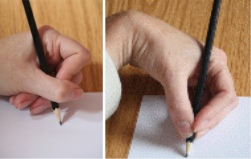
Some children will hold the pencil in a tripod grip but develop a hooked hand position or move the elbow too far up the table, causing the forearm and wrist to be nearly horizontal with the table edge, because they feel they can see what they are writing more clearly.

A hooked grip puts unnecessary strain on the hand ligaments and forces the body into a poor sitting position, again putting extra strain on the body. This in turn makes handwriting a tiring and uncomfortable task, impacting on a child’s overall learning experience.

It takes time to correct a poor hand position but it is well worth the perseverance as it will enable a child to write freely and more comfortably.

When writing normally, encourage children to angle the paper appropriately as this will also help to correct a poor hand position. With the correct paper tilt they will always be able to see what they are writing. If the paper is tilted at the correct angle for them, they will find a hooked hand position, or having their forearm further up the table, more difficult and uncomfortable to maintain.

Some children will find writing on a sloped desk helpful. Not all are comfortable writing or drawing on a flat surface and may benefit from the paper being positioned on an angled or sloped board. If you are not sure, instead of buying a specialist board, you could make one. Try using a ring binder or lever arch file stuffed with magazines and newspaper to make a sloped board. Tape the edges to stop the papers falling out or you could cover it in sticky back plastic to give a smoother finish to the board. The advantage of this is that you can make them to any angle of slope. Try a few to see which, if any, your child prefers. You may find that they only need the sloped board for a short while. It may also help to reduce the angle of the slope over time so that they gradually get used to moving from a sloped to horizontal writing plane.

Tips for Supporting #Left-handed Writers

Surprisingly there are few differences when teaching left and right-handed children to handwrite. A left-handed child needs a slightly different pencil grip, and needs to hold the pencil slightly higher up the shaft, as well as a different paper position and tilt. Some left-handed children do find handwriting challenging to start with because they naturally want to draw straight lines right to left rather than left to right.

Check out our Left-handed Writers Page for more information and tips on how to support them: https://teachhandwriting.co.uk/left-handed.html

Paper Position & Tilt are Important for Good Handwriting

The paper position and tilt on the desk, for both right and left-handed writers, can make a big difference to a child’s handwriting experience and comfort and yet it is an element which is often neglected.

The correct paper position and tilt enables your child to handwrite comfortably while being able to see what they are writing. It also allows the non-writing hand to move the paper up the table so that the writing hand elbow can stay in the same position. The aim is to have the paper move up the table, rather than the writing hand moving down and eventually off the table.

With the non-writing hand moving the paper up the table the writing line stays in the same place which means eye movements are less, helping to make the writing experience less tiring and stressful.

If the paper is positioned and tilted correctly, with their writing hand under the writing line, they will also be able to see more easily what they have just written and where to place the next letter, word or section of text on the page. This is especially important for left-handed writers.

The most appropriate paper tilt angle is generally suggested as anywhere between 20 to 45 degrees anti-clockwise for right-handed writers and 30 to 45 degrees clockwise for left-handed writers.

For more tips and advice on developing a good paper position and tilt:

For Parents: https://teachhandwriting.co.uk/paper-position.html

For Teachers: https://teachhandwriting.co.uk/paper-position-for-comfortable-handwriting.html