Alternative Pencil Grips for Handwriting

cartoon pencil hold

We ran this article last year but the debate around what is an appropriate pencil grip for writing is still hotly contended. This is why in the past we have tried to stay clear of the topic and only ever provided information on the Dynamic Tripod Grip, which is still considered the most appropriate for handwriting.

However it has become increasingly evident that we need to look more carefully at alternative suitable efficient grips for handwriting. It is too easy for us to say that one particular grip is best and then plough on regardless and not really address the fact that one size, or in this case one method, does not fit all.

What is an efficient pencil grip?

“A pencil hold that provides speed, legibility is comfortable and will not cause harm to the joints of the hand over time. If a hold satisfies these criteria there is no need to change it”

(Benrow 2002, cited: Foundation of Paediatric Practice for the Occupational Therapy Assistant, 2005)

The above publication, and those listed at the end of the article, explains that there are three efficient pencil grips for handwriting:

  1. The Dynamic Tripod Grip is still the most appropriate grip for handwriting, for those with good fine motor skills, as it allows the fingers to move freely; so the writer can form the letters more smoothly.
    • The Tripod Grip has an open web space. The pencil is held between the top of the thumb and index finger and rests on the middle finger with the ring and little fingers gently curled in
  2. The Quadrupod Grip, this grip is a little more restrictive because the fingers cannot move as freely as they would if using the Tripod grip.
    • The Quadrupod Grip also has an open web space. The pencil is held between the top of the thumb, index and middle fingers and rests on the ring finger with the little finger slightly curled in.
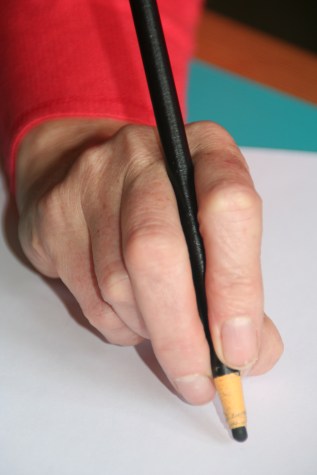
  3. The Adaptive Tripod or D’Nealian Grip developed by the Belgian Neurologist Callewaert in 1963 (cited, Ann-Sofie Selin 2003) is a functional though not conventional grip for handwriting. This grip is often more appropriate to use with children who have low muscle tone or hyper mobility of the finger joints. It can also benefit older children who continue to hold a pencil too tightly, or who hold the pencil lightly using just their fingertips (often writing using whole arm movements), as well as those children who hold a pencil with their thumb wrapped around and across the pencil and index finger.
    • The Adaptive Tripod or D’Nealian Grip has a smaller open web space than the other two grips with the pencil held between the index and middle fingers, the tip of the thumb and the index finger on the pencil, which rests against the top section of the middle finger.

Over the next few weeks we will look more closely at each of these three grips, starting with what might be considered by some the most controversial The Adaptive Tripod or D’Nealian Grip.

Bibliography

Ann-Sofie Selin, 2003: Pencil Grip A Descriptive Model and Four Empirical Studies; Abo Akademi University Press

A Wagenteld, J Kaldenberg (co-editors), 2005: Foundation of Paediatric Practice for the Occupational Therapy Assistant; Pub: Slack Incorporated, ISBN-10:1-55642-629-1

Web-sites:

https://www.ot-mom-learning-activities.com/correct-pencil-grasp.html

https://www.otplan.com/articles/pencil-grasp-patterns.aspx

https://www.pediastaff.com/resources-pencil-grasp-patterns–may-2009


Back to School – 6 Ways to Support Your Child’s Pencil Grip Development

cartoon pencil holdDate 07/09/17

After the long school summer holiday it is always good to take some time to check your child has not slipped back into some old, poor pencil grip habits.

Here is a recap of the things which may help them if they are still finding it difficult to form and maintain an appropriate pencil grip.

Remember it is important that you do not force a child to use the tripod grip if they are not developmentally ready. Just because they are starting school doesn’t mean they are ready to hold a pencil in the tripod grip for handwriting.

Have they reached the appropriate stage in their pencil grip development?

Every child develops at a different time and pace; find out if your child is ready yet: bit.ly/1s7XjNP

How do they hold a pencil for writing at the moment?

A poor pencil grip can make forming letters difficult and handwriting slow or uncomfortable. Check out our tips on how to correct a poor pencil grip: bit.ly/1qhbqc6

Have they been taught, & do they understand, how to form a Tripod pencil grip?

It may have been explained to them, but that does not mean your child has understood. Our ‘Tommy Thumb’ and ‘Drawbridge Flip’ videos may help them to learn more easily how to form a tripod grip for handwriting: bit.ly/1r6uoDg

Do they have the physical hand and finger strength to form and maintain a tripod pencil grip?

Not all children have the appropriate hand and finger strength to hold a pencil in the tripod grip and need extra support to help them develop this. To find out more check out our hand and finger strength assessment page:  bit.ly/1xDGECK

Are they left or right handed?

If they are of school age and do not have a clear hand dominance this can make it difficult to develop a good pencil grip. Our hand dominance information may help you here: bit.ly/19BPAcK

Do they swap hands when writing or drawing?

This is a normal developmental stage for many toddlers and young children, but it is not ideal for school age children. Check out our tips on tackling hand swapping issues: bit.ly/1By3GMu

If you have any queries about handwriting or pencil grip feel free to contact us at enquiries@teachhandwriting.co.uk or via this blog or Facebook.