Why it is Important to Teach Correct Letter Formation!

It can often be assumed children will pick up how to write letters if they see them often enough (by osmosis). This is just not the case.  Correct letter formation has to be taught. Seeing a completed letter or word or watching it being typed up and appear on a screen does not show children how to form the letters.

For children to develop a good handwriting style it is important to learn how to form letters correctly to begin with as this makes the transition from single letter formation to joined letter handwriting much easier. This enables them to develop a speedy, fluid and legible handwriting style.

Department of Education; The writing framework: July 2025; page32 & 33; https://www.gov.uk/government/publications/the-writing-framework now recognizes and highlights the importance of teaching correct letter formation from the very beginning, so, starting in foundation stage:

“It should be:

  • • daily, until pupils can write legibly and easily
  • • taught in small steps, with lots of opportunity for practice
  • • cumulative: teachers should build on what pupils have learned previously 
  • • consolidated before teaching moves on so that pupils do not practise letters incorrectly
  • • revisited when further practice is needed
  • • demonstrated by the teacher
  • • additional to any handwriting that forms part of teaching phonics”

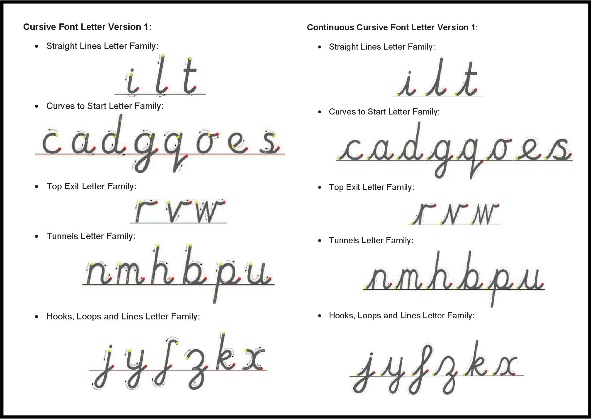
Letters are created through joining lines and curve shapes in a particular way. They have a designated start point and set directional pushes and pulls of the pencil to reach the designated finish point. This is why from the very start (2012) Teach Handwriting has always taught letter formation in groups/families rather than in alphabetical order (a Year 1 national curriculum statutory requirement in 2015). Certain groups use the same, or similar, shape and directional push and pulls of the pencil to form the letter, for instance the letter c has the same start point and anti-clockwise directional movement shape that is needed to create the letters a, d, g, o and, though a little more complicated, the letters s and e. Teaching letters in groups and families can also help to limit letter reversals such as b and d.

Another interesting and very important useful point included in the Department of Education; The writing framework: July 2025; page 33; https://www.gov.uk/government/publications/the-writing-framework, for Year 1 is that:

“Wide-lined paper is essential at this stage. Mid-line guides can also help pupils to position letters. Pupils should be introduced to paper with narrower lines once they can write legibly and easily on wide-lined paper.”

Which I believe, acknowledging the fact that children can form their letters correctly if taught correctly but may not be ready for narrow line height paper due to their developmental stage of their fine motor skill.

Also, it explains how in Year 2:

“To join letters easily and legibly, pupils first need to form the shape of each letter correctly, starting and finishing each one at the correct point and ensuring that its size is properly related to other letters in the same family.”

Due to how handwriting has or hasn’t been taught over the generations we all have our own way of handwriting. When supporting and teaching young children we need to develop a consistent approach so that they do not get confused or frustrated by adults giving them conflicting information.

For parents this means finding out from your child’s school which letter font they are teaching so that you can support them more effectively at home. This may mean that you have to learn a new way of writing some letters.

This also applies to teachers and teaching assistants; “Department of Education; The writing framework: July 2025; page 32; https://www.gov.uk/government/publications/the-writing-framework states:

“Teachers’ own handwriting should provide a model of high standards, across the curriculum and not just in handwriting lessons, but particularly when pupils are learning to write.”

As the adults in the situation, we have to accept that it is for us to make the changes. Just because something is different to the way we were taught, or do it, doesn’t mean it is wrong, it is just different! 

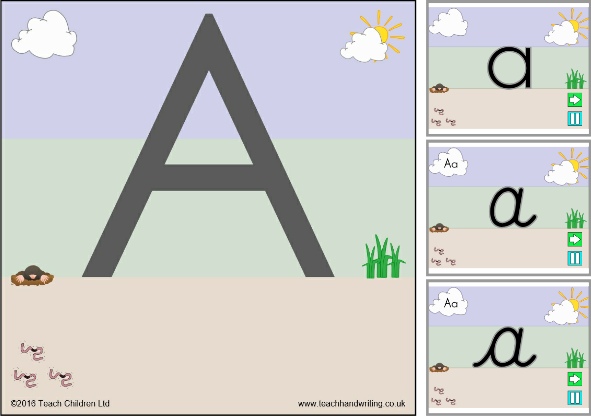
Our free letter animations are not just to support children with their learning but also to provide parents and teachers (all adults really) with the knowledge and support to help children develop a consistent handwriting style.

Parent animation link: https://teachhandwriting.co.uk/parents.html

Teacher animation link – click through on the Key Stage you are teaching: https://teachhandwriting.co.uk/teach-handwriting-teachers.html
Stage 2 to #Handwriting Success – Single Letter Formation (non-pencil activities)

Over the last couple of weeks, we explained that pre-handwriting patterns are the first stage of learning to handwrite. Once a child has mastered these, they are ready to start learning how to form letters.

But where do you start?

Our view is to focus on lower-case letters first and only the capital letters for the first letter in a child’s, examples: Peter Rabbit, Sally Green, George Blue or Mary Shell.

Why?

  • One reason is that about 95% of what children write, and are exposed to, is in a lower-case form and only 5% in capital.
  • Lower-case letters are far less complicated, requiring fewer pencil lifts to complete the letters.
  • As both lower-case and capital letters require a child to form curved lines, a skill which most children have to practice, writing lower-case letters is no more difficult than writing capitals.
  • In a young child’s writing, all the letters are initially the same size, whether they are capitals or lower case; it is part of the normal developmental path of handwriting. So, the view that teaching capitals letters is easier because they are bigger is not true.
  • Young children who have learnt mostly capital letters first find it difficult to stop, as it is so ingrained into the memory, often using them half way through words and sentences. Even when they are older this inappropriate use of capitals creeps back into their work especially if they are tired or concentrating hard on composing their work.

A child’s first major achievement, in their eyes, is to write their name. So, although concentrating on lower-case letters, teach them how to form the capital letter for the first letters of their name to get them excited about handwriting.

As they master the lower-case letters introduce the remainder of the capital letters. It is important that both are taught so that a child can develop a speedy, fluid and legible handwriting style.

As with the pre-handwriting patterns, part one of learning correct letter formation is through non-pencil activities. This is because it supports the storage of the larger gross motor memory movements; the stage of development that EYFS are working at. They can then tap into those gross motor memory movements as their fine motor skills are developing; taking the stored large movement to a smaller and smaller scale.  

Once again ‘The writing framework’ acknowledges that:

“On joining reception, some children may need teaching and practice in using and manoeuvring their thumb, wrist and shoulder muscles in the way they need for handwriting. Initially, handwriting lessons could include learning the movements needed to form letters, practising these movements at a range of sizes…”

Department of Education; The writing framework: July 2025; page 24; https://www.gov.uk/government/publications/the-writing-framework

It is through play that you can really engage a child in learning how to correctly form their letters, and has always been an important foundation stone in our Foundation Stage Teach Handwriting Scheme (https://www.teachhandwriting.co.uk/handwriting-teaching-manuals.html#hs-fs ) and strongly promoted on our website https://www.teachhandwriting.co.uk ) and blog (https://teachhandwriting.blog/ ) since 2012.  

Our non-pencil – ‘Big to Small’ activities are an easy fun way to start developing these skills early on through play: https://teachhandwriting.co.uk/big-to-small.html

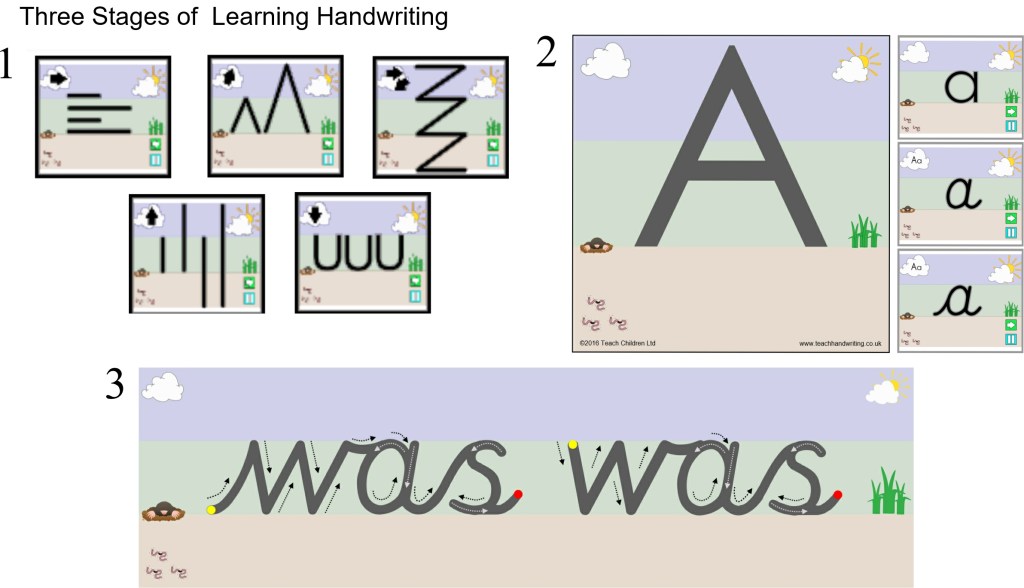
The Three Stages to Learning #Handwriting

There are three distinct stages for children to progress through to develop a good handwriting style:

Stage 1 – Pre-handwriting Patterns

Pre-handwriting patterns support a child towards handwriting success. They help the them to learn the shapes and directional pushes and pulls required to form letters. All letters are a combination of these shapes and lines.

Stage 2 – Single Letter Formation

For children to develop a good handwriting style it is important to learn how to form the letters correctly.

Beginning with lower-case letters and only the capital letters for the first letter in a child’s name, examples: Peter Rabbit, Sally Green, George Blue or Mary Shell.

Learning the correct lower-case letter formation also makes the transition from single letter formation to joined letter handwriting much easier.

Stage 3 – Joined Handwriting

Learning to join letters for handwriting enables children to develop a speedy, fluid and legible handwriting style.

School Reports – Handwriting Improvements Needed!

So, the school report has been received and you have been told that your child needs to improve their handwriting.

This is all well and good, but what exactly needs improving?

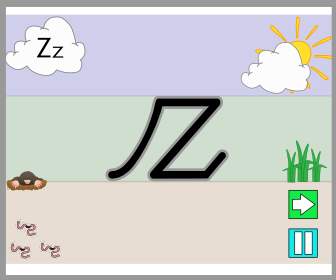
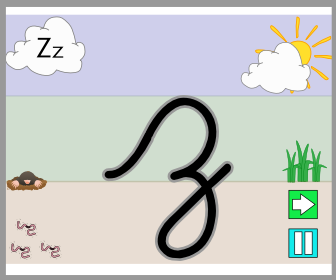
What are they finding difficult and how on earth do you write a continuous cursive z? 

So, you eventually get some handwriting practice sheets home or off the web. But no amount of time spent doing them seems to make much difference. It seemed to take longer to get them started than they spent practising handwriting. In fact they seemed worse because they were unhappy and frustrated with their own progress, so the more you try to push them the more resistant they become. Eventually you think there has to be a better way than this?

Doing more of what you are already struggling with is not always the answer. Handwriting is a complex skill to learn and there are a number of reasons why a child may be struggling.

There is a lot of information and free resources on our ‘Parent’ page which has been designed to help you: https://teachhandwriting.co.uk/parents.html

Try not to get over whelm, take things slowly and keep it simple.

Some things you might want to check and work on first before thinking about your child’s letter or join formation:

  • How are they sitting, is it a good position, it makes a difference;
  • Paper position and tilt can have a real impact especially if they are left-handed writers;
  • Are they using an efficient pencil grip for their age.

If your child is finding some or all of these elements difficult it might be that you need to work on their physical strength as well. Again, you will find information and games to help build this at the same time. And with the summer holidays coming up it is a great time for you to play games and do activities which then help them to develop the strengths and skills which may be holding them back and making handwriting a difficult task to master.

It is important to check and know which letter formations are being taught in school and that this is what you teach at home. Otherwise, you will only be causing more frustration and stress for your child.

Please note that if the letter formation being shown in the @Parent@ section is not the one being taught in school, check our @Teacher@ section of the website as you may find it there: https://teachhandwriting.co.uk/key-stage-1-handwriting-routes.html

Transferring handwriting skills from worksheets to paper 

At Teach Children our aim is to move children off of worksheets as soon as possible. To achieve this, it is important to encourage them to transfer their skills to plain or lined paper whichever is most appropriate to their ability level. We realise that it is not always possible to buy paper with the appropriate line height in all cases, so would recommend creating your own on the computer.

  • Use a combination of worksheets and lined paper in each handwriting session with your child:
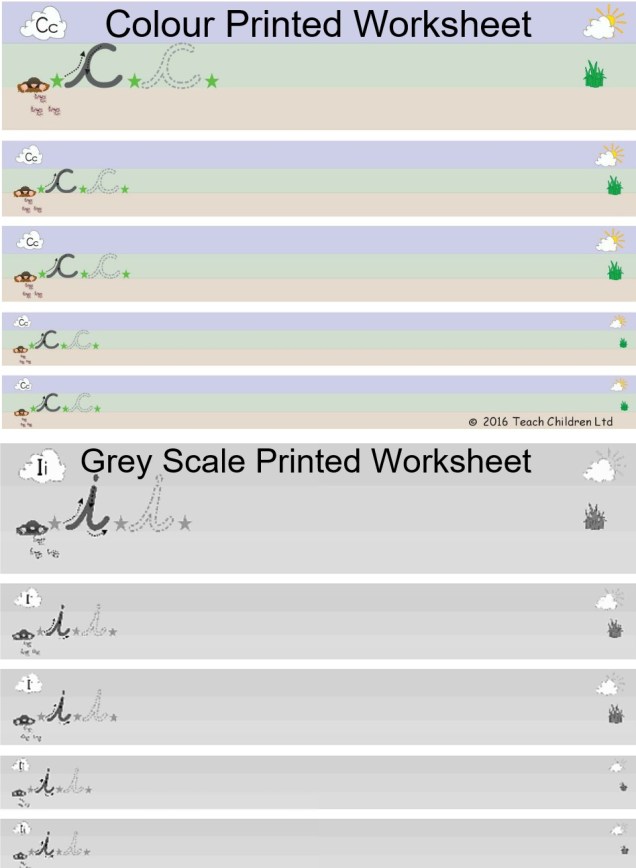
  • Use the colour worksheet, or a grey scale version, and complete one or two rows.
  • Then encourage the child to try the same patterns or letters on appropriately lined paper, again try one or two rows only.

Hopefully the worksheet will last over a couple of handwriting sessions and you and the child will see an improvement over the time. The sooner they learn to transfer their skills to paper the better.

We realise that printing off our worksheets and coloured lined paper can become costly so, to help reduce the costs:

  • Use a colour version of the appropriate worksheet initially and then try printing in grey scale. Children usually make the adjustment to grey scale well once they are used to how the picture clues and colours work.
  • You could also use the grey scale worksheets and colour the start of each row with the appropriate colour.

Letter and Join Formation Issues

Single Letter Formation

Some children will have poor letter formation skills because they have missed or just have not been taught how to form their letter correctly.

If your child is struggling with correctly forming their single letters, it can be a good idea to take a step back and check that they can form the pre-handwriting patterns. You might find that they are struggling with some of the line directional pushes and pulls that the patterns support in developing and are needed for forming letters – Parents: https://teachhandwriting.co.uk/parents.html Teachers: https://teachhandwriting.co.uk/pre-handwriting-patterns.html

It is surprising how often the pre-handwriting patterns stage in developing handwriting is skimmed over or just missed out completely.

Unfortunately, the pressure on school to focus on phonics and introducing handwriting as part of the scheme means that children who cannot draw or have experienced pre-handwriting patterns are being asked to form letters. I can’t work out the logic of this approach.

If you take a close look at your child’s lower-case single letter formation you may find that it particular letters that they struggle with.  What you may find is that these letters fall into certain letter family group. So, I would recommend working on the letter family in which the child has the most letter formation difficulties first.

If it is all the letter of the alphabet then I suggest teaching the letter families in the order shown on the website – Parents: https://teachhandwriting.co.uk/parents.html Teachers: https://teachhandwriting.co.uk/key-stage-1-handwriting-routes.html

We recommend focusing on developing a child’s lower-case single letter formation skills first as this about 95% of letter usage they need for writing and reading. Then introduce capital formation.

Why do some children struggle with letter reversal issues?

It is normal for young children to reverse letters and numbers when writing. This should stop by the time they are 6 /7 years old.

Older children can reverse their letters and numbers, when writing, for the following reasons:

  • They have poor visual and motor memory skills and so can’t remember how to form the letters correctly.
  • They have poor bilateral coordination skills.

Games and activities can help them overcome these issues: https://teachhandwriting.co.uk/games.html and https://teachhandwriting.co.uk/warm-ups.html

Teaching the letters in letter families can reduce letter reversal as the reinforcement of the pencil movements helps cement the letter shapes in the visual and motor memory.

We have grouped the letters together in families based on their shape and the directional pushes and pulls of the pencil needed to form them.

By teaching the letters in these families the letters that are most commonly reversed such as ‘b’ and ‘d’ are in different letter families as their start points and initial pushes or pulls of the pencil for them is different, so are reinforced, making it easier for your child to remember them.

Joining Issues

Some children struggle with learning to join because:

  • They may not be forming the single letters correctly. It is best to correct their single letter formation first before moving on to tackle any joining issues. You may find once they have corrected their single letter formation, many of the joining issues have rectified themselves.
  • Some children will find the join strokes a little tricky to start with, so try using the joins section in pre-handwriting patterns to help them learn the additional pencil strokes needed.
  • Some children may not remember which join strokes to use. So, teach the joins in groups, and build up their confidence by starting with the easiest joins – Parents: https://teachhandwriting.co.uk/parents.html Teachers: https://teachhandwriting.co.uk/key-stage-1-handwriting-routes.html
  • Begin by joining 2 or 3 letters together at a time rather than long lines of joins that go across the page. It is best to match the number of letters joining to a sensible word length.
  • Remind your child that the aim is not to take their pencil off the paper until the number of letters in a word has been completed, then they dot the i’s and j’s and cross the t’s and x’s.

Teaching Letter Joins – A Systematic Approach

We would recommend teaching joins in join type groups, whether your child has learnt cursive or continuous cursive single letter fonts.

Teaching the join types in their groups helps a child to understand the directional pushes and pulls required to successfully join the different letter combinations.

There are 4 main groups of letter joins; bottom joins, bottom to “c” shape joins, “e” joins (top and bottom join strokes) and top joins.

Moving from Cursive Single Letters to Joining

There are seven join strokes to be taught. Most children will find the bottom joins the easiest to achieve, as it only requires the extension of the exit stroke they already put on the letters. The bottom to “c” shape joins can be tricky at first but soon mastered. The joins that tend to cause the most confusion and difficulty are the “e” joiners and top exit joiners.

I would recommend teaching the bottom joins first, then the ‘e’ joins and finally the top exit letter joins.

Moving from Continuous Cursive Single Letters to Joining

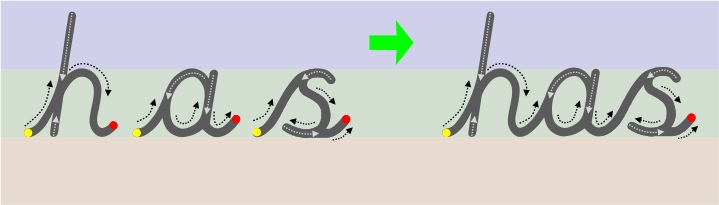
There are three join strokes to be taught. The easiest is the bottom exit letters (the majority of the letters), all a child has to do is write the letters closer together without lifting their pencil off the paper. Only the top to “e” and top joiners need to be taught for continuous cursive, as the nature of the font style means that the lead-in and exit strokes needed to join the majority of letter combinations have already been taught.

I would recommend teaching the bottom joins first, then the top exit to ‘e’ join and finally the top exit letter joins.

The ultimate aim is for a child to develop a good handwriting style; which means;

•     They can produce and maintain a good speed

•     Have a fluid hand movement that is comfortable

•     Letters are of a consistent and appropriate size, positioned correctly

•     Handwriting is legible (so others can read it easily).

It is important to remember that for some children (mainly SEND pupils) this may mean that they will always print or use a single letter form of writing as learning to join is just not appropriate. But that does not mean they will not comply with the bullet points above.

Have you got your Free Join Animations & Worksheets?

For Teachers: https://teachhandwriting.co.uk/key-stage-2-handwriting-routes.html

For Parents: https://teachhandwriting.co.uk/parents.html

Stage 3 to #Handwriting Success – Joining

Here at Teach Children we believe that a child is only ready to start learning to join their handwriting when:

  • They have learnt to form all 26 lower-case letters correctly.
  • Letters are of a consistent and suitable size (not necessarily the perfect size, remember big is beautiful).
  • Letters are positioned appropriately on the writing line as well as in relation to one another.

Children generally begin to join letters between the ages of 6 to 7 years old, depending on the handwriting font style being taught. Those taught a continuous cursive font style from the beginning tend to join much earlier due to the nature of this font (for some by the end of their Reception Year).

Children do not need to be able to remember how to correctly form all their capital letters before they are taught how to join their letters. This is because capital letters never join to the lower-case letters in a word. However, for these children correct capital letter formation needs to be taught alongside the introduction of letter joins.

We would recommend teaching joins in join type groups, whether your child has learnt cursive or continuous cursive single letter fonts.

Teaching the join types in their groups helps a child to understand the directional pushes and pulls required to successfully join the different letter combinations.

We would recommend teaching the bottom joins first, then the top exit to ‘e’ join and finally the top exit letter joins.

Have you got your Free Join Animations & Worksheets?

For Teachers: https://teachhandwriting.co.uk/key-stage-2-handwriting-routes.html

For Parents: https://teachhandwriting.co.uk/parents.html

Why it is important to teach correct letter formation?

It can often be assumed children will pick up how to write letters if they see them often enough (by osmosis). This is just not the case.  Correct letter formation has to be taught. Seeing a completed letter or word or watching it being typed up and appear on a screen does not show children how to form the letters.

For children to develop a good handwriting style it is important to learn how to form letters correctly to begin with as this makes the transition from single letter formation to joined letter handwriting much easier. This enables them to develop a speedy, fluid and legible handwriting style.

Letters are created through joining lines and curve shapes in a particular way. They have a designated start point and set directional pushes and pulls of the pencil to reach the designated finish point. This is why at Teach Handwriting we teach letter formation in groups/families rather than in alphabetical order. Certain groups use the same, or similar, shape and directional push and pulls of the pencil to form the letter, for instance the letter c has the same start point and anti-clockwise directional movement shape that is needed to create the letters a, d, g, o and, though a little more complicated, the letters s and e. Teaching letters in groups and families can also help to limit letter reversals such as b and d.

Due to how handwriting has or hasn’t been taught over the generations we all have our own way of handwriting. When supporting and teaching young children we need to develop a consistent approach so that they do not get confused or frustrated by adults giving them conflicting information.

For parents this means finding out from your child’s school which letter font they are teaching so that you can support them more effectively at home. This may mean that you have to learn a new way of writing some letters. This also applies to teachers and teaching assistants. As the adults in the situation, we have to accept that it is for us to make the changes. Just because something is different from the way we were taught, or do it, doesn’t mean it is wrong, it is just different! 

Our free letter animations are not just to support children with their learning but also to provide parents and teachers (all adults really) with the knowledge and support to help children develop a consistent handwriting style.

Parent animation link: https://teachhandwriting.co.uk/parents.html

Teacher animation link – click through on the Key Stage you are teaching: https://teachhandwriting.co.uk/teach-handwriting-teachers.html

Stage 2 to #Handwriting Success – Single Letter Formation

Last week we explained that pre-handwriting patterns are the first stage of learning to handwrite. Once a child has mastered theses, they are ready to start learning how to form letters.

But where do you start?

Our view is to focus on lower-case letters first and only the capital letters for the first letter in a child’s, examples: Peter Rabbit, Sally Green, George Blue or Mary Shell.

Why?

  • One reason is that about 95% of what children write, and are exposed to, is in a lower-case form and only 5% in capital.
  • Lower-case letters are far less complicated, requiring fewer pencil lifts to complete the letters.
  • As both lower-case and capital letters require a child to form curved lines, a skill which most children have to practise, writing lower-case letters is no more difficult than writing capitals.
  • In a young child’s writing all the letters are initially the same size, whether they are capitals or lower case; it is part of the normal developmental path of handwriting. So, the view that teaching capitals letters is easier because they are bigger is not true.
  • Young children who have learnt mostly capital letters first find it difficult to stop, as it is so ingrained into the memory, often using them half way through words and sentences. Even when they are older this inappropriate use of capitals creeps back into their work especially if they are tired or concentrating hard on composing their work.

Have you got your Free Letter Formation Animations & Worksheets?                                                                      For Teachers: https://teachhandwriting.co.uk/key-stage-1-handwriting-routes.html

For Parents: https://teachhandwriting.co.uk/parents.html

A child’s first major achievement, in their eyes, is to write their name. So, although concentrating on lower-case letters, teach them how to form the capital letter for the first letters of their name to get them excited about handwriting.

As they master the lower-case letters introduce the remainder of the capital letters. It is important that both are taught so that a child can develop a speedy, fluid and legible handwriting style.