The Simple View of Writing

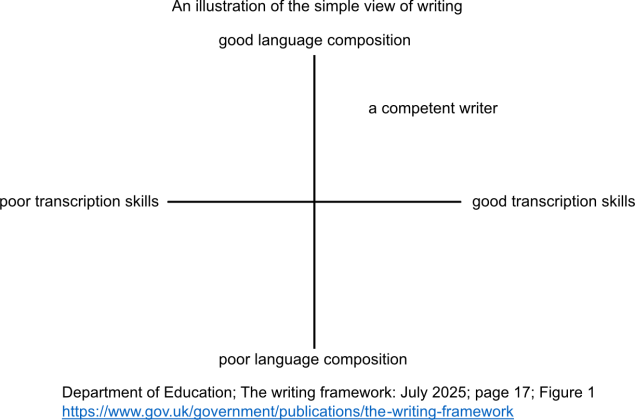
The writing framework explains, and shares, a simple illustrated example of “The Simple View of Writing” (see the end of this article), which we felt was a little too simplistic as a quick reference guide. So, we have created the one below which adds a little more information to what is in reality a complex set of skill factors.

Please note that criteria should all be considered in relation to the pupil’s age and stage of development.

What are language composition and transcription skills?

Language Composition

The writing framework explains language composition as; being able to express ideas by structuring them into speech and writing, which consists of two main but complex elements:

  1. Executive function (self-regulation, planning, organizing and monitoring) and
  2. Text generation (vocabulary, grammar and punctuation)

Executive function

This is a complex set of skills that have to come together throughout the writing process:

Self-regulation – the ability to keep control of their own thoughts, feelings and behaviors during the writing process. To help them remain focused on the task, to get started and to keep going (stamina to finish the task).

Planning – breaking down a task and organize it in a logical structure based on their knowledge of the topic, the context in which it is to be used, its purpose, and the audience it is intended for.

Organizing – covers a range of tasks such as deciding the best way to present some of the information, the relevance of information, what to keep and what to discard. Taking on new ideas that may conflict with their own thoughts.

Monitoring – their own writing process, reviewing and making amendments where necessary.

Text generation

Is the ability to correctly use grammatical conventions with a wide range of vocabulary and accurate punctuation.

Transcription Skills

The writing framework explains that transcription skills are handwriting and spelling.

Handwriting

The ability to handwriting with speed, fluidity and legibility. This means that the writer has correct letter formation and/or joining skills, placement, spacing, an appropriate consistent letter size for their stage of development and has or is moving to developing an automatic, sub-conscious approach to handwriting.

Spelling

The ability to spell accurately, which means having a good understanding of the alphabetic coding system (phonics) we use for the oral and written English language. This means being able to link the sounds heard in a word to the correct letter or letter combinations required to spell the word correctly. For example, in the word ‘fish’ we hear 3 phonemes ‘f/I/ ʃ’but spelling it correctly we need to know that the ‘ʃ ‘phoneme is represented by two letters ‘s’ and ‘h’=‘sh’.

Back to School – Ways to Support Your Child’s Pencil Grip Development

After such a long break from school it is good to take some time to check your child has not slipped back into some old, poor pencil grip habits.

Here is a recap of the things which may help them if they are still finding it difficult to form and maintain an appropriate pencil grip.

Remember it is important that you do not force a child to use the tripod grip if they are not developmentally ready. Just because they are starting school doesn’t mean they are ready to hold a pencil in the tripod grip for handwriting.

Have they reached the appropriate stage in their pencil grip development?

Every child develops at a different time and pace; find out which stage of development your child is at: https://teachhandwriting.co.uk/grip-development.html  

Have they been taught, & do they understand, how to form a Tripod pencil grip?

It may have been explained to them, but that does not mean your child has understood. ‘Drawbridge Flip’ videos may help them to learn more easily how to form a tripod grip for handwriting: https://teachhandwriting.co.uk/teaching-tripod-pencil-grip.html

You may our Pencil Grip Frequently Asked Question page helpful:  https://teachhandwriting.co.uk/grip-faq.html

Are they left or right-handed?

If they are of school age and do not have a clear hand dominance this can make it difficult to develop a good pencil grip. Our hand dominance information may help you here: https://teachhandwriting.co.uk/hand-dominance.html

Is your child left-handed? 

If your child is left-handed for writing then you may find this link useful: https://teachhandwriting.co.uk/left-handed.html

You may find our Hand Dominance Frequently Asked Questions page helpful: https://teachhandwriting.co.uk/hand-dominance-faq.html

Summer Fun-Think more Play, Play and Play!!!

We are half way through the summer holidays, six weeks may have seemed like a long time but it is amazing how quickly it is passing.

The last thing you and your child probably want to think about right now is developing your child’s phonological awareness skills ready for next term; and quite right too!

So, don’t think about it in the conventional way of practise, practise and practise.

Think more play, play and play!!!

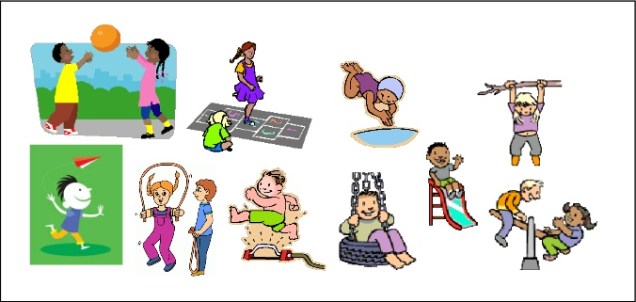
Children learn so much through just playing; developing physical, mental, communication and vocabulary strengths and skills, which all support them at school and with learning. Once introduced to a new game or activity children will very often take it and make it their own, making new rules and introducing extra characters or challenges.

The skill as a parent is remembering to let go of your preconceived ideas about how a game should be played and letting your child take the initiative.

If you provide the opportunities it is amazing how they will take on the challenge of inventing a new game or (in their eyes) improving an existing one.

This does not have to cost a penny; use the toys they already have or make games using empty plastic bottles or cardboard tubes.

The following kind of play supports and develops language and communication skills your child needs to help them learn and you have not had to mention school or homework.

  • The local play park is a fantastic free resource; running, jumping, crawling and climbing can all be encouraged. If your child is a little reluctant then it may well be that they are unsure how to do some of these activities. Explain when jumping that they needed to land on their feet and bend their knees as they land. Start small and as their confidence grows so does the height or distance they jump. Climbing can be scary for some children so again explain how to climb, moving one hand or foot at a time so that there are always three other points of contact.
  • If you are lucky enough to have a garden then mud play is messy but so much fun, it can be contained in a small area and will not only make you a cool adult but, if you join in, it will knock years off you (have a go, it is a great free therapy session).
  • Skittle games are always fun. Extend the activity by decorating the skittles (plastic bottles or cardboard tubes) using anything from crayons, paint or even dress them up as people or animals.

Turn Taking Skills for Play

This week we will look at turn taking in play a skill children need to learn to take part in meaningful interaction with others. These interactions are a vital part of children’s physical, emotional, social and intellectual growth and wellbeing.

Children need to learn the importance of waiting for their turn when playing with others, something many find hard to understand to begin with. 

Like most skills it needs to be taught and practised and is part of our phonological awareness development as it requires us to learn an associated vocabulary along with facial and other physical cue.

A child who is taught and given lots of practise at taking turns will find interacting and playing with others easier later on.

Turn taking is easy to implement into everyday activities and play and something you probably do anyway, without even thinking about it

Here are some ideas to help you to support your child:

  • Try to use the phrase “My turn”, “Your turn” or “Daddy’s turn” (name a third person) when playing or doing an activity such as sharing a book.
  • Toddlers have a short attention span so keep the turn short to start with.
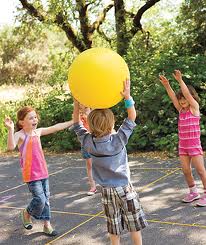
  • Physical games such as rolling and kicking a ball or running and jumping activities can help to encourage turn taking and learning to wait for your turn. Again, don’t make the turns too long and to help keep your child engaged while you have your turn, talk with them about what you are doing during your turn and when they are having theirs.
  • Count Down or Up – To help young children develop an understanding that if they wait, they will get their turn, explain that you will count to 10 and then it is time to swap and someone else has a turn, count to 10 again and return the toy or wanted object to your child. It won’t take long for them to understand that they will get their turn without a fuss.
  • Turn Time – As your child gets older try using a timer/clock to help them increase the time scale between taking turns. Try not to make the gaps between turns too long to start with, as young children find the concept of time very difficult, 1 minute might as well be an hour in their eyes. Show clearly a start point and the finish point for the time scale so your child can watch or come back and check the passing of time. Don’t be tempted to ignore the timer if it is your child’s turn, make sure they are offered the toy or turn that is due to them, otherwise they will feel cheated and some of the trust is lost.
  • As children get older, playing card and board games helps to further develop their turn taking skills.