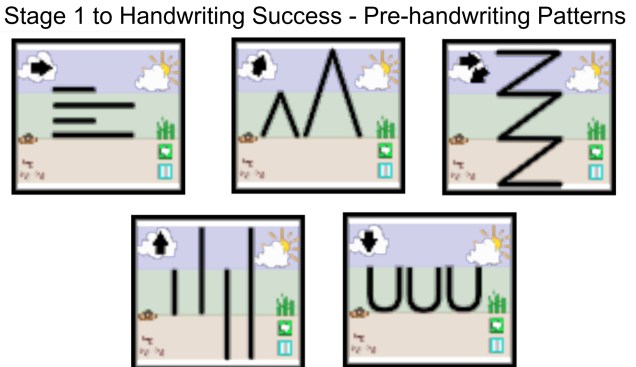
Stage 1 to #Handwriting Success – Pre-handwriting Patterns

Last week we looked at non-pencil pre-handwriting pattern development, working on large scale movements through play activities.

The next stage in the progression is to move to pencil and paper activities.

Again ‘The writing framework’ states that:

“Teaching should then progress to specific handwriting lessons and practice. This might initially include systematic teaching of and practice in moving the pencil to master the horizontal, diagonal, vertical and circular strokes needed for writing.”

Department of Education; The writing framework: July 2025; page 25; https://www.gov.uk/government/publications/the-writing-framework

Here at Teach Children Ltd we always recommend teaching the handwriting patterns in groups, as this helps to further develop the specific movements (pushes and pulls) required to form the patterns and helps commit them to the motor memory. A child can then recall these motor memories to support them as they begin to form letters.

Pre-handwriting patterns that encourage a child to move their pencil from left to right are very important for left-handed writers. They need to be taught this so that they can make the cross motion in the H, T, J, G and I from left to right, as their natural instinct is to go from right to left. If this is not corrected when writing E and F the cross lines will not be “anchored” to the letter.

Once the handwriting patterns have been mastered a child will have the confidence and skills base necessary to start forming letters, numbers and symbols.

Have you got your Free Pre-handwriting Pattern Animations & Worksheets?

For Teachers: https://teachhandwriting.co.uk/pre-handwriting-patterns.html

For Parents: https://teachhandwriting.co.uk/patterns.html

Stage 1 to #Handwriting Success – Non-pencil – Pre-handwriting Patterns

Learning to handwrite does not start with pen and paper but through play (non-pencil activities), as children explore shape and motion (how the body moves) through their senses – touch, sight and body awareness. Play is such an important element of your child’s physical, emotional, social and academic development.

Pre-handwriting patterns are the first stage in supporting a child to handwriting success. They help the child to learn the shapes and directional pushes and pulls required to form letters. All letters are a combination of these shapes and lines.

Young children can start to learn these patterns through their play, long before they are ready to pick up a pencil, moving toys back and forth across the floor or whirling them around in the air. To a child it is just play and fun, but you are doing something far more powerful and constructive by helping them to develop the motor memory patterns and directional movement skills they will need for handwriting.

Later, as their coordination and gross motor skills develop, they make more controlled and varied movement patterns in their play. Changing directions, speed and size are all prerequisite skills needed for learning pre-handwriting patterns.

Once again ‘The writing framework’ acknowledges that:

“On joining reception, some children may need teaching and practice in using and manoeuvring their thumb, wrist and shoulder muscles in the way they need for handwriting. Initially, handwriting lessons could include learning the movements needed to form letters, practising these movements at a range of sizes…”

Department of Education; The writing framework: July 2025; page 24; https://www.gov.uk/government/publications/the-writing-framework

It is through play that you can really engage a child in learning how to correctly form these movements, or what we refer to as Pre-handwriting Patterns, that have always been an important foundation stone in our Foundation Stage Teach Handwriting Scheme (https://www.teachhandwriting.co.uk/handwriting-teaching-manuals.html#hs-fs ) and strongly promoted on our website 😦 https://www.teachhandwriting.co.uk/index.html ) and blog (https://teachhandwriting.blog/ ) since 2012.  

Our non-pencil – ‘Big to Small’ activities are an easy fun way to start developing these skills early on through play: https://teachhandwriting.co.uk/big-to-small.html

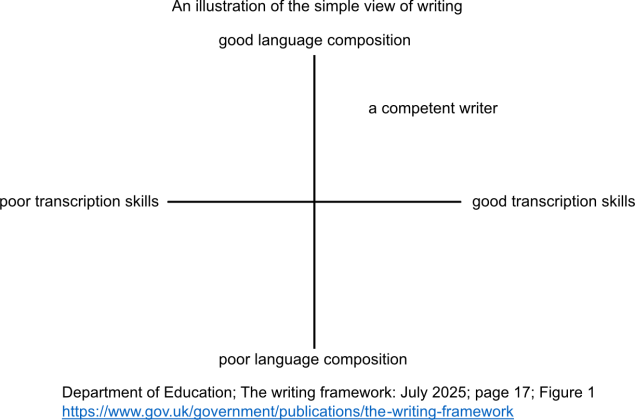
The Simple View of Writing

The writing framework explains, and shares, a simple illustrated example of “The Simple View of Writing” (see the end of this article), which we felt was a little too simplistic as a quick reference guide. So, we have created the one below which adds a little more information to what is in reality a complex set of skill factors.

Please note that criteria should all be considered in relation to the pupil’s age and stage of development.

What are language composition and transcription skills?

Language Composition

The writing framework explains language composition as; being able to express ideas by structuring them into speech and writing, which consists of two main but complex elements:

  1. Executive function (self-regulation, planning, organizing and monitoring) and
  2. Text generation (vocabulary, grammar and punctuation)

Executive function

This is a complex set of skills that have to come together throughout the writing process:

Self-regulation – the ability to keep control of their own thoughts, feelings and behaviors during the writing process. To help them remain focused on the task, to get started and to keep going (stamina to finish the task).

Planning – breaking down a task and organize it in a logical structure based on their knowledge of the topic, the context in which it is to be used, its purpose, and the audience it is intended for.

Organizing – covers a range of tasks such as deciding the best way to present some of the information, the relevance of information, what to keep and what to discard. Taking on new ideas that may conflict with their own thoughts.

Monitoring – their own writing process, reviewing and making amendments where necessary.

Text generation

Is the ability to correctly use grammatical conventions with a wide range of vocabulary and accurate punctuation.

Transcription Skills

The writing framework explains that transcription skills are handwriting and spelling.

Handwriting

The ability to handwriting with speed, fluidity and legibility. This means that the writer has correct letter formation and/or joining skills, placement, spacing, an appropriate consistent letter size for their stage of development and has or is moving to developing an automatic, sub-conscious approach to handwriting.

Spelling

The ability to spell accurately, which means having a good understanding of the alphabetic coding system (phonics) we use for the oral and written English language. This means being able to link the sounds heard in a word to the correct letter or letter combinations required to spell the word correctly. For example, in the word ‘fish’ we hear 3 phonemes ‘f/I/ ʃ’but spelling it correctly we need to know that the ‘ʃ ‘phoneme is represented by two letters ‘s’ and ‘h’=‘sh’.