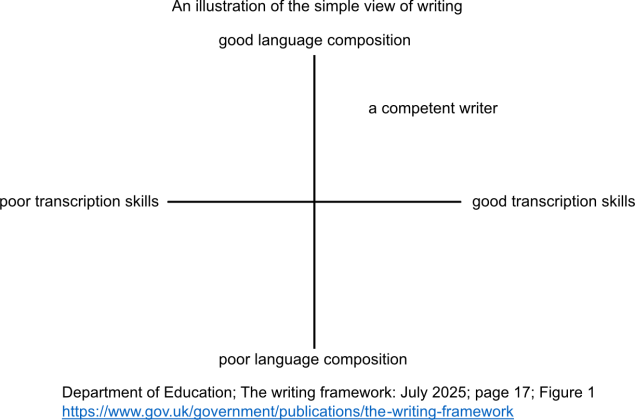
The writing framework explains, and shares, a simple illustrated example of “The Simple View of Writing” (see the end of this article), which we felt was a little too simplistic as a quick reference guide. So, we have created the one below which adds a little more information to what is in reality a complex set of skill factors.

Please note that criteria should all be considered in relation to the pupil’s age and stage of development.
What are language composition and transcription skills?
Language Composition
The writing framework explains language composition as; being able to express ideas by structuring them into speech and writing, which consists of two main but complex elements:
- Executive function (self-regulation, planning, organizing and monitoring) and
- Text generation (vocabulary, grammar and punctuation)
Executive function
This is a complex set of skills that have to come together throughout the writing process:
Self-regulation – the ability to keep control of their own thoughts, feelings and behaviors during the writing process. To help them remain focused on the task, to get started and to keep going (stamina to finish the task).
Planning – breaking down a task and organize it in a logical structure based on their knowledge of the topic, the context in which it is to be used, its purpose, and the audience it is intended for.
Organizing – covers a range of tasks such as deciding the best way to present some of the information, the relevance of information, what to keep and what to discard. Taking on new ideas that may conflict with their own thoughts.
Monitoring – their own writing process, reviewing and making amendments where necessary.
Text generation
Is the ability to correctly use grammatical conventions with a wide range of vocabulary and accurate punctuation.
Transcription Skills
The writing framework explains that transcription skills are handwriting and spelling.
Handwriting
The ability to handwriting with speed, fluidity and legibility. This means that the writer has correct letter formation and/or joining skills, placement, spacing, an appropriate consistent letter size for their stage of development and has or is moving to developing an automatic, sub-conscious approach to handwriting.
Spelling
The ability to spell accurately, which means having a good understanding of the alphabetic coding system (phonics) we use for the oral and written English language. This means being able to link the sounds heard in a word to the correct letter or letter combinations required to spell the word correctly. For example, in the word ‘fish’ we hear 3 phonemes ‘f/I/ ʃ’but spelling it correctly we need to know that the ‘ʃ ‘phoneme is represented by two letters ‘s’ and ‘h’=‘sh’.
 teachhandwriting.blog