Are you Supporting Handwriting or Phonics?

Supporting your child at home can be a big challenge for so many reasons.

So here is a tip that might just help a little.

When confronted with homework from school think about what it is that they are asking your child to do.

For instance, if it is teaching something about phonics then that is all you and your child should be focused on. Yes, you may have been told that your child needs to work on their handwriting but this is not the time to do that. This is pure phonics time.

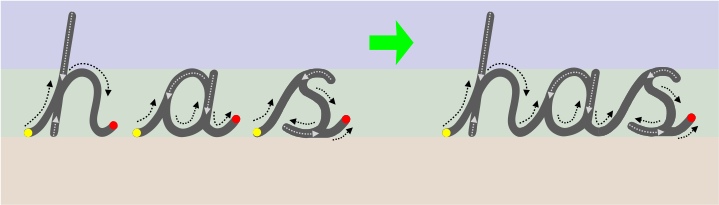
When supporting your child with their phonics work they will have to write letters and words. The important thing is for your child to have a go at writing the letters correctly, especially those they have been taught or are learning to how to form.

Remember they may not have been taught how to form the letters correctly yet. So, ask them to just have a go. Now is not the time to teach them handwriting; it is the phonics skill you are supporting. This way your child will not get confused or frustrated with the sudden changes in focus. The phonics homework will then be more appropriately focused, quicker and successful.

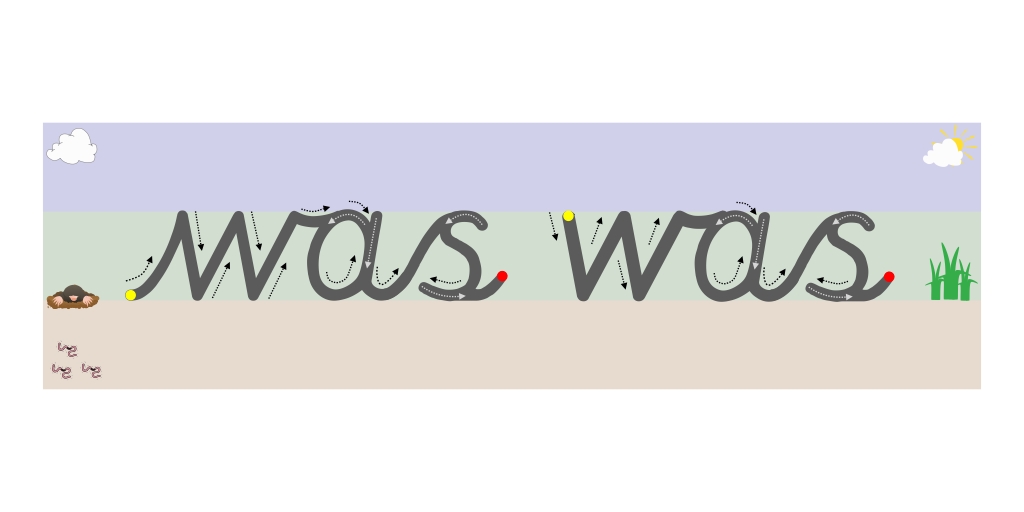
If your child has been asked to do handwriting homework then that is all that you and your child should focus on – learning to form their letters correctly or how to join them. Learning phonics skills or spelling is not the important element of the homework. The only thing that should be commented on and discussed is the handwriting.

It is important to remember that handwriting and learning the phonics system of a language are two very different skill sets. They should be taught separately, as trying to combine the two can cause your child to become confused and frustrated.  

Correctly Naming the Letters of the Alphabet

Learning the unique letter names of the alphabet is a pre-phonics skill; as well as an early learning goal. It has to be remembered that a letter is a shape which only represents a sound when it is placed within a word or sentence (has a context). Also, a letter or combination of letters can represent more than one sound and so the only unique way of identifying alphabet letters when we talk about them is to use their names.

Learning the correct letter names helps to reinforce that when talking about the letter ‘a’ (ay) for example it has a set shape regardless of the sound that it will be representing in the word. This further supports children’s handwriting development as the communication of your requirements is unambiguous.

One of the first things we like a child to be able to write correctly is their name, however most names are impossible to spell using the simple phonics code taught to young children. A name does not have to be long in length to be phonetically difficult to spell such as Christopher or Charlotte. Shorter names such as Lucy or Liam also cause a problem. 

The only logical answer is to use the letter names (an alphabet coding system) alongside the simple phonics system introduced to young children. 

Jim Rose in his report back in 2006 ‘The Independent review of the teaching of early reading, final report’ highlighted the fact that:

“… research indicates that children often learn letter names earlier than they learn letter sounds and that five year olds who know more letter names also know more letter sounds. The reasons for this are not fully understood by researchers’.”

It is important to remember that just because a child can correctly recite the ‘Alphabet’ song it does not mean they know the letters of the alphabet. It is surprising how many children can do this but when shown letters from the alphabet cannot name them at all. They may be able to tell you the sound the letter makes but have no idea of the letters name.

Teaching the correct letter names is important when supporting handwriting as this can in turn affect a child’s phonics understanding later on. For example, it can seem very easy when explaining to a child which letter to write when they ask which one is making a ‘kuh’ sound in a word such as cat to say a ‘curly kuh’. There is no such letter in the alphabet called ‘curly kuh’ it is the letter ‘c’ (cee). By adding the ‘kuh’ sound to the letter it reinforces incorrect phonics knowledge. The letter ‘c’ does not make a ‘kuh’ sound in words such as: city, circle, cycle and centre.

Some children will then only ever refer to the letter ‘c’ as ‘curly kuh’ and the letter ‘k’ as’ kicking kuh’. As I say these are not letter names of the alphabet and also devalue the power of phonics at the same time.

How can the education establishment get hot under the collar about not using the correct terminology in the teaching of English in schools such as: phonemes, graphemes, digraphs, modal verbs etc… yet still refer to the letter’s ‘c’ and ‘k’ as ‘curly or kicking kuh’!

To use, or not to use, a pencil grip aids? That is the question.

Aids to support good pencil grip can be very useful for some pupils. However, one of the issues with their use is that, when a pupil has not got the pencil grips to hand, they revert back to the original poor grip position.

Pencil grip aids generally do not correct the grip, they just force the hand and fingers into the correct position for writing. To correct the grip permanently the physical factors that have created the incorrect grip need to be addressed.

The use of grips can encourage a pupil to write more fluently, building their self-esteem, whilst you work on correcting the factors that have caused a poor grip to form. The long-term aim must always be to get the pupil to grip the pencil correctly without the use of aids.

Hand Dominance!

Hand dominance is where one hand has more influence or control than the other. This is sometimes referred to as hand preference, where one hand is preferred or chosen over the other, as it is more reliable in performing a range of skilled activities (handedness).

Children tend to develop hand dominance between the ages of 3-5 years old, for some it may be slightly later and for a few it does not become a subconscious decision until they are 8 or 9 years old. Many children will naturally develop a clear right or left-hand dominance which is greatly influenced by their genetics.

Some can develop a mixed dominance; this is where a child finds they have more control and greater skills for handwriting with say the left hand but prefer and display more precise skills with the right hand in tasks such as using scissors. Studies have shown handedness can be based on the type of muscles used in controlling gross and fine motor skills for completing particular tasks. The control of various muscle types is located in different hemispheres of the brain. Those relating to dexterity (fine motor skills), required for writing, are strongly related to hand dominance, whereas the larger muscle groups (gross motor skills), involving strength, rely less on hand dominance.

Whether a child is right or left-handed does not affect their academic ability or progress, if they have developed and been taught the appropriate key skills. The important thing is not to force particular hand dominance on a child. It will never feel natural for them and the acquisition of gross and fine motor skills will feel awkward and may well appear clumsy, delaying their development, skills ability, confidence and self-esteem.

Only about 1% of the population are truly ambidextrous, which means they are able to perform tasks using either hand with equal skill and proficiency; a rare trait indeed.

Handwriting is a Physical Activity

Handwriting with fluidity, speed, accuracy and over longer periods of time requires a complex range of whole body and hand strengths and skills. So it is not surprising that many children find handwriting challenging.

For a good handwriting style children need to develop their:

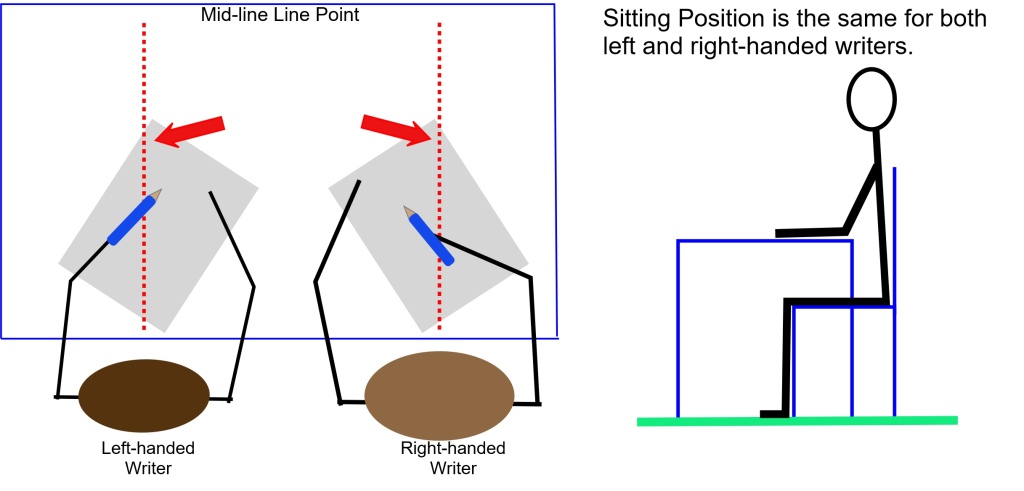
  • Gross Motor Skills – so they can sit correctly for periods of time.
  • Fine Motor Skills – so that they can hold and control the pencil and move the paper up the table as they write.
  • Motor Memory Skills – so they can recall how to form the letters.
  • Visual Memory Skills – so they recall what a particular letter looks like.
  • Spatial Awareness Skills– so they can place the letters correctly on the paper and in relation to one another.
  • Eye Tracking Skills– scanning from left to right so that the letters are formed and placed correctly.

If a child is struggling with handwriting it is important to take a closer look at their physical abilities. If they do not have all the appropriate key physical strengths to support their handwriting development getting them to do more of the paper and pencil activities is not the answer.

Our assessments are simple to complete and do not need any specialist equipment. The important elements are; your knowledge of the child and your observations of them at play and while they are engaged in normal day to day task.

For information on how to assess your child at home follow this link: https://teachhandwriting.co.uk/parent-assessment.html    

For information on how to assess at child at school follow this link: https://teachhandwriting.co.uk/teacher-assessment.html

A better understanding of a child’s key skills abilities enables you to focus more effectively, through targeted physical games and activities, to help them build and develop their skills.

You will find ‘Games to build gross and fine motor skills’ here: https://teachhandwriting.co.uk/games.html

Handwriting is such an important skill as it engages the neurological pathways and working memory in a way that pressing a keyboard just doesn’t; so once mastered it helps to open up the doorways to other literacy skills such as phonics, reading, spelling and composition.

Different Types of Play and their Importance

We are always being shown how important play is in the development of young animals’ survival and hunting skills. How many times have you thought how cute or lovely when watching kittens, puppies or polar bears playing?

Humans are also animals which thrive and develop through play; in fact, play is so important the United Nations High Commission for Human Rights state it as a right for every child (Ginsburg, 2013).

We often think of play as a frivolous pastime rather than a practical and meaningful one. However, here at Teach Children we see play as a vital part of a child’s physical, emotional, social and intellectual growth and well-being.

There has been considerable research over the years on play, which supports our point of view, with the consensus being that children need to experience five different types of play (Dr.D Whitebread, 2012). These five types of play are roughly based on the developmental opportunities they provide, especially if it is child driven rather than adult lead:

Physical Play – active exercise (running, jumping, skipping etc..), rough & tumble and fine motor skills activities to develop whole body and hand and eye co-ordination strength and endurance. The outdoor element of such play develops independence, resourcefulness and self-regulation while the fine motor skills activities support the development of concentration and perseverance.

Play with Objects – starts as soon as a child can grasp and hold an object; mouthing, biting, turning, stroking, hitting and dropping. It’s how we all learn through the exploration of our senses (sensory-motor play). This type of play develops our abilities to; physically manipulate items, think, reason and problem solve, to set challenges and goals as well as to monitor our own progress.

Symbolic Play – refers to the development of spoken language, visual symbols such as letters and numbers, music, painting, drawing and other media used for communication of thought and ideas. This type of play allows children to develop the abilities to express and reflect on experiences, ideas and emotions. Sound and language play develops phonological awareness required for literacy, while number play that relates to real life situations supports numeracy skills.

Pretence/socio-dramatic Play – Pretend play provides the opportunity to develop cognitive, social, self-regulatory and academic skills. This kind of play means children have to learn and pick up on unspoken rules of interaction, taking on the role of a character and playing within the expected confines of that role.

Games with Rules – physical games such as chase, hide & seek, sport, board and computer games. Develop social skills and the emotional skills of taking turns, winning and losing as well as other people’s perspectives.

                                                             So, to play is to learn!

Bibliography

Kenneth R. Ginsburg, MD, MSEd, 25/07/2013; ‘The Importance of Play in Promoting Healthy Child Development and Maintaining Strong Parent-Child Bonds’: THE AMERICAN ACADEMY OF PEDIATRICS: http://pediatrics.aappublications.org/content/119/1/182.full

Dr.D. Whitebread, April 2012: ‘The Importance of Play’; Commissioned for the Toy Industries of Europe:  http://www.importanceofplay.eu/IMG/pdf/dr_david_whitebread_-_the_importance_of_play.pdf                            

To Play is to Learn!

Play is often thought of as a frivolous pastime rather than a practical and meaningful one. However, here at Teach Children Ltd we see play as a vital part of a child’s physical, emotional, social and intellectual growth and well-being.

There has been considerable research over the years on play, which supports our point of view, with the consensus being that children need to experience five different types of play (Dr.D Whitebread, 2012). These five types of play are roughly based on the developmental opportunities they provide, especially if it is child driven rather than adult lead.

In our update parent section of the Teach Handwriting website we have a new ‘Learning Through Play’ section. Here you will find games and activities ideas to suit all ages.

If you click on the ‘Games’ button or follow the link (https://teachhandwriting.co.uk/games.html) you will find games split into the five types of play, which will help you encourage your child to experience them all.

This wide range of play opportunities will also support your child in developing their gross and fine motor, communication and turn taking skills.

                                                             So, to play is to learn!

Bibliography

Dr.D. Whitebread, April 2012: ‘The Importance of Play’; Commissioned for the Toy Industries of Europe:  http://www.importanceofplay.eu/IMG/pdf/dr_david_whitebread_-_the_importance_of_play.pdf                            

Half-term Fun – Clothes Peg Games

Some fun indoor activities may be the order of the day for this half term as the weather is not so hot.

This is a very simple idea which children love because they can take greater ownership of it. The aim of the activity is to help build up hand and finger strength through using the pegs; however, it can have a dual purpose, helping to keep track of the week by using it as a timetable or for learning spellings or maths activities, as well as supporting the development of language skills.

You do not need anything fancy, just some string (for the washing line), clothes pegs and pieces of paper or card to peg onto the washing line. The washing line can be a permanent fixture or you can just pop it up when you need to use it.

The clothes line needs to be at a height suitable for your child to peg things on to (placed against a wall is a safe option so that no-one can walk into it by accident and hurt themselves).

There are a whole range of games that can be played using this simple washing line and pegs concept:

Memory games – Get your child to peg up 5 to 10 different pictures or items on the line. Then give them 1 minute to remember the items. Once the time is up ask them to look away, or close their eyes, and then you remove one or more of the items. Get them to look back at the line. Can they work out what is missing?

  • You could try just moving one or two of the items around. Can they figure out which ones are in the wrong place and put them back in their correct place?
  • Try swapping an item for something new, which your child did not hang up on the line. Can they work out which is the new item on the line?

Odd One Out – Hang pictures on the line that belong together. Can they pick out the odd item on the line and explain why it is the odd one out.

  • They could all be pictures of fruit with a picture of some clothing
  • They could be shapes with straight sides and one with curves
  • They could all be animals but all are wild with only one being domestic

Sorting – Ask your child to sort all the pictures or items from a selection and to hang all the identical things on the washing line. They could all be the same;

  • Colour
  • Shape
  • Type

Pattern Work – Using pictures, different colour and shaped paper or items create different patterns. The patterns can be based on colour, size or type of object. You can create a pattern sequence on the washing line and then ask your child to try and copy the sequence. Can they explain the pattern and create their own for you to copy and explain?

Pairing or What is the Same? – Hang a range of pictures or items on the line, making sure that some of the items can be paired together because they are exactly the same. They could match because;

  • They are exactly the same e.g., a pair of socks
  • Match numbers to a picture with the same number of items on
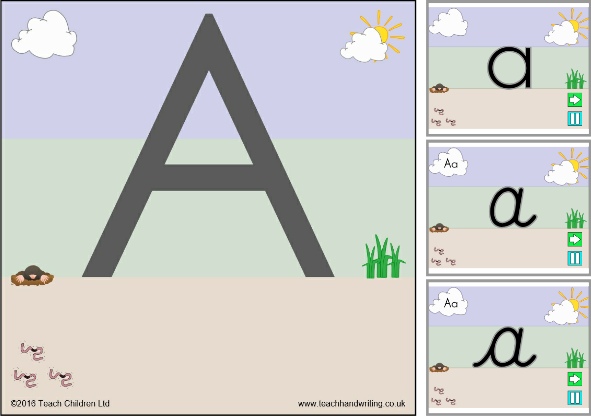
  • Match capital to lower-case letters

Or have items that can be put together because they are both from the same set, for example they are types of fruit or are the same

Transferring handwriting skills from worksheets to paper 

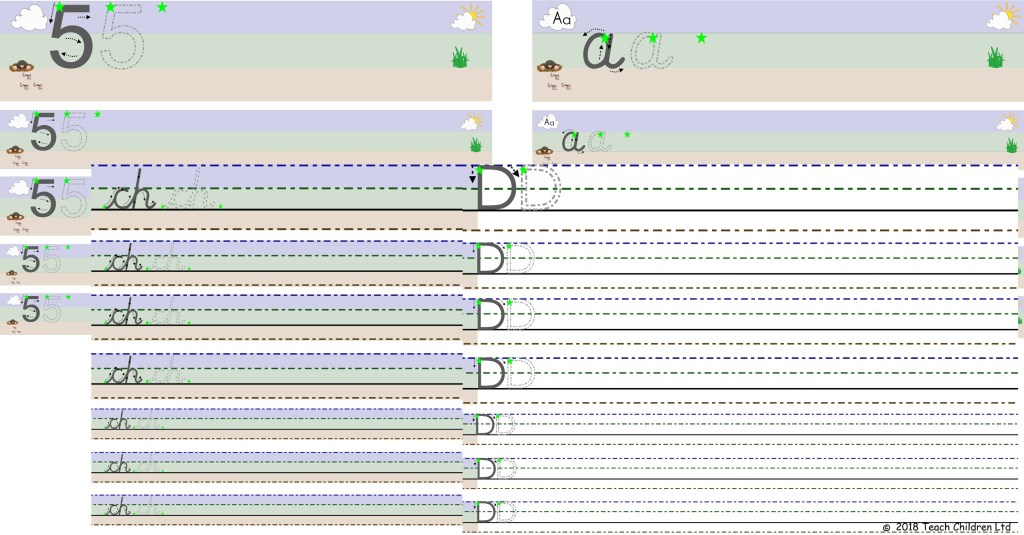
At Teach Handwriting our aim is to move children off of worksheets as soon as possible. To achieve this, it is important to encourage them to transfer their skills to plain or lined paper whichever is most appropriate to their ability level. We realise that it is not always possible to buy paper with the appropriate line height in all cases, so would recommend creating your own on the computer.

  • Use a combination of worksheets and lined paper in each handwriting session with your child:
    1. Use the colour worksheet, or a grey scale version, and complete one or two rows.
    2. Then encourage the child to try the same patterns or letters on appropriately lined paper, again try one or two rows only.

Hopefully the worksheet will last over a couple of handwriting sessions and you and the child will see an improvement over the time. The sooner they learn to transfer their skills to paper the better.

We realise that printing off our worksheets and coloured lined paper can become costly so, to help reduce the costs:

  • Use a colour version of the appropriate worksheet initially and then try printing in grey scale. Children usually make the adjustment to grey scale well once they are used to how the picture clues and colours work.
  • You could also use the grey scale worksheets and colour the start of each row with the appropriate colour.

Choosing a Pen for Handwriting

Choosing and using the right pen can help to avoid smudging; make handwriting look smarter and prevent hand strain when writing for extended periods of time. Everyone is different, so the type of pen required is different too.

There are three main points to think about when choosing a pen for handwriting:

  1. The type of ink it uses.
  2. The size and weight of the pen.
  3. The type of point it has.

1. Types of ink used:

  • Oil-based ink
    • The ink is quick drying and so does not smudge easily
    • The ink flows smoothly depending on the point style of the pen
    • Ink can stop and start for no apparent reason
    • Water-based ink
      • The ink does not dry as quickly as oil-based ink so can smudge
      • The ink flows very smoothly

2. Pen sizes and weights

Because pens come in different shapes, sizes and weights it is important for your child to try out a range of pen styles to help them find the best fit for them. Remember one pen style does not suit all, everyone’s hand size and finger length are different.

Things to consider when choosing a pen:

  • Does it feel too short or too long?
  • Does it feel too thin or too thick?
  • Does it feel too heavy or too light?
  • Some children like a smooth round pen shape.
  • Some prefer a textured round pen shape.
  • While others may prefer a hexagon shaped pen.

3. Pen points

Pens come with different point or nib widths and shapes. The size and shape of the point gives different line thicknesses and are usually purchased as point sizes: extra fine, fine, medium or bold (some will have a measurement on as well).

A fine pen point produces thin lines and some children will find this can help to make writing neater.

A medium and bold point give thicker lines which many may find smoother to write with, though the letter size may be slightly larger because of it.

Once again it is important that children try out a range of pen point sizes to help them find the best fit for them.

Remember one pen point style does not suit all, everyone’s fine motor skills and writing pressures are different.