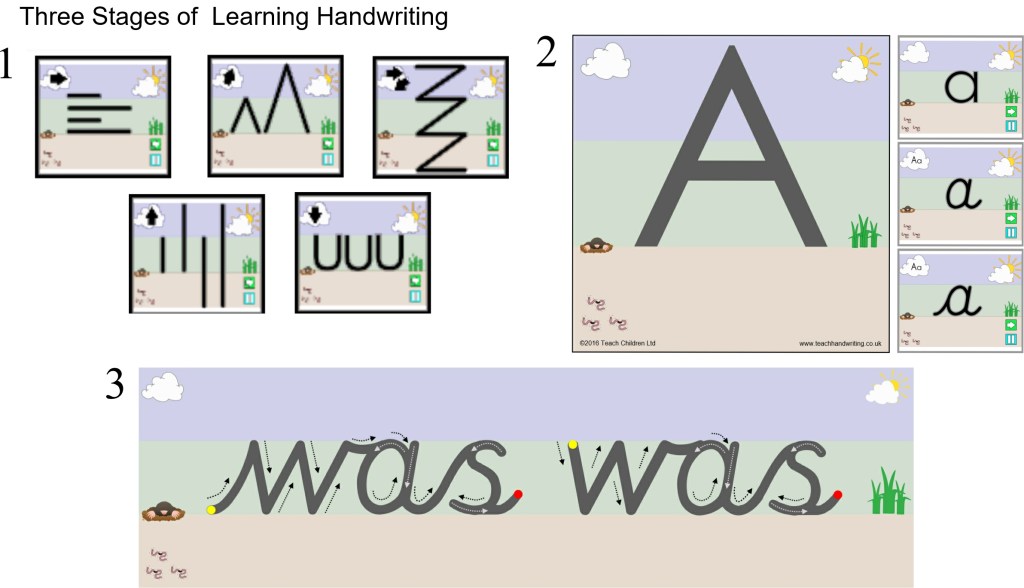
Some children will have poor letter formation skills because they have missed or just have not been taught how to form their letter correctly.
If your child is struggling with correctly forming their single letters, it can be a good idea to take a step back and check that they can form the pre-handwriting patterns. You might find that they are struggling with some of the line directional pushes and pulls that the patterns support in developing and are needed for forming letters – Parents: https://teachhandwriting.co.uk/parents.html Teachers: https://teachhandwriting.co.uk/pre-handwriting-patterns.html
It is surprising how often the pre-handwriting patterns stage in developing handwriting is skimmed over or just missed out completely.
Unfortunately, the pressure on school to focus on phonics and introducing handwriting as part of the scheme means that children who cannot draw or have experienced pre-handwriting patterns are being asked to form letters. I can’t work out the logic of this approach.
If you take a close look at your child’s lower-case single letter formation you may find that it particular letters that they struggle with. What you may find is that these letters fall into certain letter family group. So, I would recommend working on the letter family in which the child has the most letter formation difficulties first.
If it is all the letter of the alphabet then I suggest teaching the letter families in the order shown on the website – Parents: https://teachhandwriting.co.uk/parents.html Teachers: https://teachhandwriting.co.uk/key-stage-1-handwriting-routes.html
We recommend focusing on developing a child’s lower-case single letter formation skills first as this about 95% of letter usage they need for writing and reading. Then introduce capital formation.
Why do some children struggle with letter reversal issues?
It is normal for young children to reverse letters and numbers when writing. This should stop by the time they are 6 /7 years old.
Older children can reverse their letters and numbers, when writing, for the following reasons:
- They have poor visual and motor memory skills and so can’t remember how to form the letters correctly.
- They have poor bilateral coordination skills.
Games and activities can help them overcome these issues: https://teachhandwriting.co.uk/games.html and https://teachhandwriting.co.uk/warm-ups.html
Teaching the letters in letter families can reduce letter reversal as the reinforcement of the pencil movements helps cement the letter shapes in the visual and motor memory.
We have grouped the letters together in families based on their shape and the directional pushes and pulls of the pencil needed to form them.
By teaching the letters in these families the letters that are most commonly reversed such as ‘b’ and ‘d’ are in different letter families as their start points and initial pushes or pulls of the pencil for them is different, so are reinforced, making it easier for your child to remember them.
Joining Issues
Some children struggle with learning to join because:
- They may not be forming the single letters correctly. It is best to correct their single letter formation first before moving on to tackle any joining issues. You may find once they have corrected their single letter formation, many of the joining issues have rectified themselves.
- Some children will find the join strokes a little tricky to start with, so try using the joins section in pre-handwriting patterns to help them learn the additional pencil strokes needed.
- Some children may not remember which join strokes to use. So, teach the joins in groups, and build up their confidence by starting with the easiest joins – Parents: https://teachhandwriting.co.uk/parents.html Teachers: https://teachhandwriting.co.uk/key-stage-1-handwriting-routes.html
- Begin by joining 2 or 3 letters together at a time rather than long lines of joins that go across the page. It is best to match the number of letters joining to a sensible word length.
- Remind your child that the aim is not to take their pencil off the paper until the number of letters in a word has been completed, then they dot the i’s and j’s and cross the t’s and x’s.
 teachhandwriting.blog